

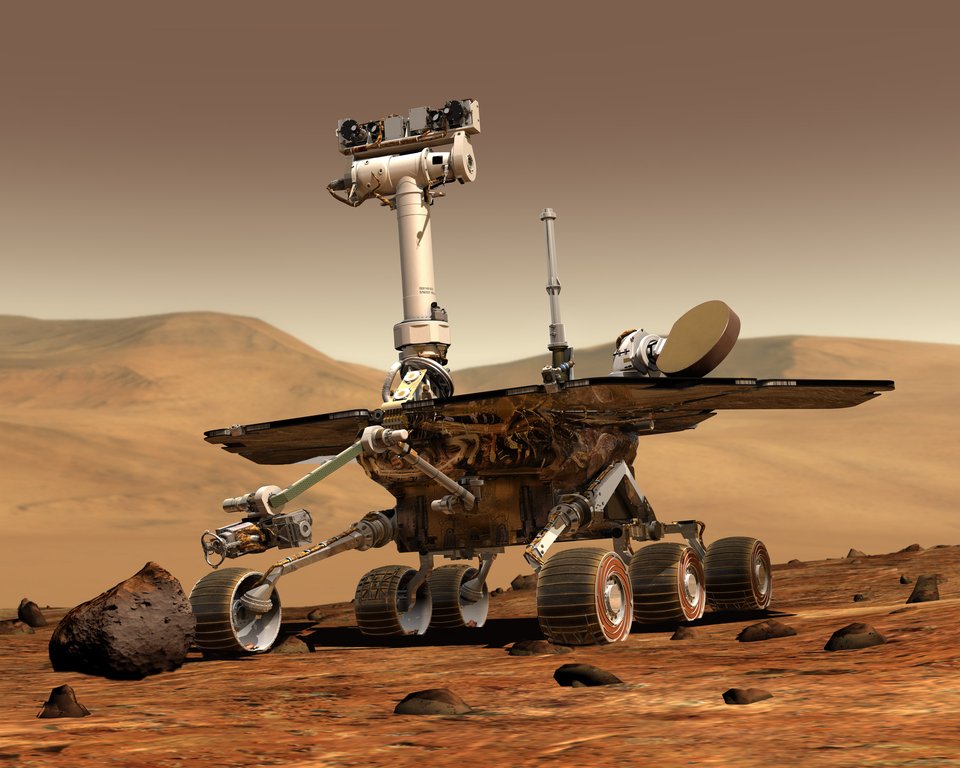
## Are we ready to send humans to Mars?
Wernher von Braun, when asked what stood between humanity and a crewed mission to Mars, reportedly answered: “political will.” More than half a century later, that answer still holds — but Mark Shelhamer, former chief scientist of NASA’s Human Research Program, argues the real barrier runs deeper.
In a new article for the Planetary Society published June 8, Shelhamer dissects the gap between “can we” and “should we” when it comes to sending people to the Red Planet. His conclusion: we could launch a Mars mission today with existing rocket technology, but we are not ready for what happens after liftoff.
**The scale problem**
The International Space Station orbits 400 kilometers above Earth, protected by the planet’s magnetic field from deep-space radiation. It sits within easy abort range. Communication is instantaneous.
A Mars mission is a different category entirely. The planet is roughly 500 times farther than the Moon. There is no abort option. Communication delays reach 20 minutes one-way. And the total mission duration stretches to approximately three years.
“It is the interaction of multiple stressors across multiple body systems and spacecraft systems that defines the true challenge of sending humans to Mars and demands new ways of thinking,” Shelhamer writes.
**The health gap**
Shelhamer, a biomedical engineer at Johns Hopkins specializing in sensorimotor function and neurovestibular adaptations to spaceflight, identifies deep-space radiation as the single most distinguishing hazard. ISS astronauts benefit from Earth’s magnetic field, which deflects galactic cosmic rays and solar particle events. A Mars crew would have no such protection for the entire three-year journey.
But radiation is only one piece of the puzzle. The article argues that traditional siloed approaches to astronaut health — treating bone loss, muscle atrophy, immune changes, and psychological isolation as separate problems — will not work for Mars. These stressors interact with each other in ways that compound over long durations. A slightly degraded immune system combined with elevated radiation exposure and chronic isolation produces risks that no ISS mission has ever had to manage.
“An actual trip to Mars will be the first time all of these stressors are present at the same time, for a long period of time, with no way to exit early, and with no chance for help from mission control,” Shelhamer writes.
**The engineering gap**
The Planetary Society article builds on a companion piece by Nancy Atkinson from 2024, which outlines the equally daunting engineering challenges.
Entry, descent, and landing (EDL) remains the single biggest unsolved engineering problem. The Perseverance rover weighs about one metric ton. A human-rated Mars lander would weigh 50 to 100 metric tons. Mars’ atmosphere is too thin for parachutes to work effectively at that scale but thick enough to generate enormous frictional heat. Technologies like supersonic retropropulsion and larger heat shields have been proposed but never demonstrated at human-mission scale.
In-situ resource utilization (ISRU) has been proven at small scale by MOXIE on Perseverance, which produced oxygen from Martian carbon dioxide. Scaling that up to support a crew remains unproven. Closed-loop life support systems that recycle air, water, and waste without resupply for three years have not reached maturity.
**The political dimension**
A third companion piece by Casey Dreier, also published June 8, adds a sobering political reality check. The success of Artemis II has re-entrenched the Moon as NASA’s central human spaceflight focus. Mars briefly captured presidential attention in 2025 but, in Dreier’s words, “has once again faded into the background.” The billion dollars NASA requested for a rapid humans-to-Mars program was met with “polite indifference from Congress.”
Shelhamer’s original question, filtered through von Braun’s lens, comes full circle: the technology is not the primary obstacle, but neither is the political will the only missing piece. The physiological and engineering challenges are real and unresolved, and they demand integrated solutions that neither Apollo nor the ISS program ever required.
The bottom line: we could send humans to Mars today, but we cannot yet guarantee they would return in good health, or at all. Closing that gap will require not just better rockets, but a fundamental rethinking of how we keep people alive in deep space.