

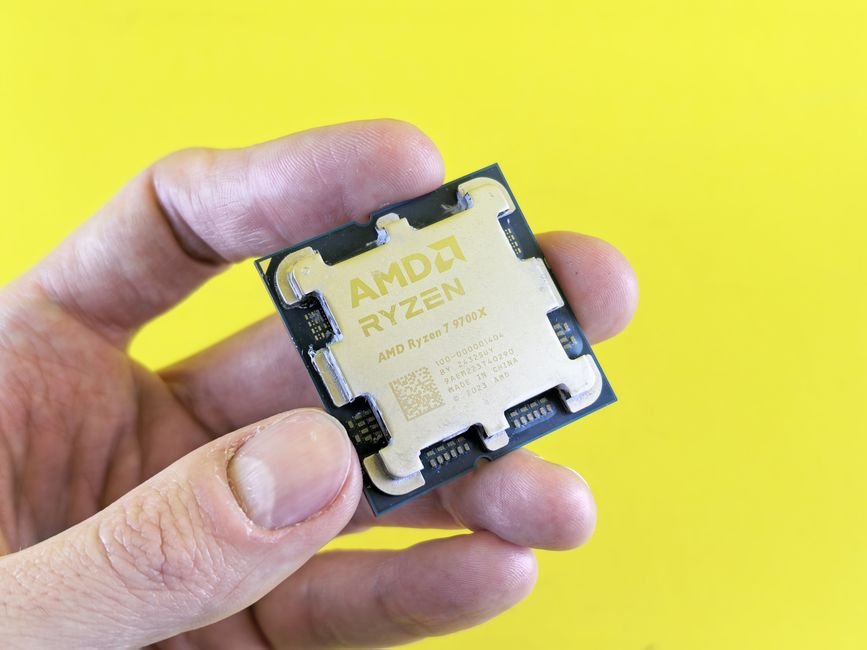
AMD has quietly brought back its seven-year-old Zen 2 architecture in a new desktop processor, the Ryzen 7 4700LE, which has already appeared in a budget pre-built gaming PC on Amazon.
The 4700LE is an 8-core, 16-thread CPU based on AMD’s Zen 2 microarchitecture, the same design that powered the Ryzen 3000 series when it launched in July 2019. It runs at a base clock of 3.6 GHz with a maximum boost of 4.2 GHz, draws 65 watts, and lacks integrated graphics — making it a pure CPU rather than an accelerated processing unit (APU) like the otherwise similar Ryzen 7 4700G from 2020.
The chip’s L2+L3 cache totals just 12 MB, of which only 8 MB is the higher-performance L3. By comparison, AMD’s current Zen 5 processors can exceed 100 MB of cache in their X3D variants and boost past 6 GHz. The 4700LE is entry-level hardware for 2026.
OEM only
AMD has designated the 4700LE as “OEM only,” meaning it will not be sold as a standalone retail product. Instead, system integrators can include it in pre-built machines. A brand called Qehi is already selling a desktop on Amazon US priced at US$800 (approximately £620). The system pairs the 4700LE with an Nvidia GeForce RTX 3050 GPU featuring 8 GB of video memory, 16 GB of DDR4 RAM, and a 500 GB (half-terabyte) SSD.
Hardware reviewers noted the system is not an obvious bargain at US$800. ExtremeTech reported that the same money in 2024 would not have been a good deal either. The Zen 2 architecture’s limited cache and modest clock speeds will constrain gaming performance, especially in CPU-bound titles, and the RTX 3050 is not a high-end graphics card by 2026 standards.
Why now?
The most likely explanation is a combination of surplus Zen 2 silicon and sustained demand for budget PCs. AMD continues to squeeze value from its AM4 platform, which has maintained remarkable longevity across four architectural generations. The 4700LE is one of several “new old” chips AMD has quietly added to its lineup, including various Ryzen 5000-series refreshes.
The chip may also reflect ongoing supply dynamics in the entry-level desktop market. With AI demand diverting advanced manufacturing capacity to data center products, AMD may be using older 7 nm (7-nanometer) wafers from TSMC for budget desktop chips. Those wafers are fully depreciated and therefore cheaper to produce than newer 4 nm or 3 nm designs.
When buying a pre-built system from an unfamiliar brand, buyers should check the specifications carefully. An “8-core processor” in 2026 may be based on architecture that is seven years old.
Sources: AMD revives aging Zen 2 processor for budget PCs (Tom’s Hardware, July 9, 2026); AMD brings back Zen 2 with Ryzen 4700LE (ExtremeTech, July 9, 2026); AMD quietly launches Zen 2-based Ryzen 7 4700LE (Wccftech, July 9, 2026)