

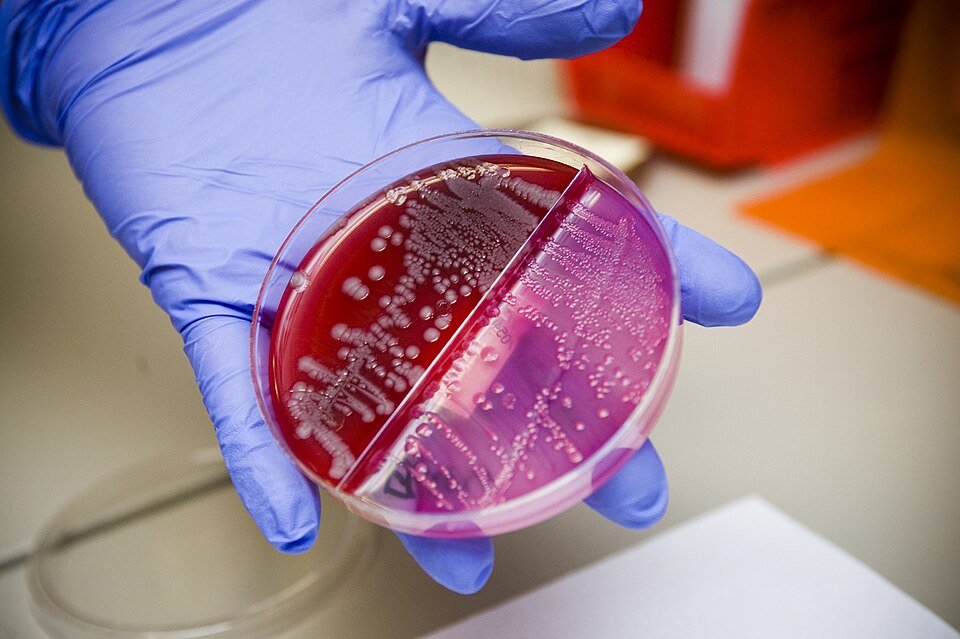
Neisseria gonorrhoeae has developed resistance to virtually every antibiotic ever deployed against it. Even the newest oral drugs, zoliflodacin and gepotidacin, the first new classes in over 30 years, are expected to face resistance within 5 to 10 years. A study published June 17 in Science Translational Medicine from the lab of James J. Collins at MIT and the Wyss Institute at Harvard University reports two entirely new chemical scaffolds with novel mechanisms of action, discovered through artificial intelligence.
The team, led by co-first authors Melis N. Anahtar (Massachusetts General Hospital/Harvard), Jacqueline A. Valeri, and Seyed Majed Modaresi, trained a graph neural network on phenotypic growth inhibition data from 38,650 small molecules tested in the lab. The GNN, which learns to represent molecules as graphs of atoms and bonds, was then used to screen roughly 6 million compounds from virtual libraries. It identified 213 candidates for experimental validation, of which 83 (a 39 percent hit rate) inhibited N. gonorrhoeae growth.
Two molecules, two mechanisms
The two lead compounds, designated A1 and MP20, are structurally dissimilar to any existing antibiotics. A1 belongs to the aminothiazole class (a novel scaffold for gonorrhoea treatment), while MP20 is structurally distinct. Both showed rapid bactericidal activity, low resistance frequency, low human cell cytotoxicity, and high selectivity indices.
The mechanism of A1 was identified through a collaboration with researchers at Karolinska Institutet, who used a proteomics approach (the PISA assay) to show that A1 targets alanine racemase, an enzyme essential for bacterial cell wall (peptidoglycan) synthesis. No existing antibiotic for gonorrhoea targets this enzyme. By hitting a pathway untouched by current drugs, the likelihood that circulating strains carry pre-existing resistance is low.
A1 was validated in a mouse vaginal infection model. MP20 was validated in a human Vagina-on-a-Chip model.
Why AI was necessary
The traditional antibiotic discovery pipeline relies on screening large chemical libraries for growth inhibition, then iteratively optimizing hits. This is slow, and the rate of discovery has not kept pace with resistance evolution. The graph neural network approach changes both the speed and the search space: it can screen billions of compounds computationally, then prioritize only those most likely to be active, drug-like, and structurally novel.
The GNN also outperformed other architectures, including a large language model, at identifying active molecules that did not resemble known antibiotics. This structural novelty is critical: resistance usually emerges against familiar chemical scaffolds through existing bacterial defense mechanisms.
The bigger picture
N. gonorrhoeae is classified as an urgent threat by both the WHO and the U.S. CDC. The study’s pipeline is scalable to ultra-large billion-compound libraries and provides a path to continuously replenish the antibiotic pipeline ahead of resistance emergence. As Collins and his team note, this is the first demonstration of AI-guided discovery of novel narrow-spectrum antibiotics specifically targeting N. gonorrhoeae, but the approach is transferable to other priority pathogens.
Source: Anahtar, M.N., Valeri, J.A., Modaresi, S.M. et al. AI-guided discovery of narrow-spectrum antibiotics against Neisseria gonorrhoeae. Science Translational Medicine (2026). DOI: 10.1126/scitranslmed.ads4699