

A team of Japanese researchers has grown rice in simulated lunar soil using nothing more than air, electricity, and a device the size of a shoebox, marking a major advance for the dream of farming on the Moon.
Scientists from Tohoku University and the Japan Aerospace Exploration Agency (JAXA) built a compact plasma generator that pulls nitrogen directly from air and converts it into nitrate fertilizer with nearly 100 percent efficiency, using less than 100 watts of power. When they applied the resulting nitrate-rich water to lunar regolith simulant, rice plants grew markedly stronger than controls and reached the heading stage (the first step toward forming grain) within four months.
The breakthrough solves a fundamental problem: lunar regolith, the gray dust covering the Moon’s surface, contains no organic matter and almost no nitrogen compounds. The Moon has no atmosphere, so any air for farming must come from a sealed habitat with nitrogen shipped from Earth or manufactured on site.
“Our device could allow future lunar farmers to recycle the nitrogen already circulating around them into exactly the fertilizer their crops require,” said Toshiro Kaneko, lead researcher at Tohoku University, in a statement accompanying the study published May 2, 2026 in the journal npj Microgravity.
The plasma device works by converting nitrogen from ambient air into dinitrogen pentoxide gas (N2O5). When dissolved in water, this gas forms nitrate, the essential nutrient plants need to thrive. The entire process runs on electricity alone, sidestepping the fossil-fuel-intensive Haber-Bosch process that dominates terrestrial fertilizer production.
Fixing hostile Moon dust
The benefits went far beyond nitrogen delivery. Raw lunar regolith is highly alkaline, with a pH of 9.09, making it hostile to most plants. Adding the nitrate-enriched water dropped the pH to a hospitable 6.76. This neutralization unlocked calcium, magnesium, and potassium ions that were chemically trapped in the regolith grains, making them available to the rice roots.
At the same time, the treatment suppressed toxic aluminum ions that normally damage root development and stunt plant growth. The combined effect produced noticeably stronger rice plants within three months, with the first heading stage observed by the fourth month.
An unexpected immunity boost
While testing the device, the team discovered an unexpected bonus. Spraying the dinitrogen pentoxide gas directly onto plant leaves activated hormone pathways linked to disease resistance and general immunity. The gas exposure also kept stems shorter and sturdier, counteracting the excessive stretching that occurs in low gravity (a problem that would make crops top-heavy and fragile in a lunar environment).
“This could prove essential for managing crop structures under the low-gravity conditions of space environments,” Kaneko noted.
Earth-bound promise
Because the fertilizer process runs entirely on electricity rather than fossil fuels, the same technology could offer a cleaner, more sustainable route to producing nitrogen fertilizer on Earth. Conventional ammonia production through the Haber-Bosch process accounts for roughly 1 to 2 percent of global energy consumption and a significant share of agricultural carbon emissions.
“The process of producing this fertilizer operates entirely on electricity and low power, completely decoupling nitrogen fixation from fossil fuels,” Kaneko said. “This makes the technology suitable for sustainable crop production on the Moon and here on Earth.”
The device’s small size, low power draw, and ability to generate fertilizer from any nitrogen-bearing air make it well suited for the cramped, resource-constrained conditions of a lunar habitat. With NASA’s Artemis program aiming to return humans to the Moon later this decade and plans for a permanent lunar outpost taking shape internationally, in-situ food production has become a strategic priority.
As the researchers put it, the work is a reminder that solving the practical puzzles of living off world so often ends up teaching us something useful about living on it.
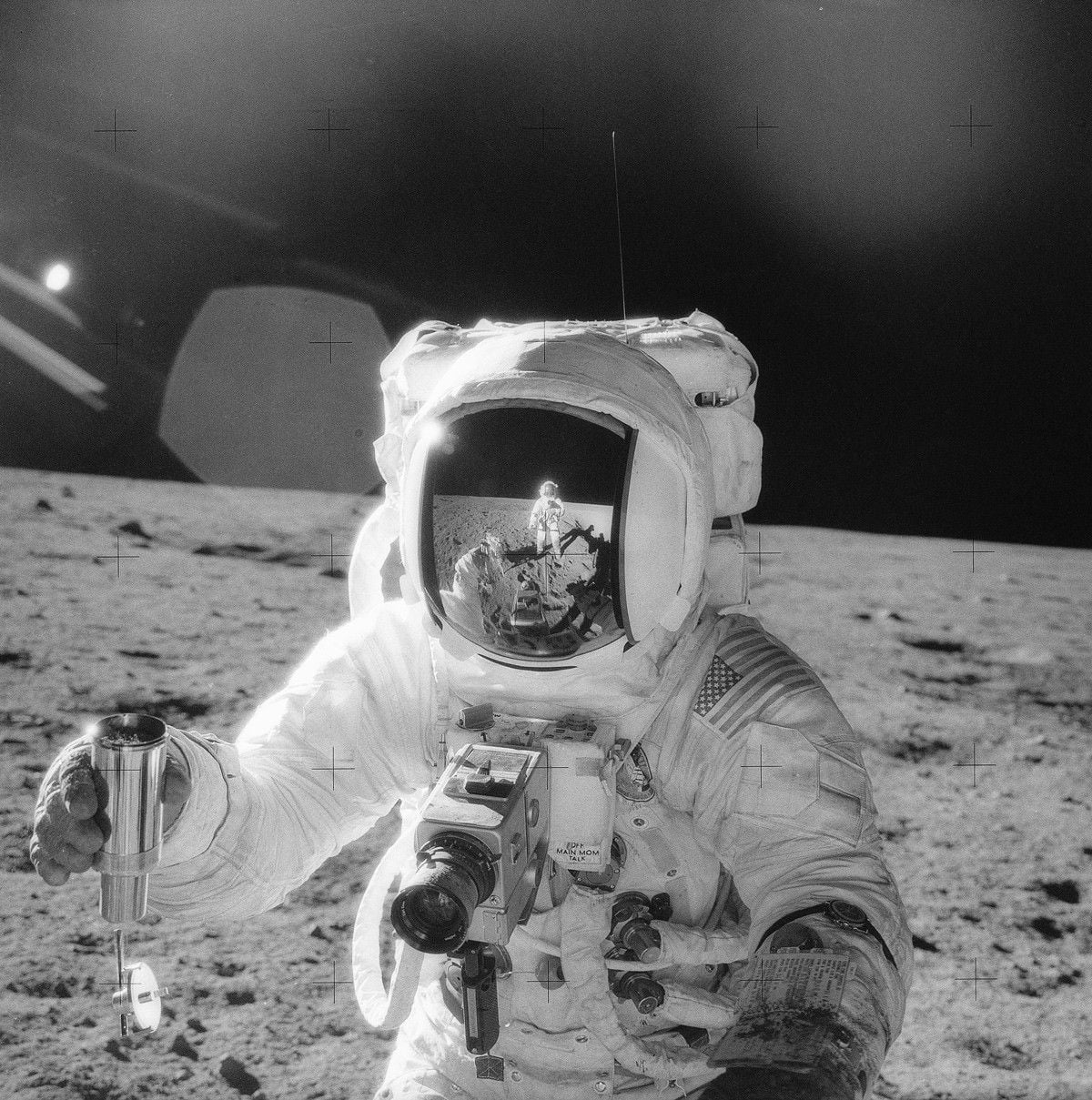
Featured image: Apollo 12 astronaut on the lunar surface. Credit: NASA