

China Is Building the World’s Largest Nuclear Fleet — and Doing It Faster and Cheaper Than Anyone Else
The United States has built two reactors in the past quarter-century. They took 15 years each and cost roughly $15 per watt of capacity. France connected its first new reactor in 20 years in December 2024. China, by contrast, started construction on six reactors in 2025 alone, two more in the first five months of 2026, and has 37 reactor units under construction — the most of any nation for the 19th consecutive year.
The numbers, detailed in a June 11 report by MIT Technology Review’s Casey Crownhart, paint a picture of two diverging nuclear industries. One is stalled by cost overruns, regulatory uncertainty, and declining political support. The other is accelerating.
“We’re seeing a tale of two nuclear industries,” Crownhart writes. “China is building large reactors quickly and cheaply. The US and Europe are betting on small modular reactors that remain unproven at commercial scale.”
China’s approach is not a single bet on one reactor design. It is a coordinated campaign across multiple technologies, built in parallel.
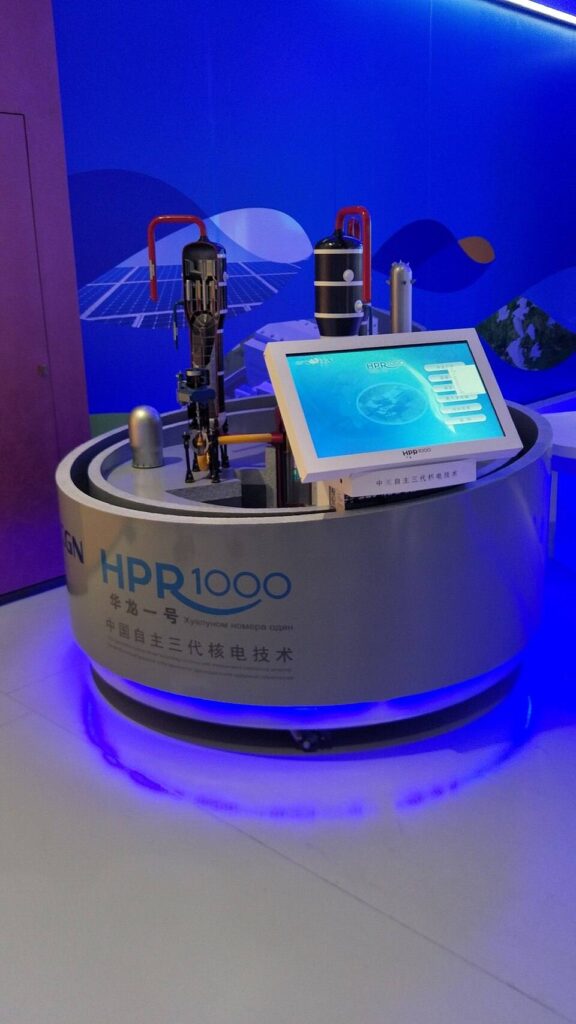
The backbone of the fleet is the Hualong One (HPR1000), a third-generation pressurized-water reactor producing 1,090 megawatts net. Each unit has a 60-year design life, combines active and passive safety systems, and uses a double containment building. Over 85% of its components are sourced domestically. China builds them in batches of six or more, achieving economies of scale that Western projects have not matched.
A second large design, the CAP1400 (Guohe One) — a scale-up of the Westinghouse AP1000 — is already operating two units at Shidaowan in Shandong province, with four more planned at Bailong.
Alongside these gigawatt-scale reactors, China is operating the world’s first commercial Generation IV reactor: the HTR-PM pebble-bed reactor at Shidao Bay, which entered commercial service in December 2023. The HTR-PM uses helium coolant and TRISO fuel pebbles encased in multiple ceramic layers. It is designed to be “walk-away safe” — capable of cooling naturally without any human intervention or external power, a feature confirmed in emergency tests. At 210 megawatts per twin module, it is smaller than the Hualong One but inherently safer.
A sodium-cooled fast reactor, the CFR-600, is nearing completion at Xiapu. Two units are expected to be ready this year. Chinese Academy of Sciences plans identify fast reactors as the primary reactor type by 2050, capable of burning nuclear waste as fuel.
A thorium molten salt reactor prototype (TMSR-LF1) has been operating since 2023 in Wuwei, Gansu province, using thorium — an element three to four times more abundant than uranium.
And the Linglong-1 (ACP100), the world’s first commercial small modular reactor, is expected to begin feeding power to the grid in the first half of 2026 on Hainan Island. At 125 megawatts, it is a fully integrated module that can be installed underground and refueled every two years — proving that China is not skipping small reactors either.
Why China Is Faster
Average construction time in China is 5 to 7 years from first concrete to grid connection, compared to a global average of roughly 9 years. The fastest Chinese builds have taken 4.1 years.
The drivers are structural, not technological. Chinese regulators approve reactors in standardized batches. Each Hualong One unit is a copy of the previous one — the design, licensing, and supply chain are identical across the batch. The project management system is uniform across CNNC, CGN, and SPIC, the three state-owned operators.
Cost data published by Liu et al. in Nature in July 2025 put Chinese overnight construction costs at roughly $2,000 to $2,500 per kilowatt — one-seventh the cost of the U.S. Vogtle expansion and roughly half the cost of France’s Flamanville EPR. A September 2025 Roosevelt Institute analysis concluded that the key factor was indigenization: as China moved its supply chain from imported components to domestic manufacturing, costs stabilized and then declined, avoiding the cost escalation seen in the US and Europe.
China is also planning the next iteration: the Hualong Two, targeting a 25% cost reduction and build time of four years.
The Framework
China’s nuclear build-out is part of its 2060 carbon neutrality pledge. The country generated roughly 4.8% of its electricity from nuclear in 2025, with current installed capacity at approximately 61 gigawatts. The target is 200 gigawatts by 2035 — roughly 10% of generation — requiring 150 additional reactors at a cost of about $440 billion.
By 2030, China is expected to overtake both the United States and the European Union in total installed nuclear capacity. The United States currently operates 94 reactors, but the pace of retirements outpaces new construction. France’s 56 reactors generate about 63 gigawatts.
China is also exporting its designs: Hualong One units are under construction in Pakistan and planned for Kazakhstan under the Belt and Road Initiative.
The Western Alternative
The US and many European nations have largely abandoned large-reactor construction in favor of small modular reactors (SMRs), which promise lower upfront costs and factory fabrication. But no commercial SMR is yet operating in the United States. Antares, a California company, reached criticality on its Mark-0 sodium-cooled microreactor on June 2, 2026 — but it produces no electricity. The company targets grid power in late 2027 and field deployment in 2028.
The irony noted by Crownhart is that China already has a commercial SMR — the Linglong-1 — about to start generating power, while simultaneously building large reactors at record pace.
“Larger reactors generally provide more electricity to the grid for a lower price,” the article notes. The bet that small reactors will be cheaper per unit of output has yet to be proven.
The Challenges Ahead
Safety remains the central concern for any nuclear expansion. China has hosted 12 IAEA Operational Safety Review missions and strengthened its National Nuclear Safety Administration through laws passed in 2017. The HTR-PM’s walk-away safety demonstration is a genuine engineering achievement. But building 150 additional reactors over the next decade at anything approaching current speed will strain regulatory capacity, workforce training, and supply chain quality control.
For the world, the question is whether China’s approach — standardization, batch building, domestic supply chains, and state investment — represents a model others can adopt, or a case study in structural advantages that cannot be replicated.
Source: Crownhart, C. (2026). “Why China is betting on big nuclear reactors.” MIT Technology Review, June 11, 2026. https://www.technologyreview.com/2026/06/11/1138789/china-big-nuclear-reactors/