

More than a million mourners packed the streets of Najaf, Iraq, on July 8 for the funeral procession of Iran’s late Supreme Leader Ali Khamenei. The crowds were so dense that the six-kilometer route through the holy city took hours to complete.
The numbers from Iraqi authorities were staggering. Hashd al-Shaabi, Iraq’s Popular Mobilization Forces, said more than 2.3 million people took part in Najaf alone. Al Mayadeen television, citing the Karbala governorate, reported 7 million mourners in Karbala, where the body was taken after the Najaf ceremonies.
The procession began at 6 a.m. at the shrine of Imam Ali, one of Shiite Islam’s holiest sites. Mourners carried portraits of Khamenei and waved Iraqi, Iranian, and Hezbollah flags. Elegies and chants echoed across the city. Roads leading into Najaf were gridlocked from before dawn, with pilgrims arriving from Basra, Muthanna, and Maysan provinces.
Why Iraq mattered
Khamenei’s funeral route through Iraq was a deliberate choice. The supreme leader was killed on February 28, the first day of the US-Israeli war on Iran. Routing his body through Najaf and Karbala, the two holiest cities in Shiite Islam after Mecca, was a message about the bonds between Iran and Iraq’s Shiite majority.
It was also a political statement. Iraq’s Shiite political establishment, led by figures like former Prime Minister Nouri al-Maliki and Ammar al-Hakim, turned out in force. Maliki called attendance at the funeral “a duty” and said the message was that “the Islamic Republic of Iran is not alone, but has friends who stand beside it and support it.”
Notably, Baghdad was dropped from the funeral route. Iraqi officials cited time constraints. But the decision spared the government in Baghdad from hosting a mass outpouring of pro-Iranian sentiment at a moment when Prime Minister Ali al-Zaidi is preparing for a visit to Washington.
The Gaza connection
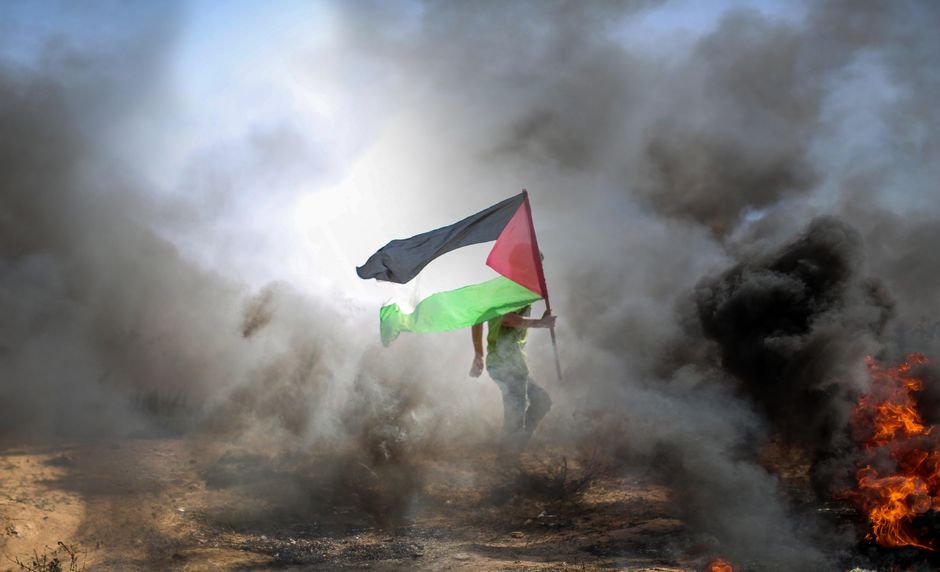
The crowds were not just mourning Khamenei. The funeral became a platform for anger over the war in Gaza, which has killed tens of thousands of Palestinians since October 2023. Many of the chants in Najaf mixed mourning for the supreme leader with condemnation of Israel and the United States.
The connection between the two conflicts runs deep. Khamenei built Iran’s foreign policy around opposition to Israel and support for Palestinian armed groups. His death at the start of a US-Israeli war against Iran reinforced the narrative that Washington and Tel Aviv were targeting the entire axis of resistance.
The presence of officials from Hamas, Hezbollah, and the Houthis at the Tehran ceremonies earlier in the week reinforced that message. Khamenei’s funeral was not just a farewell to a leader. It was a gathering of the forces that have fought Israel and the US across the Middle East.
A six-day farewell
Khamenei’s state funeral was one of the largest in modern history. The ceremonies began on July 4 in Tehran, where organizers prepared for up to 20 million mourners. The body was then taken to the holy city of Qom on July 7 before flying to Najaf.
The funeral procession in Tehran drew vast crowds, with drone footage showing tens of thousands lining the streets. High-ranking officials from more than 30 non-Western countries attended, including Russia’s former president Dmitry Medvedev. The ceremonies offered a rare pause from weeks of war and negotiations.
At the Grand Mosalla prayer hall in Tehran, a striking tableau unfolded: President Masoud Pezeshkian stood near IRGC and Quds Force commanders. Former president Mahmoud Ahmadinejad appeared in public for the first time since the war began. Khamenei’s sons prayed beside his coffin.
The funeral culminated in his burial at the shrine of Imam Reza in Mashhad on July 9.
What comes next
The scale of the funeral is a measure of Khamenei’s influence, but it also raises questions about succession. Khamenei ruled Iran for 37 years. His death leaves a gap that no single figure in Iran’s factionalized political system can easily fill.
For now, the mourning has brought a temporary unity. Hardliners and pragmatists stood together at the funeral prayers. But the underlying divisions, over the war with the US, over economic collapse, over the direction of the Islamic Republic, remain.
The Gaza war was a backdrop to every ceremony. The chants in Najaf were not just for a dead leader. They were a signal that the anger fueling the Middle East’s conflicts is not going to fade with him.