

When you fall asleep, the world does not go silent because your sensory organs stop working. Your ears still pick up sound, your skin still feels pressure, your eyes still register light. What changes is how your brain processes that information , and a new study published June 11 in Nature Communications reveals that the mechanism is far more specific, and more active, than previously understood.
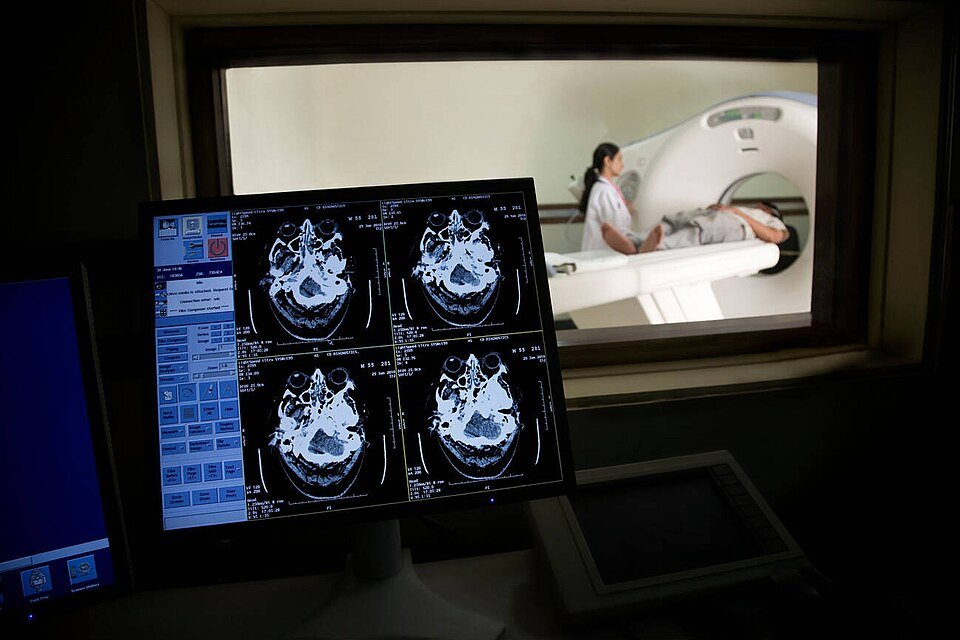
The study, led by researchers at Boston University, MIT, and Massachusetts General Hospital, used simultaneous EEG-fMRI to watch the brains of 15 healthy adults as they napped in an MRI scanner while a flickering visual stimulus was presented to their closed eyes. The key discovery: the visual thalamus , a deep brain structure that relays visual information from the eyes to the cortex , continued to respond to visual stimulation during both N1 and N2 sleep. But the visual cortex responded with an inverted pattern: instead of activating in response to light, it actively deactivated.
“The cortex isn’t just turning down the volume on sensory input,” said corresponding author Laura D. Lewis, an associate professor at MIT’s Institute for Medical Engineering and Science and the Martinos Center for Biomedical Imaging at MGH. “It’s actively suppressing the response in a way that flips the sign of the signal.”
The method: EEG inside an MRI
The experimental setup was technically demanding. Participants entered a 3-tesla MRI scanner while wearing a scalp EEG cap that allowed simultaneous recording of brain electrical activity and hemodynamic responses. The team, including lead author Nicholas G. Cicero (a joint graduate student at BU and MIT) and co-first author Michaela Klimova (BU/Northeastern), designed a protocol in which a full-field checkerboard pattern flickered at 7 Hz in alternating 16-second blocks of high contrast (100% modulation) and low contrast (10% modulation), interspersed with non-flickering gray screens.
Participants lay with their eyes closed and were allowed to spontaneously transition between wake and sleep. The EEG data allowed precise sleep staging , identifying N1 (the transition to sleep) and N2 (established light sleep) episodes , while the fMRI BOLD signal tracked the hemodynamic response in the lateral geniculate nucleus (LGN) of the thalamus and in early visual cortex (V1 and extrastriate areas).
What they found
The results were remarkably consistent. In the LGN, stimulus-evoked activation was present and largely intact during both wake and sleep , the thalamus continued relaying visual information. But in early visual cortex, sleep produced a profound change: the normal positive BOLD response to visual stimulation was suppressed, and for strong stimuli (high contrast), it flipped to a negative BOLD response , deactivation rather than activation.
This was not simply a reduction in gain, as if the volume knob had been turned down. The intensity-by-state interaction showed that stronger stimuli produced stronger inversion during sleep, consistent with active cortical inhibition , local inhibitory circuits, likely within the cortex itself or mediated by thalamocortical interactions, actively suppressing the incoming signal.
The steady-state visual evoked potentials (SSVEPs) recorded on EEG showed systematic spectral changes across arousal states, and the hemodynamic inversion could not be explained by the rare K-complexes that occurred during the recording.
Why it matters
The classical model of sleep sensory gating places the thalamus as the primary gatekeeper , the structure that decides which sensory signals get through to the cortex. This study challenges that model in a fundamental way. The thalamus continues to relay visual information faithfully, but the cortex actively suppresses it.
“This dissociation between preserved subcortical relay and cortical suppression suggests that sensory isolation during sleep is enforced at the cortical level,” said corresponding author Sam Ling, an associate professor at BU’s Department of Psychological and Brain Sciences. “The brain is not blocking sensory input at the front door. It’s letting the input in, then actively suppressing it where it would reach conscious awareness.”
The finding has implications for understanding how the brain balances the competing demands of sensory disconnection , necessary for uninterrupted sleep , and environmental monitoring , necessary for survival. The thalamus remains vigilant, tracking changes in the external world, while the cortex enters a state of active inhibition that prevents those signals from reaching conscious perception.
The authors suggest this mechanism may also play a role in memory consolidation during sleep. If the cortex is actively suppressing incoming sensory information, it may be freeing computational resources for the replay and stabilization of memories , a process widely believed to be one of sleep’s core functions.
Additional co-authors include Louis Vinke (MGH Psychiatry). The study was funded by the National Institutes of Health (grants F31NS139696, R01EY028163, U19NS128613, R01AG070135) and by a Sloan Fellowship, McKnight Scholar Award, and Pew Biomedical Scholar Award to Lewis.
Source: Cicero, N.G., Klimova, M., Vinke, L. et al. “Cortex-specific inversion of visual responses during sleep.” Nature Communications (2026). DOI: 10.1038/s41467-026-73997-y. Published 11 June 2026. Open access.