

Taiwan Fires HIMARS From West Coast in First Live-Fire Drill Facing China
For the first time, Taiwan fired U.S.-supplied HIMARS rockets from its west coast into the Taiwan Strait, a live-fire demonstration of the asymmetric “porcupine” defense strategy aimed at making any Chinese invasion prohibitively costly.
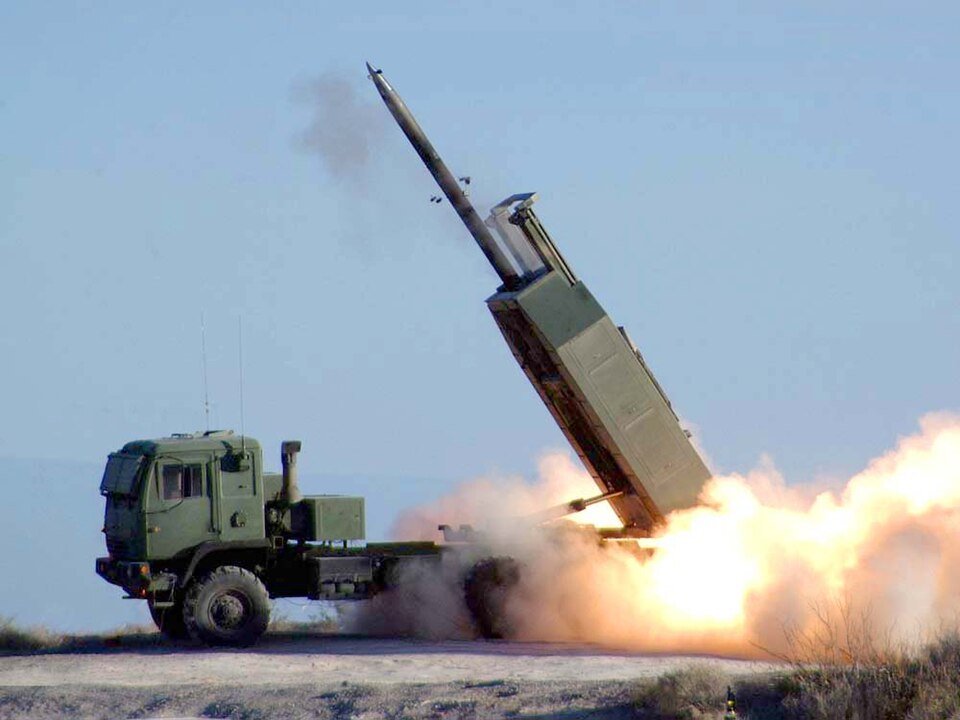
TAICHUNG. The rumble started just after sunrise on June 10, rolling across the mud flats and river mouth where the Dajia River meets the Taiwan Strait. Six M142 High Mobility Artillery Rocket Systems, three perched on each bank, erupted in sequence as Taiwan’s 58th Artillery Command conducted the island’s first live-fire HIMARS exercise on its western coastline, the narrow strip of land that China’s People’s Liberation Army would have to cross in any invasion scenario.
Each launcher carried six M28 reduced-range rockets. The plan called for three firing waves, with every HIMARS releasing two rockets per wave for a total of 36 projectiles aimed at impact points nine kilometers offshore in the Taiwan Strait. But live fire is never a perfect rehearsal. Two rockets failed to ignite on the north bank, and two more misfired on the south bank, leaving 32 successful launches and four malfunctions that Colonel Weng Yi-ming, chief of staff of the 58th Artillery Command, confirmed are now under investigation.
The malfunction rate is itself a story worth noting. Four misfires out of 36 rounds is roughly 11 percent, not catastrophic, but high enough to raise questions about the M28 practice rounds, the launcher systems, or the crew training. Colonel Weng declined to speculate on the cause, and the military has not released a timeline for the inquiry. What matters for the strategic picture is not the four that failed, but the 32 that flew.
The HIMARS system, built by Lockheed Martin, has a maximum range of approximately 300 kilometers when armed with Army Tactical Missile System munitions. From the Dajia River estuary, that range places military installations, port facilities, and staging areas across the Taiwan Strait in China’s Fujian province within reach. The exercise used reduced-range M28 rockets that splashed down just off the coast, but the message was clear: Taiwan can now place precision fires on the other side of the strait from positions along its most vulnerable shoreline.
This matters because the west coast has always been Taiwan’s strategic soft underbelly. The beaches and mud flats from Taichung southward are the most likely landing zones for any amphibious assault by the People’s Liberation Army. For decades, Taiwan’s defensive planning assumed it would meet an invasion force at the water’s edge with fixed fortifications and massed artillery, a static defense that Chinese planners could map, target, and neutralize before the first landing craft touched sand.
The HIMARS drill signals a shift. Mobile launchers that can “shoot and scoot”, fire a salvo and relocate within minutes, are harder to target than fixed artillery batteries. They represent the core of Taiwan’s evolving “porcupine” strategy: a layered, asymmetrical defense that aims not to defeat a Chinese invasion in a conventional battle, but to make the cost of invasion so high that Beijing thinks twice.
Taiwan first test-fired HIMARS off its east coast in May 2025. That location was safer, facing the Pacific Ocean rather than the mainland. Firing from the west coast is a different proposition entirely. The launchers operated in a narrow coastal corridor where Chinese radar, drones, and surveillance aircraft maintain near-constant watch. The exercise was as much a test of survivability as it was of accuracy: could the launchers get into position, fire, and withdraw before being detected and targeted?
The two-day drill, conducted by the army’s 10th Corps, also involved 155mm howitzers alongside M109A2 and M110A2 self-propelled artillery systems, simulating a coordinated coastal defense against an amphibious landing. But the HIMARS were the centerpiece, and their presence on the west coast marks a deliberate escalation in Taiwan’s defensive posture.
“Due to the current enemy threat, we will continue HIMARS training with unwavering determination to protect Taiwan as the nation’s strongest force,” Army Sergeant Wang Ming-hui said after the exercise.
China, which claims Taiwan as a renegade province and has never renounced the use of force to bring the island under its control, responded predictably. State media condemned the drill as provocative, and Beijing reiterated its opposition to any U.S. arms sales to Taiwan. The People’s Liberation Army has conducted its own major exercises around the island in recent years, sending warships and warplanes into the skies and waters near Taiwan on an almost daily basis.
The United States, which does not recognize Taiwan as a sovereign country but opposes any forcible change to its status, has approved the sale of 29 HIMARS launchers to Taipei as part of a broader military modernization program. An additional 82 launchers were approved in December 2025 as part of an $11 billion arms package, the largest single U.S. arms sale to Taiwan in history.
What the June 10 exercise demonstrated, beyond the technical capability of the weapon system, is a strategic reality that neither Beijing nor Washington can ignore. Taiwan is building a mobile precision-strike network designed to punish an invasion force before it can establish a beachhead. The HIMARS on the west coast are only one piece of that puzzle. But they are a piece that China can see from its own shoreline, and that is precisely the point.