

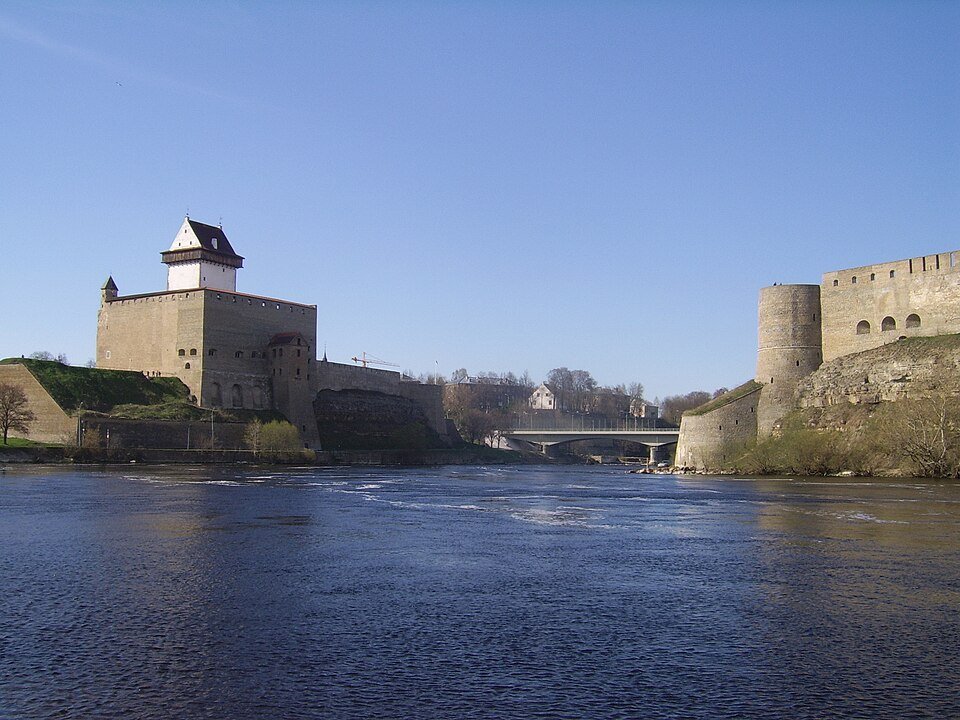
Estonia will begin construction of a permanent military base in the border city of Narva later this year, Defense Minister Hanno Pevkur announced Tuesday, as the Baltic state continues building defensive infrastructure on its frontier with Russia.
The base, located in Estonia’s third-largest city at the northeastern edge of both EU and NATO territory, will be built just meters from the Russian border. An initial container-base phase will be constructed through a public procurement process to establish the Estonian Defense Forces’ presence as quickly as possible.
“Expanding our presence in Narva is important because Estonia takes defending itself from the very first meter seriously,” Pevkur said during a visit to Ida-Viru County, where he met with Narva city leaders. The city government agreed to support the project beginning as early as June.
The Narva base joins a series of infrastructure projects along Estonia’s eastern border. Last year, the Reedo base near the town of Voru in the south was commissioned, and construction of 600 bunkers along the border with Russia began in 2025. More than 100 ammunition depots are also being built across the country.
More than 200 military personnel, including allied units, are expected to be stationed at Narva. The base represents the first major NATO infrastructure project on the alliance’s direct frontier with Russia, and it carries a clear message: Estonia does not intend to trade territory for time in any future confrontation.
The timing is significant. The Estonian announcement came on the same day that a new report from the Peace Research Institute Oslo confirmed that state-based armed conflicts have reached their highest level since World War II. For the Baltic states, which share a 294-kilometer (183-mile) border with Russia, the data confirms what they have been saying for years: the threat is real, and it is not receding.
Narva is a symbolically charged location. The city sits on the Narva River, with Ivangrad, Russia, visible from its banks. For much of the Cold War, Narva was a closed military zone. In a conflict between NATO and Russia, it would be among the first towns attacked.
Estonia has been one of the most vocal NATO members in calling for increased defense spending and a permanent alliance presence on its soil. It spends more than 3% of GDP on defense — among the highest in the alliance — and has pushed for a fundamental shift in NATO’s posture from rapid-reaction forces to permanent forward defense.
With the Narva base, Estonia is not waiting for Brussels to act. It is building its own deterrent, one bunker and one base at a time.
The broader context matters. Finland and Sweden have joined NATO since Russia’s invasion of Ukraine, transforming the Baltic Sea into a de facto NATO lake. Estonia, Latvia, and Lithuania have all accelerated their military infrastructure programs. The Narva base is the easternmost expression of this new reality: a permanent military footprint on a riverbank that separates NATO from Russia.
For the people of Narva, a city where roughly 80% of the population is Russian-speaking, the base is also a domestic political signal. Estonia has worked to integrate its Russian-speaking minority while maintaining a firm line against Moscow’s influence operations. A military base in the heart of a Russian-speaking city makes a statement about loyalty and sovereignty that goes beyond concrete and barbed wire.
The Narva base will not stop a full-scale Russian invasion on its own. It does not need to. Its purpose is to ensure that any attack on Estonia begins with an assault on a fortified position, not an undefended border crossing. In military doctrine, that changes the calculus of risk. In political terms, it changes the signal. Estonia is not a gap in the line. It is a fixed point.