

Commonwealth Fusion Systems (CFS), the MIT spin-off building what could become the world’s first grid-scale fusion power plant, has published five peer-reviewed papers detailing the physics that underpin its ARC reactor design. The collection, published in the Journal of Plasma Physics, represents the most detailed public accounting yet of how a privately funded commercial fusion plant would actually work.
Spanning 226 pages with 58 co-authors from CFS, MIT, Columbia University, the Max Planck Institute for Plasma Physics and other institutions, the papers cover everything from plasma stability to heat exhaust to what happens when things go wrong. The verdict, according to CFS chief science officer Brandon Sorbom: ARC can generate 1.1 gigawatts of fusion power and deliver 400 megawatts of net electricity to the grid, enough to power about 280,000 average American homes.
“We demonstrate that the ARC power plant has a solid foundation in physics,” Sorbom told reporters. “The papers confirm that when we build the ARC fusion power plant, it will work.”
The machine
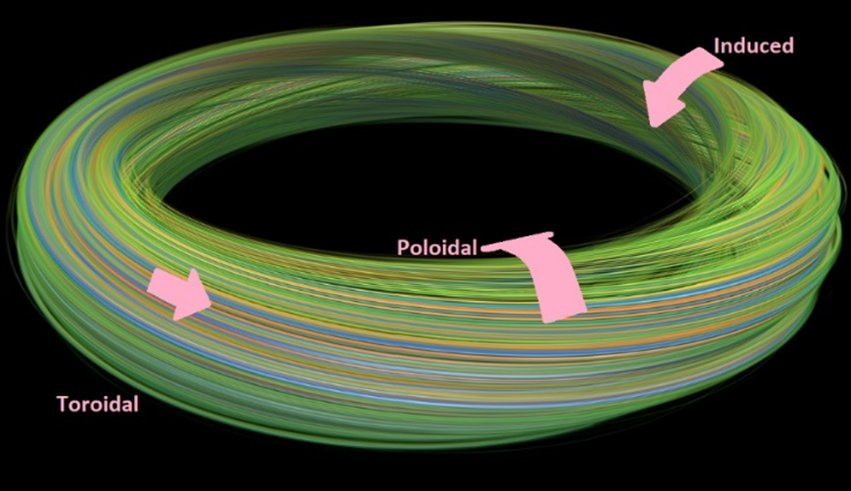
ARC (affordable, robust, compact) is a tokamak, a doughnut-shaped magnetic bottle that confines plasma at temperatures exceeding 150 million °C (270 million °F), hot enough for hydrogen isotopes to fuse into helium and release energy. What sets ARC apart from previous designs, notably the international ITER project, is its use of high-temperature superconductor (HTSC) magnets. These operate at 20 to 77 kelvins (minus 253 to minus 196 °C), dramatically warmer than the near-absolute-zero temperatures required by conventional superconducting magnets. The result is a far more compact reactor that requires significantly less cooling infrastructure.
The fusion reaction uses deuterium and tritium, two isotopes of hydrogen. Neutrons escaping the plasma carry energy into a surrounding blanket of continuously flowing molten salt, which heats water to drive turbines for electricity generation. That same salt blanket serves a second purpose: neutrons striking lithium within the salt transmute it into tritium, which can be extracted and used as fuel, enabling the reactor to breed its own supply.
CFS plans to build ARC at a site in Chesterfield County, Virginia, the Fall Line Fusion Power Station, and has already applied to connect it to the PJM Interconnection grid. The company has signed Google as its first commercial customer.
Five papers, one foundation
Four of the papers focus on specific physics challenges; the fifth provides an overview that synthesizes the findings.
Overview of the physics basis for the ARC fusion power plant (Hillesheim et al., E69): Led by Jon C. Hillesheim, the overview paper combines modeling across all major plasma physics domains to show that ARC can sustain the conditions needed for net power production. It details how the tokamak’s design parameters, including magnetic field strength, plasma current, density and temperature profiles, yield a predicted fusion power output of 1.1 GW.
Performance and transport in the ARC tokamak (Howard et al., E67): This paper models how heat and particles move within the plasma. Using the same physics frameworks that informed the earlier SPARC design, the authors predict that the plasma will remain sufficiently confined to sustain fusion conditions, with turbulent transport losses within acceptable bounds.
Power and particle exhaust for the ARC fusion power plant (Eich et al., E66): One of the most critical engineering challenges in any tokamak is managing the intense heat that flows out of the plasma. This paper shows how ARC’s divertor, the component that handles exhaust, can withstand the extreme thermal loads through a combination of geometry and the molten salt blanket’s heat absorption capacity.
ARC disruption physics and strategy (Sweeney et al., E68): Plasma disruptions, when instabilities cause the superheated plasma to suddenly collapse and contact the reactor wall, are among the greatest threats to a tokamak’s survival. A disruption in ARC would release a plasma carrying 12 million amperes of electrical current at 150 million °C. The paper describes mitigation strategies including rapid injection of massive amounts of gas to cushion the impact, and demonstrates that ARC is designed to withstand at least one disruption per day and restart the plasma within a minute without interrupting power output.
ARC physics basis, magnetohydrodynamics (Leuthold et al., E49): Published in April, this paper covers the equilibrium and stability of the plasma under the influence of magnetic fields. It confirms that ARC’s magnetic configuration can maintain a stable plasma free from large-scale instabilities.
From SPARC to ARC
SPARC, CFS’s smaller demonstration tokamak now under construction in Devens, Massachusetts, is more than 75% complete and on track for first plasma in 2027. SPARC’s mission is to demonstrate net fusion energy, producing more power from fusion than is required to heat and confine the plasma, a milestone known as Q>1. No privately built tokamak has achieved this.
What SPARC teaches will directly inform ARC. The two machines share the same fundamental design philosophy, with ARC essentially scaled up for power generation. “By design, the two tokamaks are similar so we can transfer what we’ve learned directly from SPARC to its successor,” the company stated. “Once SPARC works, we know ARC plants will, too.”
The projected lifetime of ARC is 25 to 30 years. Its vacuum vessel, the chamber that contains the plasma, will erode from neutron bombardment and need replacement every one to two years. CFS has designed the reactor to be opened, the molten salt drained, and the vessel cut out and replaced in a process the company aims to complete within a couple of months. “Every time we replace it, we can upgrade it,” Sorbom said.
Caution from the community
Not everyone is ready to call the case closed. Tony Roulstone, a nuclear engineer at the University of Cambridge, told Nature that while the team behind the papers includes “some of the best in the fusion business,” the pressure from private capital creates an incentive “to claim things before the evidence is fully in place.”
The key uncertainty, several researchers noted, is that the papers rely on simulations and extrapolations from existing tokamaks. Real validation will require data from an operating SPARC, results that are at least two years away. The papers themselves acknowledge these uncertainties, describing the work as a physics basis rather than a final engineering design.
Troy Carter of Oak Ridge National Laboratory, the special issue editor, emphasized the value of open peer review in the commercialization process: “These papers provide the broader community an opportunity to critically examine the physics basis for a fusion power plant while demonstrating that fusion companies like CFS can meaningfully contribute to the open scientific literature without compromising intellectual property.”
What comes next
CFS has raised nearly $3 billion since its founding in 2018. With SPARC assembly underway and the ARC physics foundation now published, the company is shifting attention toward detailed engineering design. The papers establish a unified simulation framework that CFS says will allow it to refine ARC’s design as new data comes in from SPARC, optimizing the plant for both performance and economics.
The timeline remains ambitious: first plasma from SPARC in 2027, ARC operational in the early 2030s. If successful, it would mark the first time fusion energy has been delivered to a commercial electricity grid, a milestone that has been perpetually “a decade away” for more than half a century.
Source: Five papers in Journal of Plasma Physics, Volume 92 (2026): Hillesheim et al., E69 (DOI: 10.1017/S0022377826101706); Sweeney et al., E68; Howard et al., E67; Eich et al., E66; Leuthold et al., E49. All open access. Also reporting from IEEE Spectrum, Nature News, and the CFS blog.