

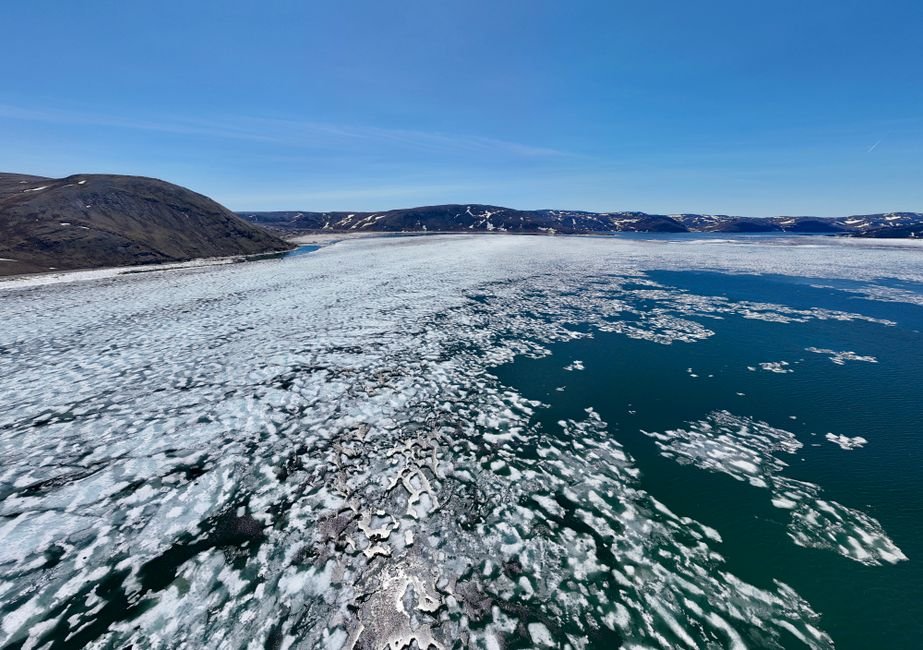
The first real-world field test of a geoengineering concept to slow Arctic sea ice loss has produced a clear result: pumping seawater onto the surface of sea ice can thicken it by up to 32 centimeters. The question is whether the approach can ever work at a meaningful scale.
The experiment, conducted during the 2024-2025 winter in Cambridge Bay, Nunavut, Canada, involved team members from the University of Washington, University College London, and the local Ekaluktutiak Hunters and Trappers Organization. Their findings, published May 22 in Earth’s Future, show that flooding a 1-square-kilometer test area with seawater using submersible pumps (each drawing less power than a toaster) produced ice that was significantly thicker and brighter than untreated control areas by mid-May.
But the same paper also documents why this approach is unlikely to prevent the long-term decline of the Arctic ice cap.
How It Works
The concept is deceptively simple. In winter, when air temperatures are well below freezing, pump seawater onto the surface of existing sea ice. The water freezes, adding a new layer of ice on top. Because this new ice is saltier than the natural ice below, it also increases the surface albedo, reflecting more sunlight back into space during the spring melt season.
The team established eight test areas and three control areas across a 1-square-kilometer site, flooding some areas once (in December or January) and others twice (December plus February, or January plus February). Each application added up to 20 centimeters (8 inches) of seawater. One control area was used for a separate melt-pond drainage experiment.
By mid-May, the twice-flooded areas were up to 32 centimeters thicker than the control areas. This gain is equivalent to roughly 50 years of spring sea ice thinning in Cambridge Bay, where the ice has been thinning at about 6 centimeters per decade since 1980. The flooded ice also remained brighter through the melt season, with the drained melt-pond site brightening markedly within one week.
The Scalability Gap
Here is the catch. A 2016 study estimated that covering just 10 percent of the Arctic Ocean would require approximately 10 million wind-powered pumps. Covering the entire Arctic would need 100 million. The logistics of deploying, maintaining, and powering such an infrastructure across one of the most hostile environments on Earth are staggering.
The authors of the new study are candid about these limits. “Local-scale use is plausible,” they write, but large-scale deployment faces “severe feasibility, cost, and ecological barriers.” A 2025 review concluded that sea ice thickening was “simply not feasible” at a meaningful scale.
Additional complications include the rapidly closing window of opportunity: Arctic sea ice extent has shrunk by roughly 20 percent since 1979, and as the ice becomes thinner, there may soon not be enough stable ice to deploy on. The 2024-2025 winter was also exceptionally warm in Cambridge Bay, which the authors note may affect the generalizability of their results.
The Broader Context
The experiment should be understood in the context of a field, Arctic geoengineering, that is growing more serious as the consequences of Arctic sea ice loss become more apparent. Disappearing summer sea ice amplifies global warming through the albedo effect (dark ocean absorbs more sunlight than white ice), disrupts weather patterns, threatens coastal communities with increased storm surge, and endangers species that depend on the ice edge.
Other proposed interventions include spraying reflective aerosols into the Arctic stratosphere, brightening marine clouds, and even building artificial icebergs. None have been tested at scale. All carry unknown ecological risks.
The Cambridge Bay experiment is valuable precisely because it provides real-world data on what works and what does not. Seawater pumping works at the local scale to thicken ice. But the authors’ own conclusion, that local-scale use is plausible while large-scale deployment is “challenging”, is a reminder that geoengineering is not a substitute for reducing emissions. Even if 100 million pumps could be deployed, they would only buy time, not solve the underlying problem.
Disclosure: Based on a peer-reviewed paper in Earth’s Future, May 22, 2026. DOI: 10.1029/2025EF007894. Lead author Edward Blanchard-Wrigglesworth (University of Washington). Covering the Live Science article by Sascha Pare, July 6, 2026.