

Blue Origin’s New Glenn explodes on pad, grounding Amazon’s satellite plans and threatening NASA’s moon timeline
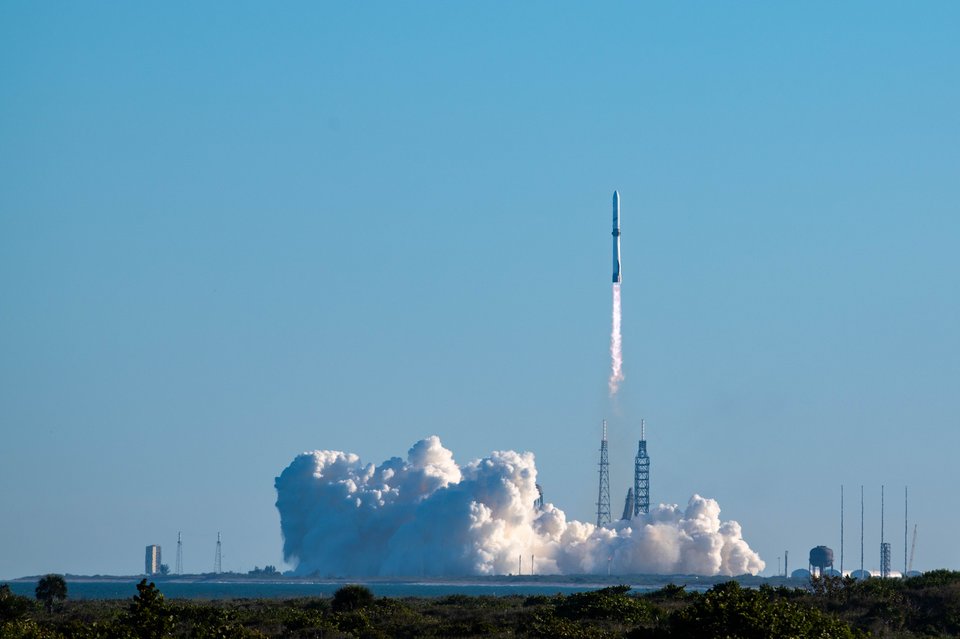
Blue Origin’s New Glenn rocket exploded catastrophically on the launch pad at Cape Canaveral Space Force Station on the night of May 28, destroying the vehicle, obliterating ground support equipment, and freezing one of the most ambitious launch manifests in commercial space.
What happened
At 9:00 p.m. ET, Blue Origin began a static fire test — a standard pre-launch procedure where engines ignite briefly while the rocket remains bolted to the pad — at Launch Complex 36. The seven BE-4 first-stage engines appeared to ignite, then something went wrong at the base of the 98-meter (321-foot) rocket. The 57-meter (188-foot) first stage collapsed in flame; the 27-meter (87-foot) upper stage tilted and fell as the full load of methane and liquid oxygen erupted (TechCrunch). The fireball was visible 185 km (115 miles) south in Fort Pierce, and residents in South Carolina reported seeing a glow in the sky (The Guardian).
“All personnel are accounted for and safe,” Jeff Bezos wrote on X. “It’s too early to know the root cause but we’re already working to find it. Very rough day, but we’ll rebuild whatever needs rebuilding and get back to flying. It’s worth it.” (TechCrunch)
Damage assessment
The explosion destroyed not just the rocket but the transporter erector — the massive gantry that moves and raises the vehicle — and knocked out at least one of two lightning protection towers. The primary umbilical tower remained standing, but video showed violent shaking that may indicate foundation damage. The tank farm likely sustained major damage as well (TechTimes). NASA Administrator Jared Isaacman said the agency will “work with our partners to support a thorough investigation” and assess impacts to the Artemis program (TechCrunch).
A program in freefall
This is the third anomaly in New Glenn’s brief flight history. NG-1 (January 2025) reached orbit but failed to recover its booster. NG-2 (November 2025) succeeded in both orbit and booster landing. NG-3 (April 19, 2026) landed its booster again but lost its payload — an AST SpaceMobile satellite — when a cryogenic leak froze a hydraulic line in the upper stage (TechTimes). The FAA grounded New Glenn after NG-3; Blue Origin completed the investigation, identified nine corrective actions, and received clearance to resume flights on May 22. The explosion occurred six days later.
The FAA confirmed to Spaceflight Now that the static fire test was outside the scope of FAA-licensed activities, so no new agency-led investigation will open — the root cause investigation is Blue Origin’s responsibility.
Amazon’s 24-launch manifest is frozen
NG-4 was targeting June 4 to carry 48 Amazon Leo internet satellites to low Earth orbit — the first flight under a 24-launch contract between Amazon and Blue Origin. That manifest is now indefinitely suspended. The explosion also raises concerns for United Launch Alliance’s Vulcan Centaur rocket, which uses the same BE-4 engines (TechTimes). If the root cause traces to the engine design, ULA’s vehicle is grounded too.
No backup pad
The SpaceX parallel is instructive. After a Falcon 9 exploded on the pad at SLC-40 in September 2016, SpaceX resumed launches from Vandenberg in four months and from Pad 39A in five — but only because it had multiple certified pads on two coasts. Blue Origin has one orbital launch facility. LC-36 must be assessed, cleared, and rebuilt before any New Glenn flies again, a timeline Spaceflight Now described as almost certainly longer than the investigation itself (TechTimes). The company had planned 12 New Glenn launches this year.
The moon connection
Just three days before the explosion, NASA announced Blue Origin had won a contract to help build its $20 billion moon base. Blue Origin’s Blue Moon lander is also a contender to ferry astronauts to the lunar surface for Artemis IV, planned for 2028. Isaacman said NASA would “provide any impacts to the Artemis and Moon Base programs as it becomes available” (The Guardian; TechCrunch).
Elon Musk offered a brief public condolence: “Most unfortunate. Rockets are hard. I hope you recover quickly.” (TechCrunch)
Sources: TechCrunch (May 28, 2026); The Guardian (May 29, 2026); TechTimes (May 29, 2026); Wired (May 29, 2026)