

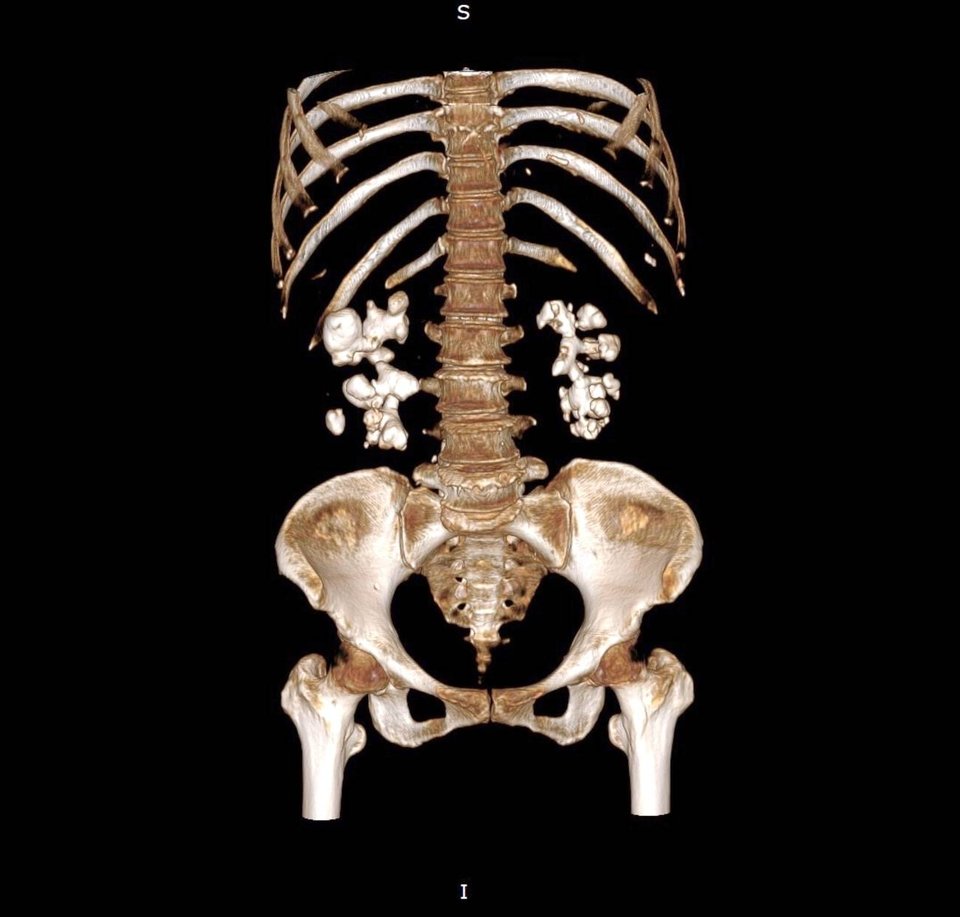
When a kidney mass is spotted on a CT scan, the chain of decisions that follows is fraught with uncertainty. Is it benign or malignant? How aggressive is it? Will surgery be curative, or will the cancer return? Each question carries a different set of clinical consequences — and at every step, the risk of getting it wrong is real.
Up to 20% of surgically removed renal masses turn out to be benign. Patients undergo nephrectomy — removal of part or all of a kidney — for lesions that would never have harmed them. At the other extreme, an aggressive tumor that appears unremarkable on a scan can be underestimated, leading to inadequate treatment planning.
Researchers have long sought an AI tool that could bring objective, reproducible precision to this workflow. Most attempts have followed a “one model, one task” paradigm — a dedicated algorithm for malignancy, another for surgical complexity, a third for prognosis. These models rarely generalize beyond the institution where they were trained, and they ignore the rich semantic information contained in radiologists’ own reports.
In a paper published June 8 in *Nature Communications*, a team led by researchers at Fudan University and Microsoft Research Asia presents a fundamentally different approach. RenalCLIP is a vision-language foundation model — an AI system that learns to align the visual patterns in CT scans with the clinical language used to describe them — and applies that understanding across the full spectrum of kidney cancer assessment.
## Learning to see and speak kidney cancer
The core innovation behind RenalCLIP is its two-stage pre-training strategy. Rather than training a model from scratch on labeled datasets — which requires thousands of expert-annotated scans for each individual task — the team first infused each of the model’s two “encoders” (one for images, one for text) with domain-specific knowledge, then aligned them through a contrastive learning objective.
The image encoder was pre-trained within a multi-task framework supervised by structured clinical attributes systematically extracted from radiology reports. The text encoder, built on top of the Llama3 large language model, was transformed into a specialized medical language expert using LLM2Vec techniques. In the second stage, these knowledge-enriched encoders were jointly optimized to create a shared embedding space — one where a CT image of a renal tumor and its corresponding radiological description are mapped to nearby points in a high-dimensional space.
The scale of the training data is notable. The pre-training dataset included 21,819 CT scans from 6,867 patients across four major Chinese medical centers. For downstream evaluation, a separate cohort of 1,942 patients (6,047 CT scans) was assembled, comprising an internal test set, five proprietary external cohorts from distinct institutions, and the publicly available Cancer Imaging Archive (TCIA) cohort — the latter drawn primarily from a Caucasian population, enabling cross-ethnic validation.
## Ten tasks, one model
RenalCLIP was evaluated across 10 core clinical tasks spanning three domains: anatomical characterization, diagnostic classification, and survival prognosis. In every domain, it outperformed both a conventional 3D CNN trained from scratch and three state-of-the-art general-purpose CT foundation models — CT-CLIP, Merlin, and CT-FM.
**Anatomical characterization.** The R.E.N.A.L. nephrometry score quantifies tumor complexity across five components: Radius, Exophytic/Endophytic, Nearness to collecting system, Anterior/Posterior, and Location. RenalCLIP achieved the highest ROC AUC on four of five components in the internal validation cohort — Radius (0.908), Exophytic (0.646), Anterior/Posterior (0.857), and Location (0.747) — and on four of five in the combined external cohort. It also generated radiology reports that scored highest across all standard language metrics (BLEU, METEOR, ROUGE-L) when compared against GPT-4o, MedGemma, RadFM, and CT-CHAT.
**Diagnosis of malignancy and aggressiveness.** For distinguishing benign from malignant renal masses, RenalCLIP achieved an AUC of 0.856 in the internal cohort and 0.841 in the combined external cohort — with a sensitivity of 0.827, specificity of 0.735, and F1-score of 0.876. The performance gap widened in external cohorts, where RenalCLIP outperformed the leading baseline (CNN) by 17.3% (0.841 vs. 0.717), compared with 8.2% in the internal cohort — a sign that its disease-centric training confers superior generalizability.
On the more nuanced task of aggressiveness stratification — distinguishing indolent from aggressive tumors — RenalCLIP achieved an AUC of 0.703 in the external cohort. Critically, when patients were stratified into risk groups, only RenalCLIP’s predictions retained statistically significant prognostic power in the TCIA cohort (p=0.010, HR=2.23). Every baseline model — including the 3D CNN, CT-CLIP, Merlin, and CT-FM — failed to produce a significant survival separation.
**Non-invasive survival prediction.** Perhaps the most striking result was RenalCLIP’s performance on survival prediction. For recurrence-free survival (RFS) in the TCIA cohort, the model achieved a concordance index (C-index) of 0.726 — a 22.6% improvement over the best-performing baseline (CT-FM at 0.592). It also outperformed baselines for disease-specific survival (0.690 vs. 0.649) and overall survival (0.650 vs. 0.623).
In Kaplan-Meier analysis, patients classified as high-risk by RenalCLIP had significantly worse RFS than low-risk patients (p<0.001, HR=3.7). Even after adjusting for standard pathological indicators such as TNM stage and WHO/ISUP grade in a multivariate Cox regression, the RenalCLIP risk score remained an independent adverse prognostic factor (p=0.016, HR=2.27). No baseline model's risk score retained significance after adjustment. ## Zero-shot and data-efficient learning RenalCLIP's most practically significant capability may be its performance in low-data regimes. For malignancy classification, the model's zero-shot performance — making predictions without any fine-tuning on labeled examples — surpassed the peak performance of every baseline model, even after those baselines had been fully fine-tuned on 100% of the training data. When fine-tuned with only 20% of labeled data, RenalCLIP matched or exceeded the best performance of any baseline model trained on the full dataset. For aggressiveness classification, zero-shot RenalCLIP exceeded the fully fine-tuned results of CNN, CT-CLIP, and Merlin in the internal cohort. This matters because expert-annotated medical datasets are among the most expensive and labor-intensive resources in AI. A model that can perform well with 20% of the usual data — or skip annotation entirely in some cases — lowers a major barrier to clinical deployment. ## Limitations and caveats The authors acknowledge several important limitations. The study is retrospective, which carries inherent selection and spectrum biases. Prospective validation in a real clinical workflow is essential. While cross-ethnic validity was demonstrated on the TCIA cohort (predominantly Caucasian), the pre-training data came almost entirely from a Chinese population, and validation in African and Hispanic populations is needed. RenalCLIP's report generation, while superior to other AI models, is not yet at human-expert level and can exhibit minor factual inconsistencies. The evaluation also did not extend to genomic profiling from imaging — a frontier in radiogenomics that remains an open challenge. ## A blueprint for disease-centric AI RenalCLIP represents a departure from the prevailing approach in medical AI — the general-purpose foundation model trained on all pathologies, which the authors argue lacks the depth needed for the nuanced decisions in oncology. Their disease-centric strategy, embedding renal-specific clinical-pathological knowledge into the model's pre-training, offers a template for other areas of oncology where the same gap exists. The model has been made available alongside the paper, and its architecture provides a foundation for extending into data-scarce problems — rare histologic subtypes, therapy response prediction, and imaging-based genomic markers — that have so far resisted machine learning approaches. **Source:** Tao, Y., Zhao, Z., Wang, Z. et al. "A disease-centric vision-language foundation model for precision oncology in kidney cancer." *Nature Communications* (2026). DOI: [10.1038/s41467-026-74175-w](https://doi.org/10.1038/s41467-026-74175-w). Published 08 June 2026. Open access under CC BY-NC-ND 4.0. **Funding:** National Key R&D Program of China [2024YFF1207500], Shanghai Action Plan for Science [23410710400], National Natural Science Foundation of China [81974393], and others. Funders had no role in study design or interpretation. **Competing interests:** The authors declare no competing interests.