

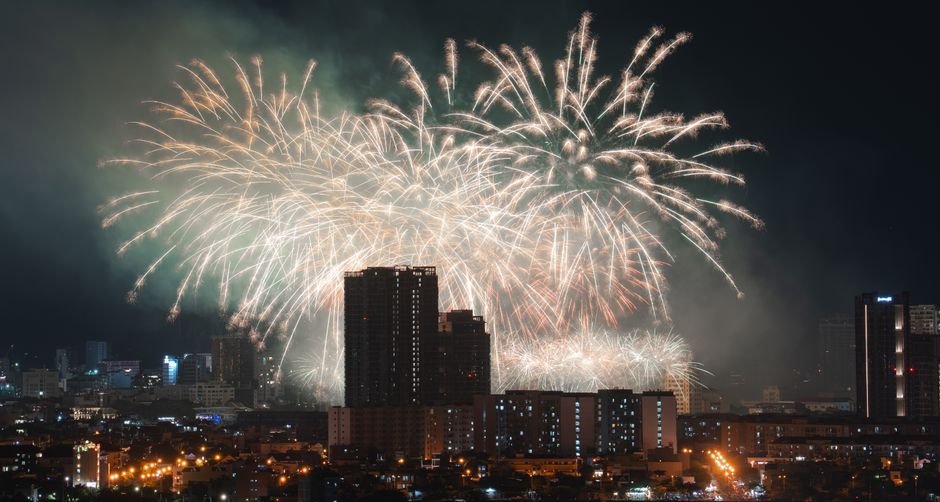
Fireworks are synonymous with celebration, but after the colors fade and the smoke clears, they leave behind a chemical legacy that persists in the environment far longer than the spectacle itself. Three studies published by the American Chemical Society, released in conjunction with the U.S. Independence Day holiday, quantify the hidden pollution from fireworks across three different environmental media, water, air, and atmospheric chemistry, revealing impacts that extend well beyond the night of the show.
“Once fireworks burn out, they leave behind more than ash,” the authors of the first study note. “Spent firecrackers scatter residue that contains partially burned fuel, metal salts, additives, and pieces of charred packaging.”
Water chemistry altered by firecracker debris
The first study, published in Environmental Science & Technology, examined what happens when spent firecracker residue enters waterways. Researchers placed firecracker debris in lake and river water and tracked the chemical changes.
The residue released metal ions, including potassium and manganese, and dissolved organic matter, including simple phenols and sulfur-containing compounds. The debris also absorbed some larger, more complex organic compounds that were already present in the water, changing the overall molecular composition of the dissolved organic matter pool.
These chemical shifts could have ecological consequences. Changes in dissolved organic matter composition can alter microbial community structure and function, and elevated metal concentrations can be toxic to aquatic organisms. The effect is likely most pronounced after large festivals when debris accumulates in concentrated areas and subsequently washes into waterways during rain.
The authors emphasize the importance of proper collection and disposal of spent fireworks debris, a simple intervention that could substantially reduce these water-quality impacts.
Air pollution exceeds WHO limits at multi-day events
The second study, published in ACS ES&T Air, monitored air quality during a multi-day athletic event in the United Kingdom. Researchers detected sharp, short-lived increases in both coarse and fine particulate matter (PM) from multiple sources: cooking emissions from food vendors, dust stirred up by vehicles and crowds, and two distinct PM spikes during the opening and closing ceremonies.
The first spike during each ceremony came from crowds and dust. The second, slightly smaller spike was directly attributable to fireworks. The cumulative effect was significant: people who attended every day of the event were exposed to fine particulate matter levels exceeding the World Health Organization’s recommended limits.
While a single fireworks display may not pose a health risk to most individuals, the study highlights how repeated exposures over multi-day events can accumulate, pushing vulnerable populations, children, the elderly, and those with respiratory conditions, into unsafe territory.
Hidden amines contribute to haze
The third study, published in Environmental Science & Technology Letters, investigated a previously overlooked component of fireworks pollution: amines. These nitrogen-containing organic compounds react in the atmosphere to form secondary organic aerosols, a major component of haze.
During Lunar New Year celebrations in suburban China, the researchers detected substantial increases in both gaseous and particulate amines during fireworks displays. They also found elevated levels of fine particulate matter, sulfate ions, and potassium ions compared to non-celebratory periods.
The finding suggests that fireworks contribute more than visible smoke to the haze that often lingers after large celebrations. Amines are known to enhance new particle formation and growth, potentially contributing to persistent air quality degradation that outlasts the visible plume.
A cumulative picture
Taken together, the three studies paint a comprehensive picture of fireworks pollution that extends well beyond the immediate visual and auditory experience. Fireworks affect water chemistry through debris leaching, air quality through particulate emissions that can accumulate over multi-day events, and atmospheric chemistry through the release of reactive compounds that contribute to haze formation.
All three studies offer practical implications. Proper debris disposal can reduce water impacts. Awareness of cumulative exposure during multi-day events can inform public health guidance. And recognition of amine emissions suggests that fireworks’ atmospheric chemistry effects may be more complex than previously understood.
Sources:
Chen G-L, Du M, Qian C, Yu H-Q. Molecular-Level Perturbations of Dissolved Organic Matter Driven by Episodic Firecracker Residue Leaching. Environmental Science & Technology (2026). DOI: 10.1021/acs.est.6c01478
Acton WJF, Lalchandani V, Du M, et al. The Impact of Hospitality on Air Quality at a Major Sporting Event. ACS ES&T Air (2026). DOI: 10.1021/acsestair.5c00142
Gui L, Xu Y, Ma Y-J, et al. Firework Display Is a Newly Identified Source of Gaseous and Particulate Amines. Environmental Science & Technology Letters (2025). DOI: 10.1021/acs.estlett.5c00806