

Quantum Information Theory Could Sharpen Exoplanet Imaging to Theoretical Limits
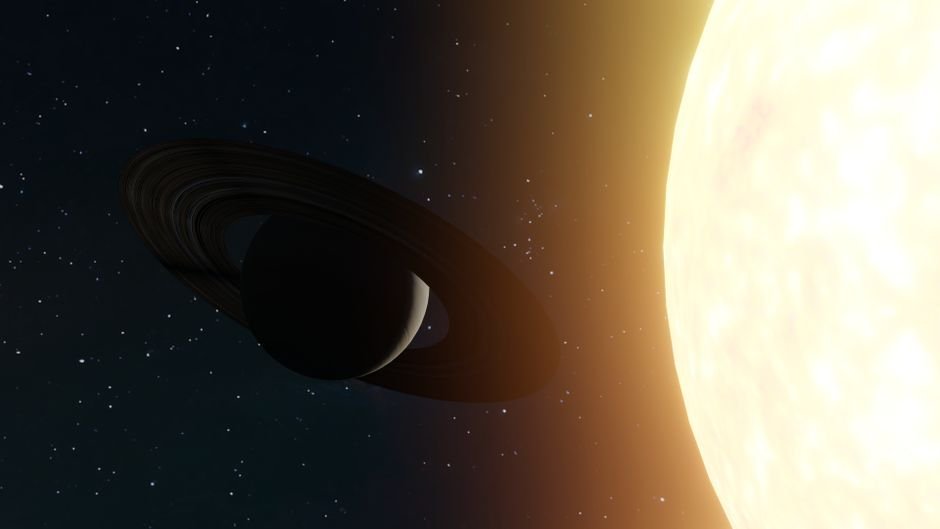
Featured image: [Artist’s impression of a direct exoplanet observation with a coronagraph; credit: NASA/JPL-Caltech]
A new study applies tools from quantum information theory to coronagraph design, showing how spatial mode-sorting can push exoplanet detection to the theoretical quantum limit even for the most challenging observational scenarios.
The paper, led by Yinzi Xin and submitted to Astronomy & Astrophysics on July 2, 2026, addresses a fundamental limitation of conventional coronagraphs: they struggle to reach the theoretical detection limit for exoplanets at close angular separations from their host stars. This problem becomes more severe when the telescope has a segmented or obstructed aperture, or when the star is partially resolved as a finite disk rather than a point source.
The quantum approach. The team used density matrix formalism from quantum information theory to calculate the optimal measurement for detecting an exoplanet. The density matrix encodes the full quantum state of the optical field arriving at the telescope, including both the starlight leakage and the planet signal. From this, the optimal spatial mode for nulling the starlight can be derived.
A key finding is that the spatial mode which maximizes the classical signal-to-noise ratio is approximately quantum-optimal to leading order in two critical parameters: stellar leakage and the planet-to-star flux ratio. This means that existing mode-sorting coronagraph designs are close to the fundamental performance limit, but can still be refined using the new framework.
Three real-world applications. The authors present optimized coronagraph designs for three specific cases of scientific interest:
The first is an extension of the fiber nuller architecture, optimized for detecting and spectrally characterizing planets across an arbitrary field of view using high-resolution spectroscopy. Fiber nullers suppress starlight by injecting it into a fiber that filters out the on-axis stellar mode, but the optimal configuration depends on the planet’s position and the star’s angular size.
The second application supports the Habitable Worlds Observatory, NASA’s proposed flagship mission for direct imaging of Earth-like planets. The quantum-optimal modes enable HWO to follow up its visible-light detections at more challenging infrared wavelengths, where thermal background and smaller planet-to-star contrast ratios make detection significantly harder.
The third targets the Planetary Camera and Spectrograph on the Extremely Large Telescope (ELT-PCS), a ground-based instrument designed to detect and localize planets at very close working angles. At these small separations near the diffraction limit, conventional coronagraphs perform poorly, and the quantum-optimal nulling modes offer the greatest improvement.
Broader implications. The work provides a general framework for calculating optimal coronagraph configurations that accounts for realistic telescope imperfections, finite stellar size, and the need to detect multiple planets with a single instrument. The authors characterize the inherent tradeoffs when a coronagraph targets more than one planet location, showing that optimizing for a single position degrades performance elsewhere.
This unified approach could influence the design of next-generation exoplanet instruments across both space-based and ground-based observatories. By establishing the quantum detection limit as a benchmark, the framework gives instrument designers a clear target to aim for rather than relying on incremental empirical improvements.
The paper is currently under review at Astronomy & Astrophysics and is available on arXiv under reference 2607.02065.