

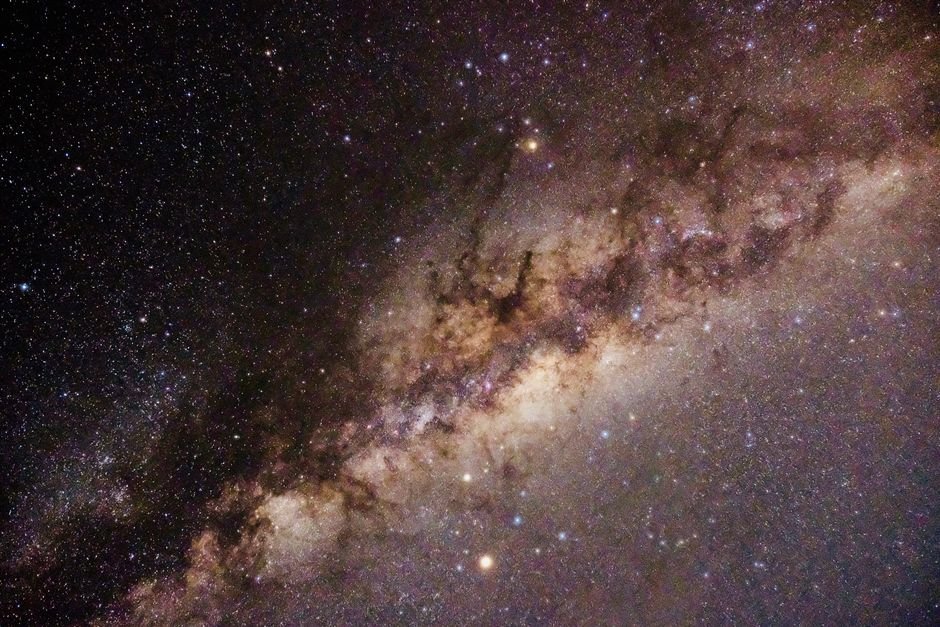
On July 4, 1776, when the Declaration of Independence was signed, the known universe was small. Five planets were recognized (Mercury, Venus, Mars, Jupiter, Saturn). The heliocentric model was settled. The Milky Way was a diffuse ribbon across the sky. And for all anyone knew, that ribbon was the entire cosmos.
Two hundred and fifty years later, we know that our galaxy is one of trillions, that the universe has been expanding for 13.8 billion years, and that 95 percent of its content is invisible, dark matter and dark energy that we are only beginning to understand. The journey from the first view to the current one is a story of four conceptual revolutions, each one led or heavily shaped by American science.
The Sun: from coal to fusion
In 1863, Scientific American published an article debunking a remarkably persistent idea: that the Sun was a burning lump of coal. The numbers made the notion absurd, if it were coal, the Sun would last only 5,000 years at its observed rate of energy output. The magazine estimated the Sun’s lifetime at 100 to 400 million years, still short, but a step in the right direction.
The real answer came in 1920, when Arthur Eddington suggested that stars are powered by nuclear fusion, converting hydrogen to helium. In 1938, Hans Bethe worked out the proton-proton chain and the CNO cycle, the actual mechanisms. The Sun was not burning; it was fusing. That fusion would give it a lifetime not of millions of years, but of billions.
The ether: a null result that changed everything
In July 1887, in a basement in Cleveland, Ohio, Albert Michelson and Edward Morley conducted an experiment that became “the most important null result in science.” They built an interferometer to measure differences in the speed of light depending on the direction of Earth’s motion through the hypothesized “luminiferous ether”, an invisible medium thought to fill all of space.
They found no difference at all. The ether did not exist.
The null result cleared the path for Einstein’s special relativity in 1905 and general relativity in 1915, which replaced the ether with a radically new conception of space, time, and gravity. The Michelson-Morley experiment, conceived and executed on American soil, was the experimental foundation upon which modern physics was built.
The Milky Way and beyond
In 1785, William Herschel mapped the Milky Way and concluded it was disk-shaped with the solar system at its center. In 1918, Harlow Shapley used observations of globular clusters to show that the solar system was not at the center at all, it was roughly 27,000 light-years out, a demotion even more profound than Copernicus’s.
But the most dramatic expansion of the known universe came in 1923, when Edwin Hubble, using the 100-inch Hooker telescope at Mount Wilson Observatory in California, imaged the Andromeda Nebula and resolved individual stars, including Cepheid variables that allowed him to calculate its distance. Andromeda was at least one million light-years away (later refined to 2.5 million), far beyond the Milky Way’s boundaries. It was a separate galaxy.
The universe had just grown by an unimaginable factor. Everything beyond the Milky Way, every nebula, every fuzzy patch of light, was now understood to be another island of stars.
From expansion to acceleration
In 1929, Hubble made another discovery: galaxies were moving away from us, and the farther they were, the faster they receded. The universe was expanding. Einstein, who had introduced a “cosmological constant” to keep his model of the universe static, called it his biggest blunder.
For 70 years, cosmologists assumed the expansion was slowing down under the pull of gravity. In 1998, two international teams, both led by American scientists (Saul Perlmutter, Adam Riess, and Robert Kirshner), independently discovered the opposite: the expansion was accelerating. Something was pushing galaxies apart. That unknown something was named dark energy.
Today, dark energy and dark matter together account for 95 percent of the content of the universe. We know of their existence through gravitational effects, but we do not know what they are.
The next 250 years
What will the view be in 2126, at America’s 500th anniversary? The Hubble Space Telescope, the James Webb Space Telescope, and the upcoming Nancy Grace Roman Space Telescope are expected to push further into the nature of dark matter and dark energy. If the pattern of the past 250 years holds, the answer will be humbling: the universe is even stranger than we think.
Sources
- Lea R. “Space science has come a long way since July 4, 1776. Here’s a look back at the saga.” Space.com, July 4, 2026. https://www.space.com/astronomy/space-science-has-come-a-long-way-since-july-4-1776-heres-a-look-back-at-the-saga