

MAUNAKEA, Hawaii, Astronomers using the W. M. Keck Observatory on Maunakea, Hawaii Island, have discovered the third known galaxy that appears to contain no dark matter, deepening the mystery of how such objects form and bolstering the case for dark matter as a real physical substance.
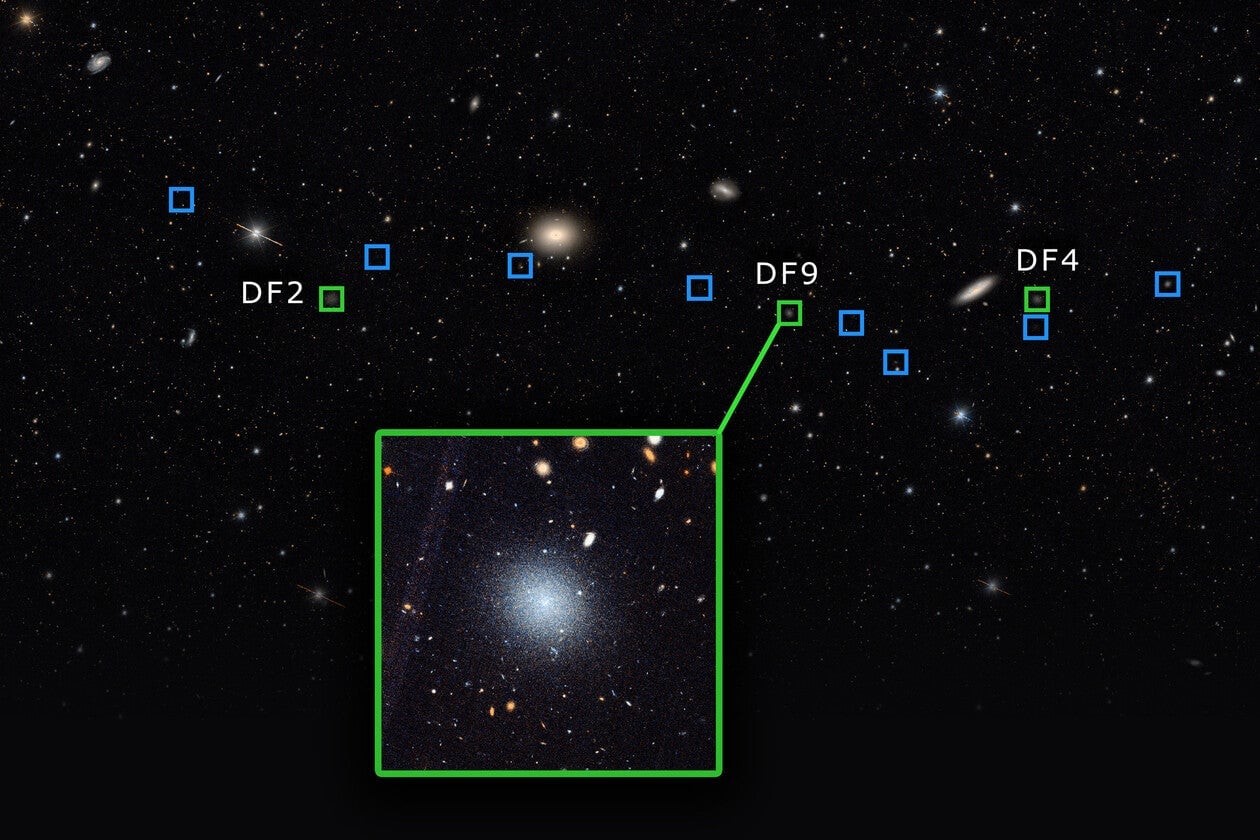
The galaxy, designated DF9, is a faint dwarf galaxy located approximately 45 million light-years (14 megaparsecs) from Earth. It belongs to a remarkable linear structure of seven galaxies that may have formed during a single violent collision between larger galaxies. Such a lineup of dark-matter-free galaxies has never been seen before.
“This line of galaxies lacking dark matter has never been seen before,” said Michael Keim, a PhD candidate at Yale University and lead author of the study published June 16 in The Astrophysical Journal. “The discovery provides some of the strongest evidence yet that these galaxies formed through an extreme and previously unseen process and offers a rare new window into the nature of dark matter itself.”
DF9 joins DF2 and DF4 as the only known galaxies whose mass comes entirely from visible matter: stars, gas, and dust. Using the Keck Cosmic Web Imager (KCWI), Keim and his team measured the motions of stars within DF9 to calculate its mass. They found it to be about 100 million solar masses, entirely consistent with the amount of visible material present. A normal galaxy of similar size would be expected to have roughly 100 times more mass due to dark matter.
“KCWI’s exceptionally high precision enabled us to measure DF9’s extraordinarily low mass with the accuracy needed to demonstrate its lack of dark matter,” Keim said.
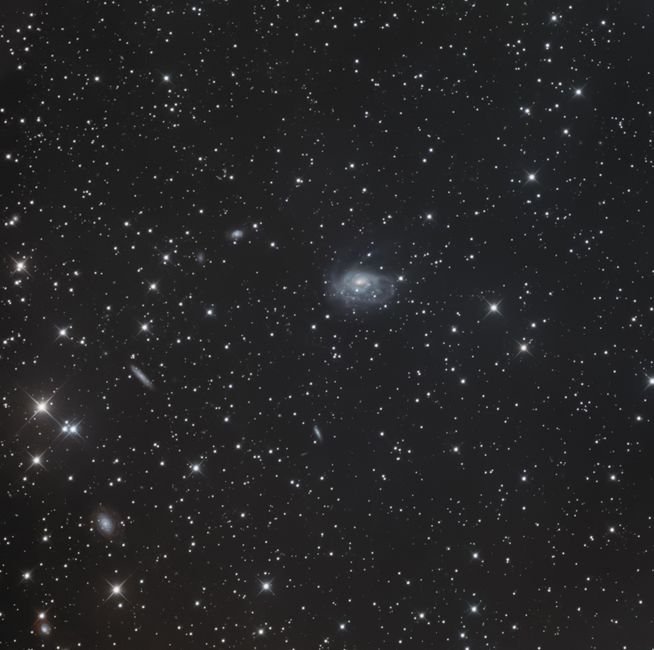
The three galaxies share a common thread. All were discovered in the same region of sky near the NGC 1052 galaxy group, and DF2 and DF4 were previously studied by Yale professor Pieter van Dokkum using the Hubble Space Telescope. DF9 was initially misclassified as a possible black hole before Keim reidentified it as a faint dwarf galaxy.
The findings carry significant implications for two major debates in cosmology. First, they challenge the standard model of galaxy formation, which holds that all galaxies form within massive halos of dark matter. The existence of galaxies without dark matter suggests a different formation mechanism may be at work, possibly a high-speed galactic collision that stripped star-forming gas clouds away from their dark matter halos.
Second, the discovery strengthens the case that dark matter is a real physical substance rather than a manifestation of modified gravity theories. Modified gravity theories have been most vigorously debated at the scale of dwarf galaxies, where these observations carry the most weight.
“The finding provides compelling evidence that dark matter behaves as a physical substance rather than the effect of an alternative theory of gravity, particularly at the dwarf-galaxy scale where those theories are most heavily debated,” van Dokkum said.
The team is now conducting follow-up observations with the Mothra telescope, co-founded by van Dokkum, and other observatories. Their goal is to detect any leftover gas in the region, which would help confirm that the dark-matter-free galaxies formed from a cataclysmic collision.
If confirmed, the linear structure of seven galaxies would represent an entirely new class of cosmic object: a trail of galaxies born from a single violent event, each lacking the dark matter that pervades the rest of the universe.