

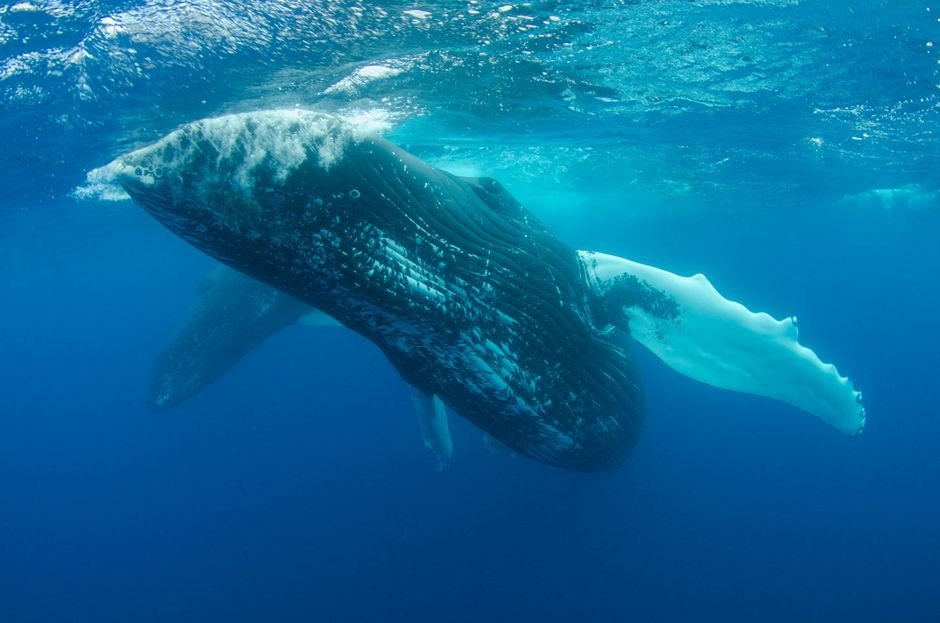
Whales spend most of their time not making a sound. Vocalization-based tracking, the standard tool for studying cetacean movement and behavior, leaves a blind window covering the majority of their lives. A new study from the Norwegian University of Science and Technology has found a way to fill that gap, using a network of sensors already lying on the seafloor: undersea fiber-optic telecommunications cables.
The study, led by Robin André Rørstadbotnen and Martin Landrø at NTNU’s Centre for Geophysical Forecasting and published in PNAS on June 23, demonstrates that distributed acoustic sensing (DAS) on a commercial submarine cable off the coast of Svalbard in the Arctic can detect silent blue whales by the hydrodynamic pressure fields generated by their swimming bodies.
How DAS works, and how they extended it
Distributed acoustic sensing works by firing coherent laser pulses down an optical fiber. Microscopic impurities in the glass cause a small fraction of the light to reflect back toward the source, Rayleigh backscattering. When an acoustic wave or pressure fluctuation strains the fiber, the phase of the backscattered light shifts in proportion to the strain. Because the speed of light in the fiber is known precisely, the interrogator can localize the disturbance to within approximately 10 meters along cables 50 kilometers or longer. The entire cable becomes thousands of virtual strain sensors.
DAS has been used for earthquake detection, pipeline monitoring, and acoustic whale tracking, but standard DAS records frequencies in the acoustic range, the sound waves that whales produce when they vocalize. Rørstadbotnen and Landrø pushed the technique into the ultralow-frequency regime of 0.01 to 0.1 hertz, where the signal is not acoustic but hydrodynamic: the physical displacement of water created by a moving body.
When a whale swims, its body pushes water aside, generating a pressure and velocity field around it. This is the same kind of signal produced by a ship moving through water, though approximately 100 times smaller at comparable distances. The NTNU team adapted a model originally published by Rayleigh in 1917 describing cavity collapse in incompressible flow to the case of a translating source, the swimming whale. The strain-rate amplitude when the source is directly above the fiber is proportional to the inverse cube of the source depth, limiting the detection range to approximately 40 meters for whales compared to roughly 550 meters for large ships.
Real ocean demonstration
This was not a tank experiment. The team used a live seabed telecom cable off Svalbard, real Arctic infrastructure, data gathered for other purposes and re-analyzed. They identified 13 low-frequency hydrodynamic events from blue whales that were not vocalizing at the time, cross-referencing the signals against vocalization spectrograms (blue whale downsweeps from 60 to 20 hertz) to confirm the species identity.
Ship movements were validated against Automatic Identification System data and used as calibration targets for the pressure field model. The signals decayed as the inverse cube of distance, matching the theoretical prediction.
What this enables
The main advantage is coverage. Whales that do not vocalize, or that vocalize in frequency bands above standard DAS recording ranges, as many toothed whales do, are invisible to conventional acoustic monitoring. Hydrodynamic detection works regardless of whether the animal is making noise. The method is also scalable: the global network of submarine telecom cables already on the seafloor could, in principle, be repurposed for passive marine mammal monitoring.
The approach also has potential applications beyond whale detection. The same ultralow-frequency sensitivity could be used to monitor ocean currents, internal waves, and other hydrodynamic features that conventional oceanographic sensors cannot resolve at cable-network scale.
Source: Rørstadbotnen RA, Landrø M. Detection of silent whales using distributed acoustic sensing on submarine fiber-optic cables. PNAS. 2026;123(26):e2603077123. doi:10.1073/pnas.2603077123