

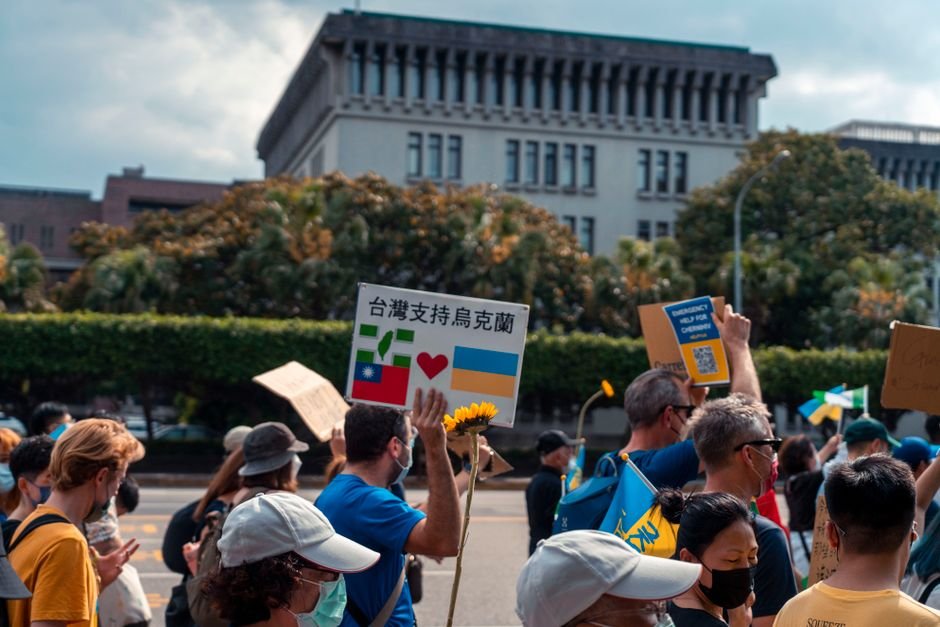
Beijing’s thought police arrive in Taiwan today. Starting July 1, the Chinese Communist Party’s new Ethnic Unity and Progress Promotion Law makes Taiwanese identity a crime.
The law, passed by the National People’s Congress in March 2026, took effect this morning. Article 21 mandates that the CCP “strengthen the sense of belonging, identification, and honor of Taiwan compatriots toward the Chinese nation.” It includes a reporting mechanism under which any individual can be reported and prosecuted. A Taiwanese person who does not identify as Chinese is, under the law’s terms, committing a crime subject to criminal liability.
As Kolas Yotaka, a former spokesperson for Taiwan’s Presidential Office, writes in The Diplomat: “The law set to take effect on July 1 establishes something like a thought-police system, an invisible identity camp.”
The numbers tell you why Beijing needed a law to do what propaganda could not. According to polling by National Chengchi University’s Election Study Center, roughly two-thirds of Taiwan’s population identify primarily as Taiwanese. Fewer than 3 percent primarily see themselves as Chinese. Among younger Taiwanese aged 18 to 34, more than 80 percent identify as primarily Taiwanese and just one percent as primarily Chinese. These figures have held steady for years and show no sign of reversing.
Taiwan’s 23 million people are not a monolith. Roughly 600,000 are indigenous Polynesian peoples with languages and cultures entirely distinct from China’s Han majority. More than a million are new residents from Vietnam, Indonesia, Japan, Hong Kong, Macau, and parts of mainland China. The largest group consists of people whose ancestors migrated from coastal southeastern China roughly 400 years ago and have since developed distinct identities. As Yotaka puts it, their ancestors came from China, but that does not mean they still identify as Chinese any more than Americans whose ancestors came from England still call themselves British.
The law’s definition of “undermining ethnic unity” is deliberately vague. That vagueness is the point. It creates a legal fog in which anyone can be guilty without knowing it. Taiwanese journalists, academics, businesspeople, and public figures who travel to China or Hong Kong must now wonder whether something they said online or in an interview could land them in detention. The law applies extraterritorially through Article 63, which holds organizations and individuals outside China legally liable for acts that “undermine ethnic unity and progress or promote ethnic separatism.”
Taiwan’s Mainland Affairs Council has warned that the law contains “very vague” legal concepts that leave people unable to determine what is safe or risky. The result is self-censorship. That is the design.
This is not a law about ethnic minorities in Xinjiang or Tibet, though it applies to them too. It is specifically about Taiwan. Article 21 is written directly for Taiwanese people. It demands that they identify as Chinese. It makes any other answer a crime.
Beijing’s timing is calculated. Taiwan has been the nation most targeted by foreign disinformation for 10 consecutive years. Research shows that 95 percent of Taiwanese have received disinformation. Trust in politicians has fallen to 68 percent. Trust in media stands at 70.5 percent and is still dropping. The CCP is weaponizing these fractures through a law that formalizes its political objectives, exploiting existing distrust to spread both hatred and Chinese identity narratives from within. As Yotaka writes, “Taiwan’s freedom of expression is being used as a weapon against itself.”
The stakes go beyond Taiwan’s 23 million people. Taiwan produces the bulk of the world’s advanced semiconductors. The global supply chain depends on the stability of an island that Beijing has now declared a crime scene. If this law follows the pattern of Hong Kong, Tibet, and Xinjiang, the next steps are predictable: enforcement escalates, the definition of “undermining ethnic unity” expands, and what starts as a thought crime becomes a detention camp.
The United States under Donald Trump has abandoned the language of democratic values in its approach to Taiwan. Trump has repeatedly criticized Taiwan and questioned the rationale for defending it militarily. Taiwan faces this fight increasingly alone.
What begins today is not a legal reform. It is an identity trap. Beijing has declared that the 95 percent of Taiwanese who do not identify as Chinese are criminals. The only way to comply is to stop being who you are.
- George, 1ban.news