

NASA’s Chandra Reveals ‘Red, White, Blue’ Universe for US 250th Anniversary
Featured image: Composite image showing four cosmic scenes rendered in red, white, and blue.
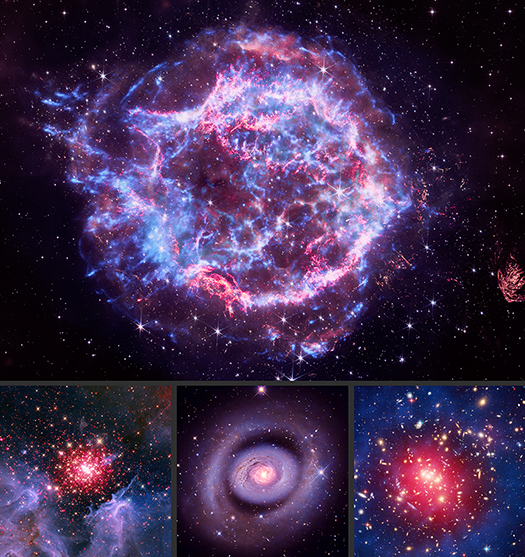
Four views of the universe, Cassiopeia A, NGC 3603, Messier 94, and ZwCl 0024+1652, rendered in red, white, and blue for America’s 250th birthday. Credit: NASA/CXC/SAO/STScI/ESA
NASA’s Chandra X-ray Observatory has released four cosmic images rendered in red, white, and blue to mark the 250th birthday of the United States, along with three new sonifications that translate astronomical data into sound.
The collection, published June 30, 2026, combines data from Chandra, the James Webb Space Telescope, the Hubble Space Telescope, and ground-based observatories to produce patriotic-hued views of supernova remnants, star clusters, galaxies, and dark matter.
“The images represent the wonders of the universe that NASA explores,” the agency said.
Cassiopeia A: A Stellar Blast Wave
The top panel features Cassiopeia A, a supernova remnant approximately 11,000 light-years (3,400 parsecs) from Earth. Chandra’s X-ray data, rendered in blue and purple, reveals the blast wave that tore through the exploded star along with elements in the debris field including iron, calcium, and oxygen. Webb’s infrared data, shown in red and white, captures the expanding shell of material and cosmic dust throughout the remnant. The result has been described as an electrified ring with marbled veins of red and blue.
NGC 3603: Stellar Nursery in the Milky Way
Located in the Milky Way Galaxy, NGC 3603 contains a massive cluster of young stars. The composite image merges Chandra X-ray data (red and white) showing diffuse emissions and point-like X-ray sources with Hubble optical, infrared, and ultraviolet observations (red-orange, green, blue, yellow) that reveal stars, gas, and dust. The nebula appears predominantly in red, white, and blue, with X-rays highlighting the hottest young stars.
Messier 94: Starburst Ring Galaxy
Messier 94 (NGC 4736), a spiral galaxy about 16 million light-years (4.9 megaparsecs) away, displays a bright inner starburst ring where new stars are forming. Chandra X-ray data (red, orange, blue) combines with ground-based visible light (red, green, blue) to reveal this ring, which may be fueled by gas driven inward by the galaxy’s oval bar-like structure. An outer ring of spiral arms is also visible.
ZwCl 0024+1652: Dark Matter Detective
The fourth image depicts ZwCl 0024+1652, a galaxy cluster where Chandra X-ray data (red) reveals a vast reservoir of superheated gas more massive than all the cluster’s galaxies combined. Specially processed Hubble data appears in blue, providing evidence for dark matter through gravitational lensing. Individual galaxies show in yellow and white. The visual centers on a round pool of bright red light surrounded by a royal blue haze.
New Sonifications
Alongside the images, Chandra released three new sonifications for NGC 3603, Messier 94, and ZwCl 0024+1652. These radar-like scans map brightness to volume: brighter areas produce louder sounds. NGC 3603 assigns compact X-ray sources to piano notes and diffuse emissions to a range of audio frequencies, with Hubble data providing sustained tones and acoustic guitar harmonics. Messier 94 maps X-rays to wind-like sounds and compact sources such as neutron stars and black holes to pitched tones on a glass marimba. ZwCl 0024+1652 uses airy synthesizer notes for X-rays at the cluster center, with dark matter mapped to volume peaks.
The sonification team includes visualization scientist Kimberly Arcand (Chandra X-ray Center), astrophysicist Matt Russo, musician Andrew Santaguida (SYSTEM Sounds), and consultant Christine Malec.
Program Management
NASA’s Marshall Space Flight Center in Huntsville, Alabama manages the Chandra program. Science operations are conducted by the Smithsonian Astrophysical Observatory’s Chandra X-ray Center in Cambridge, Massachusetts. Flight operations are based in Burlington, Massachusetts.
Since its launch in 1999, Chandra has provided high-resolution X-ray observations of the universe, complementing the work of Hubble, Webb, and other space telescopes.
Clark – 1ban.news