


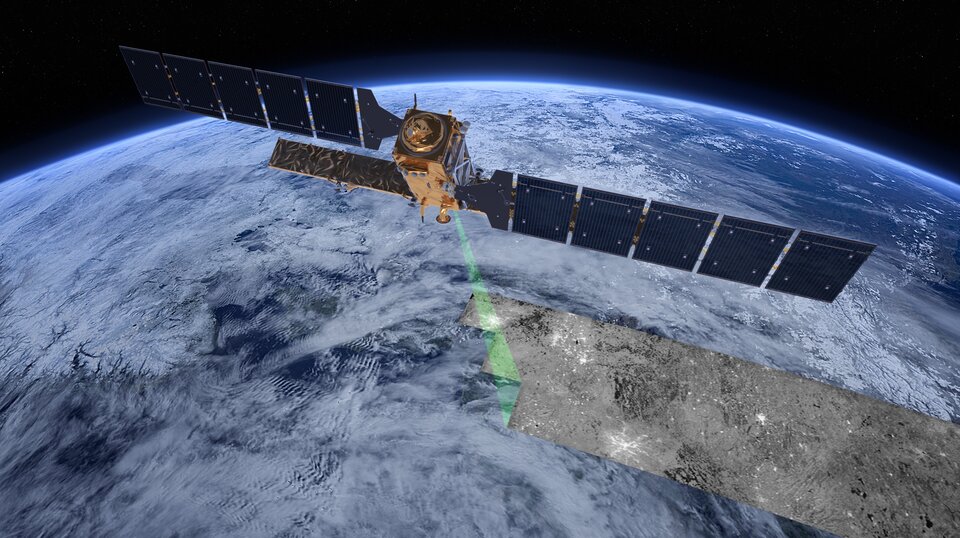
Sentinel-1A paved the way for Europe’s Copernicus Earth observation program. Credit: ESA
The European Space Agency has officially ended operations for Sentinel-1A, the first satellite of the Copernicus program, after more than 12 years of service. The spacecraft’s operational duties ceased on June 29, 2026, nearly double its original 7-year design lifetime.
Launched on April 3, 2014, from Europe’s Spaceport in French Guiana aboard a Soyuz rocket, Sentinel-1A was equipped with a C-band synthetic aperture radar (SAR) that could image Earth’s surface through cloud cover, smoke, and darkness. This all-weather, day-and-night capability made it an indispensable tool for environmental monitoring and disaster response worldwide.
“This satellite opened the Copernicus era,” said ESA’s Director of Earth Observation Programs. “For over a decade, it delivered vital data every day, helping us better understand our planet and respond to some of society’s most pressing challenges.”
Over its mission life, Sentinel-1A tracked Arctic sea ice, monitored glacier movement, detected oil spills, mapped floods, and supported earthquake response efforts. Its data were made freely and openly available, building a massive radar archive that scientists and operational services will use for decades.
The satellite’s longevity proved especially critical after its sister spacecraft, Sentinel-1B, suffered a power-system failure and ended its mission in December 2021. Sentinel-1A shouldered the full responsibility of maintaining Europe’s radar Earth observation capability during the gap years until its successors arrived.
Nuno Miranda, ESA’s Sentinel-1 Mission Manager, said the satellite remained a cutting-edge asset even in its final years. “Despite being the oldest member of the fleet, it is far from obsolete in the new-space era. Sentinel-1A remains at the forefront of Earth observation and continues to play a key role in enabling the application of artificial intelligence in data and services.”
Two of the last radar images Sentinel-1A returned before retirement captured western Iceland and Melbourne, Australia.
In the weeks leading up to the retirement, mission controllers at ESA’s Operations Center in Germany executed complex orbital maneuvers to reconfigure Sentinel-1A, Sentinel-1C, and Sentinel-1D into a three-satellite formation. This ensured a seamless handover of responsibilities. Sentinel-1C (launched December 2024) and Sentinel-1D (launched November 2025) now operate 180 degrees apart in orbit, optimizing global coverage and data delivery.
Both successor satellites carry upgraded C-band SAR instruments and Automatic Identification System (AIS) payloads for maritime ship detection and tracking, offering improved capabilities compared to Sentinel-1A.
ESA teams are now preparing for the disposal phase of Sentinel-1A, which is expected to begin during the northern summer of 2026. The satellite will be deorbited in accordance with space debris mitigation guidelines.
“Sentinel-1A holds a special place for all of us,” Miranda added. “It paved the way for new approaches in both operations and science. After years of outstanding service, Sentinel-1A has earned a well-deserved retirement.”
With Sentinel-1C and Sentinel-1D now fully operational, Europe’s radar eye on Earth remains unbroken. The archive of millions of radar images from Sentinel-1A will continue to inform climate science, maritime security, agriculture, and humanitarian relief for years to come.