

Published: June 04, 2026, 04:33 UTC
First Sugar Ever Found in Interstellar Space — A Four-Carbon Molecule That Could Rewrite the Origin of Life
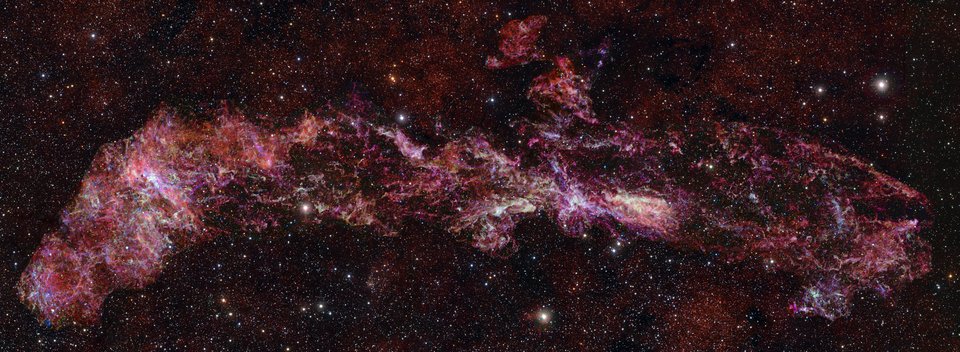
The Galactic Center molecular cloud G+0.693-0.027, where erythrulose was detected, imaged by the IRAM 30m telescope. Credit: IRAM / Jimenez-Serra et al.
Astronomers have detected a four-carbon sugar in interstellar space for the first time — a discovery that fills a critical missing link in the chain of molecules that may have seeded the early Earth with the building blocks of life.
The molecule, a ketose sugar called erythrulose (C₄H₈O₄) , was identified in the molecular cloud G+0.693-0.027 near the center of the Milky Way, approximately 8,200 parsecs from Earth. The detection was made using the Yebes 40m telescope in Spain and the IRAM 30m telescope in the Spanish Sierra Nevada, as part of an ultrasensitive broadband spectral survey of the Galactic Center region.
While sugars — including ribose, glucose, and other monosaccharides — had previously been found in asteroids and meteorites that fell to Earth, no sugar had ever been directly observed in the interstellar medium itself. This made it impossible to determine whether these prebiotic molecules formed in space before being incorporated into planetesimals, or if they formed later within the parent bodies of meteorites.
“This is the first detection of any sugar in the interstellar medium,” the team, led by Izaskun Jimenez-Serra of the Centro de Astrobiología (CAB) in Spain, reports in a paper submitted to *Nature Astronomy*. “It demonstrates that complex organic sugars can form in space and become available to nascent planetary systems.”
A Cosmic Sugar Factory
Erythrulose belongs to the tetrose family — four-carbon sugars — and is a chiral molecule, meaning it has a handedness that could have played a role in the development of biological homochirality on Earth. The molecule was identified through rotational spectroscopy, matching laboratory spectra against hundreds of thousands of spectral lines collected toward the Galactic Center cloud.
The detection was remarkably clear: the astronomers identified five unblended rotational transitions of erythrulose in both its lowest-energy conformer, with signal-to-noise ratios exceeding 5σ. Crucially, the molecule is at least eight times more abundant than analogous three-carbon sugars (aldoses), which remain undetected even in the same ultrasensitive observations — suggesting that carbon-chain length plays a significant role in interstellar sugar formation efficiency.
Quantum chemical and astrochemical modeling indicates that erythrulose forms efficiently on the surfaces of interstellar dust grains from simpler precursors: two-carbon aldehydes and alcohols that are already known to be abundant in molecular clouds. This grain-surface chemistry pathway may be the dominant mechanism for building complex organic molecules in space.
From Interstellar Dust to Primordial Soup
The significance of the discovery extends well beyond astrochemistry. Ketoses like erythrulose can readily isomerize into aldoses under aqueous conditions — meaning that if erythrulose-rich dust grains were incorporated into asteroids and comets during solar system formation, and later delivered to the early Earth via impacts, they could have contributed directly to the sugar inventory available for early metabolic and replication processes.
This is precisely the kind of exogenous delivery that origin-of-life researchers have long hypothesized. Laboratory experiments attempting to synthesize sugars under simulated prebiotic Earth conditions have struggled to produce sufficient concentrations of monosaccharides — a long-standing puzzle known as the “formose problem.” The new detection offers a potential solution: the sugar stockpile may have been manufactured in space and delivered ready-made.
“These results show that the interstellar medium contains the essential molecular feedstock for life,” the authors write. “The detection of erythrulose expands the inventory of prebiotic molecules found in star-forming regions and supports the idea that key biomolecular building blocks are widespread throughout the galaxy.”
What’s Next
The findings set the stage for a systematic search for even larger sugars — pentoses (five-carbon) and hexoses (six-carbon), including ribose, the backbone sugar of RNA, and glucose, the universal cellular fuel. The same team is already planning deeper observations with the Yebes 40m and IRAM 30m telescopes, as well as targeted searches with the NOEMA interferometer, which can resolve spatial distributions of molecules across molecular cloud structures.
The detection also underscores the growing power of broadband radio astronomy: by collecting complete spectral surveys across centimeter and millimeter wavelengths, astronomers can simultaneously search for dozens of molecules — building a chemical inventory of the galaxy one species at a time.
The paper, “Detection of a four-carbon sugar in interstellar space,” is authored by an international team from research institutions in Spain, the Netherlands, Japan, Germany, Chile, and the United States.