

Scientists Confirm Two Long Gamma-Ray Bursts Came from Collapsing Neutron Stars
A team of researchers at Los Alamos National Laboratory has confirmed that two unusual long-duration gamma-ray bursts, GRB 211211A and GRB 230307A, were produced by the collapse of neutron stars into black holes. The findings, published in The Astrophysical Journal Letters, provide the most detailed confirmation yet of a mechanism that has long been theorized but difficult to prove.
Gamma-ray bursts are divided into two broad classes based on duration. Short bursts, lasting less than two seconds, are associated with the merger of two neutron stars or a neutron star and a black hole. Long bursts, lasting more than two seconds, are linked to the collapse of massive stars, a process called a collapsar. But GRB 211211A, detected in 2021, and GRB 230307A, detected in 2023, blurred this tidy classification. Both were long-duration bursts, yet their afterglows showed signatures that looked like kilonovae, the explosive events traditionally linked to neutron star mergers.
This ambiguity left astrophysicists with two possibilities: either the traditional classification was wrong, and neutron star mergers could produce long bursts, or the collapsar model was more versatile than previously understood.
Supercomputer simulations settle the question
The Los Alamos team, led by postdoctoral researcher Marko Ristic, turned to the Chicoma supercomputer to model the nucleosynthesis occurring in each scenario. The key diagnostic was the production of heavy elements. Neutron star mergers are known to produce the full range of r-process elements, including the heaviest, such as gold, platinum, and uranium. Collapsars, by contrast, produce only lighter r-process elements.
The simulations showed that the observed kilonova signatures from both GRBs matched the predictions of the collapsar model almost exactly. The element yields lacked the very heavy elements that would be expected from a merger, while matching the lighter r-process pattern characteristic of a collapsar.
“We are confirming that these two long gamma-ray bursts are collapsars, in spite of the fact that they have kilonova emissions that previously made scientists think they could be neutron star mergers,” Ristic said. “GRBs represent some of the most intense and exotic situations in the universe. It is a privilege to use the most powerful computers in the world to simulate them.”
What a collapsar looks like
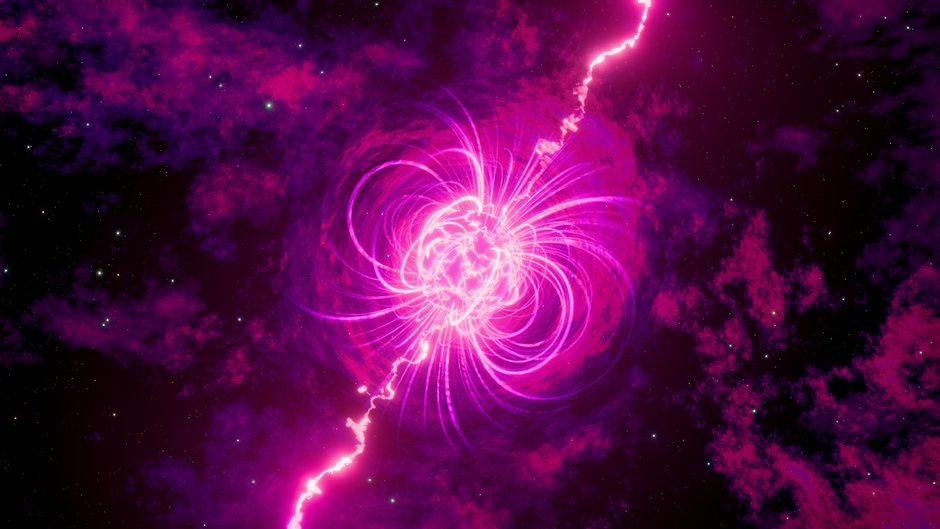
In the collapsar mechanism, a massive, rapidly spinning star exhausts its nuclear fuel and its core collapses. The collapse first produces a neutron star, but continued infall overwhelms the neutron star’s structure and it collapses further into a black hole. The black hole’s spin and the surrounding accretion disk launch relativistic jets that punch through the star’s outer layers, producing the gamma-ray burst.
The key insight from the Los Alamos study is that the collapsar’s jets can produce a kilonova-like signal through the radioactive decay of freshly synthesized elements, without requiring the involvement of merging neutron stars. The ejecta are heated by the decay of isotopes such as nickel-56, producing an optical and infrared transient that resembles a merger kilonova but has a distinct chemical fingerprint.
“The evidence strongly suggests that kilonovae are more varied and difficult to interpret than we thought,” said Matthew Mumpower, a Los Alamos theoretical physicist and co-author on the study. “This means not all kilonova-like emissions are associated with the production of the heaviest elements, like gold.”
Implications for GRB science
The findings preserve the traditional short-merger, long-collapsar classification but with an important nuance: long GRBs can produce kilonova-like signals, and the diversity of kilonova observations is greater than previously understood. Future observations, particularly those combining gravitational wave detectors with electromagnetic telescopes, will be needed to fully disentangle the progenitor populations.
“This work shows that rapid progress requires large-scale computation to confront models with data,” Mumpower said. “These findings will inform future campaigns by LIGO, Virgo, KAGRA and the next generation of gravitational-wave detectors.”
For the two GRBs in question, the collapsar origin is now confirmed. Both events were detected by NASA’s Fermi Gamma-ray Burst Monitor, one of the workhorses of high-energy astrophysics, and followed up by ground-based observatories around the world. The detailed modeling by the Los Alamos team provides the missing link between the observed light and the underlying physics.