

Published: June 03, 2026, 02:41 UTC
In the standard narrative of quantum computing, progress is measured in qubits — the fragile two-level quantum bits that form the basic unit of quantum information. Google has 105. IBM has more than 1,000. Every year brings hardware with more qubits, higher coherence times, and fewer errors.
But a team at the University of Waterloo’s Institute for Quantum Computing has been exploring a fundamentally different approach: instead of adding more physical qubits, they are making each one count for more. In a paper published in Nature Communications, Pei Jiang Low, Nicholas C. F. Zutt, Gaurav A. Tathed, and Crystal Senko demonstrate quantum logic operations and algorithms using a single trapped barium ion encoded with 25 energy levels — a “qudit” (quantum digit) that packs the computational power of roughly 4.6 qubits into a single atom.
Qubits vs. Qudits
A qubit is a two-level quantum system. It can be in state |0⟩, state |1⟩, or any quantum superposition of both. A qudit — short for “quantum digit” — generalizes this: a d-level system with computational basis states |0⟩ through |d−1⟩. The mathematics is the same superposition principle, but with more dimensions to play with.
The payoff is exponential: a single 25-level qudit can encode as much information as log₂(25) ≈ 4.64 qubits. More importantly, certain quantum operations that would require multiple entangled qubits — and the overhead of entangling gates between them — can be implemented directly within a single qudit’s high-dimensional Hilbert space.
The Barium Ion
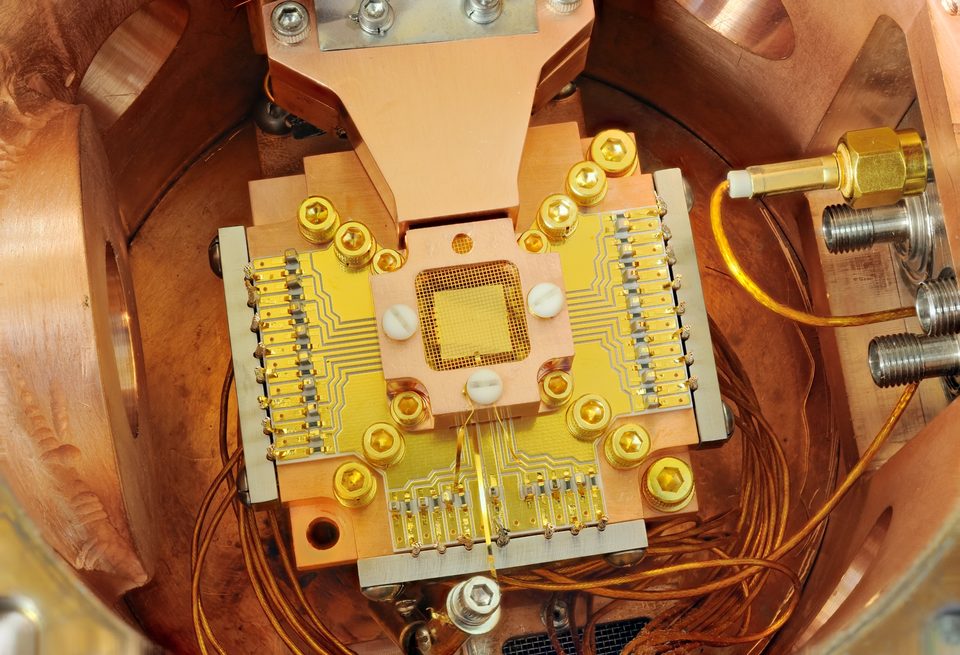
The team chose a ¹³⁷Ba⁺ (barium-137) ion held in a Paul trap — a standard trapped-ion platform cooled and manipulated with lasers. The crucial insight is that ¹³⁷Ba⁺ has a rich internal energy structure thanks to its nuclear spin of I = 3/2, which splits the electronic energy levels into 32 independent Zeeman sublevels within the 6S₁/₂ and 5D₅/₂ orbitals.
The researchers selected 25 of these sublevels to serve as the qudit’s computational basis — the largest qudit dimensionality ever demonstrated in a trapped-ion system. Previous trapped-ion qudits had maxed out at d = 7.
What They Demonstrated
The team achieved three major milestones:
1. State preparation and measurement. They developed laser-based protocols to prepare the ion in any of the 25 basis states with high fidelity, and a fluorescence-based readout scheme that can distinguish all 25 levels in a single shot. This is not trivial — the energy differences between adjacent Zeeman sublevels are tiny, requiring MHz-level frequency precision.
2. Coherent control of multi-level superpositions. Using multi-tone laser pulses, they created and manipulated quantum superpositions involving up to 24 basis states simultaneously — a level of coherent control over a high-dimensional quantum system that pushes the boundaries of what has been achieved in any physical platform.
3. Quantum algorithms. This is where the qudit advantage becomes concrete. They implemented a 3-qubit Bernstein-Vazirani algorithm — a quantum algorithm that determines a hidden binary string in a single query — using a single 25-level qudit. The same algorithm would normally require three entangled qubits, entangling gates, and the associated error overhead. They also demonstrated a 4-qubit Toffoli gate, a fundamental building block for reversible computing, again using a single ion.
Both algorithms ran with fidelities that the team characterized across different qudit dimensions, providing the first systematic study of how gate and measurement errors scale with the number of levels.
Why This Matters
The paper’s significance is not that a 25-level qudit outperforms today’s best quantum processors — it doesn’t, at least not yet. The significance is architectural.
Current quantum computers face a scaling challenge that is as much about engineering as it is about physics. Each additional qubit requires control electronics, wiring, laser routing, and error correction overhead. By encoding more computational power per physical entity, qudits could reduce the hardware complexity needed to run useful algorithms.
Certain quantum algorithms — particularly those involving Fourier transforms, arithmetic operations, and error correction — map naturally onto high-dimensional Hilbert spaces. A qudit-native implementation of these algorithms could be dramatically more efficient than their qubit-based equivalents, even with the same physical hardware.
The error scaling data the team collected is also valuable: understanding how errors grow with dimensionality informs the design of future qudit processors and the error correction codes they will need.
The Road Ahead
This is a proof of principle, not a production system. The experiment used a single ion in a lab setting. Scaling to multiple qudits — and connecting them via entanglement — remains a substantial engineering challenge. Trapped ions can be entangled through their shared motional modes, but the control complexity grows quickly.
Still, the direction is clear. As Senko and colleagues note in their paper, the open-source data and analysis scripts they have published on GitHub (github.com/senkolab/QuantumLogic_25Level_Qudit) are intended to help the broader quantum computing community explore the qudit paradigm. The question is no longer whether qudits are possible — it is what algorithms and architectures can best exploit them.
Source: Low PJ, Zutt NCF, Tathed GA, Senko C. Quantum logic operations and algorithms in a single 25-level atomic qudit. Nature Communications. 2026. DOI: 10.1038/s41467-026-72662-8. arXiv: 2507.15799. University of Waterloo, Institute for Quantum Computing, Waterloo, Ontario, Canada.