

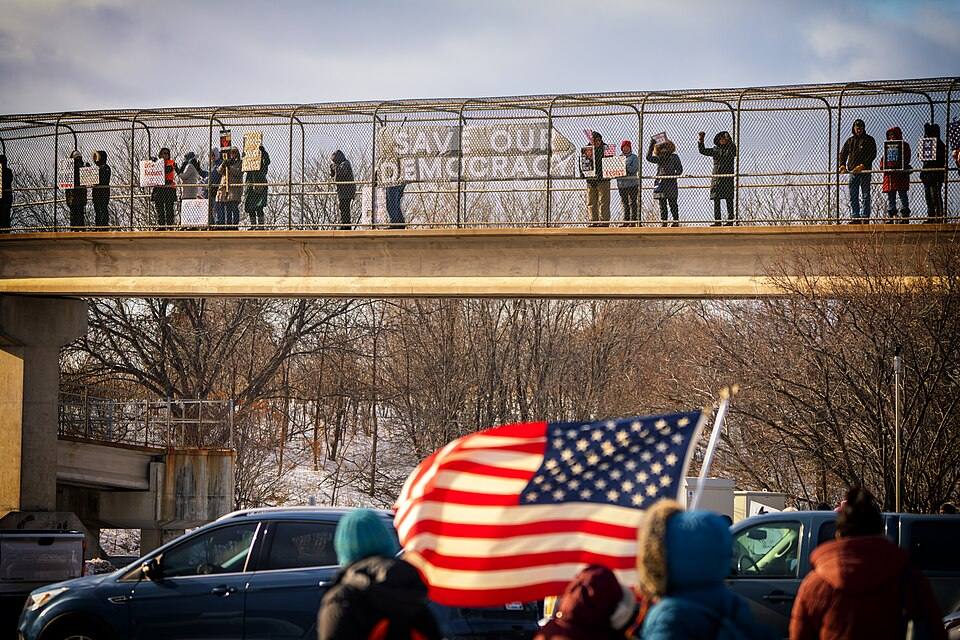
When thousands of immigration agents flooded Minnesota earlier this year under Operation Metro Surge, a loose network of neighbors sprang into action. They tracked the movements of federal officers. They fed each other. They got children to school safely, navigating streets where deportation raids had become routine. The crackdown killed two local residents and deported many hundreds more. Now those same organizers are shifting their focus. The target is not ICE. It is November.
The group Monarca, a project of the Minnesota organizing network Unidos MN, has launched what it calls democracy defense trainings. The premise is simple: the infrastructure built to monitor immigration enforcement can be repurposed to protect the ballot box. Organizers are going door to door not to warn about raids but to ensure that every neighbor can vote and that those votes will be counted when the results are challenged.
David Brauer helped lead one of the first training sessions. He put it plainly. “We’ve got to make sure that everybody who wants to vote can vote, and everybody’s vote is counted, and those votes and the will of the majority is respected,” he said. “Basic stuff, but so crucial right now. But that’s just the first step. Once they’re cast, we know we’ll have to defend them.”
The training sessions take place in church basements and community centers. Attendees find their seats by tables labeled with their voting precincts. The setting is familiar to anyone who attended the earlier ICE monitoring workshops. The faces are the same. The urgency is higher.
Jess, a former federal worker who was fired during the Department of Government Efficiency purge and uses only a first name for fear of retaliation, helped train about 2,500 people on constitutional observation during the immigration crackdown. She described the mood among the organizers now. “There is a general, very visceral concern that this administration is planning to ensure that the elections go their way by any means necessary,” she said.
That concern is not abstract. The Trump administration has already demonstrated its willingness to use federal power against political opponents. Federal prosecutors have opened criminal investigations into Minnesota Governor Tim Walz and Minneapolis Mayor Jacob Frey. The president has publicly stated that California’s previous election results would be investigated, an effort widely understood as an attempt to undermine the legitimacy of outcomes the administration did not prefer.
Public trust in the electoral process has been eroding for years, but the shift from rhetoric to action has changed the calculation for organizers on the ground. What was once theoretical is now operational. Among those who attended the Monarca trainings, the working assumption is that the same federal apparatus deployed for immigration enforcement will be available for election interference if the administration decides to use it.
The overlap between the two efforts is not accidental. The same phone trees used to alert neighborhoods about ICE raids are being retooled to coordinate poll monitoring and rapid response. The same volunteer logistics that delivered meals during the surge are being reorganized to get voters to the polls. The organizational memory of the crackdown has become a practical asset.
Defending democracy can feel like a vague exercise until it becomes necessary. For these organizers, necessity has arrived. The November 2026 midterm elections will test whether the same network of neighbors who protected each other from immigration agents can protect the electoral process itself.
The November elections will be the first major national test of this administration’s approach to voting since its return to power. In Minnesota, the organizing infrastructure built in response to Operation Metro Surge has become a potential model for broader democratic defense. Whether that model holds will depend on what happens when the polls close and the challenges begin.
What began as neighbor watching out for neighbor in the face of a federal crackdown has evolved into something larger. The question now is whether that evolution can keep pace with the threats it is designed to meet.