

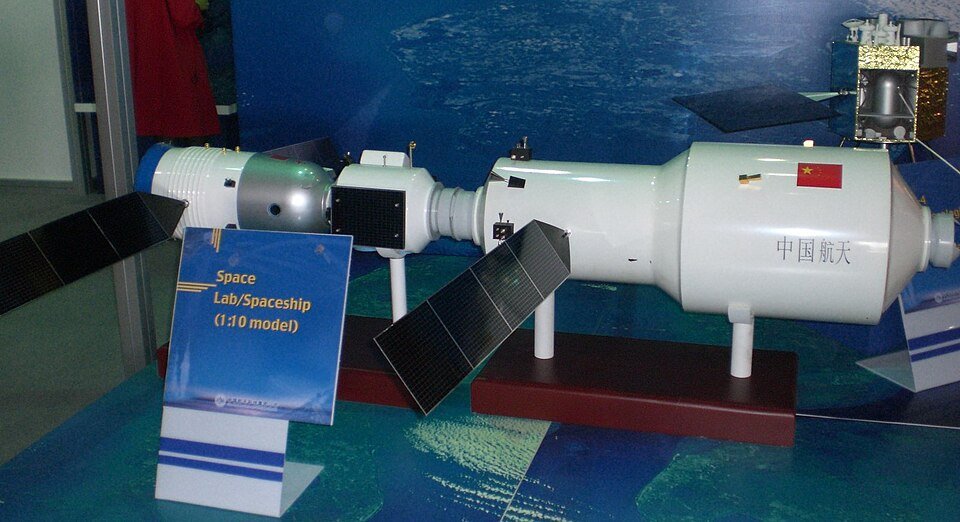
Featured image: Illustration of the expanded Tiangong space station in cross configuration; credit: CMSA
China has formally announced plans to double the size of its Tiangong space station, expanding from three to six modules and adding a co-orbiting Hubble-class telescope, positioning the facility to become the world’s largest permanent outpost in low-Earth orbit as the International Space Station approaches the end of its operational life.
The China Manned Space Agency (CMSA) unveiled the expansion blueprint on June 22, 2026, detailing a two-phase build-out that will transform the station’s current T-shaped configuration into a cross-shaped, 180-metric-ton orbital complex. The existing station, comprising the Tianhe core module launched in April 2021 and the Wentian and Mengtian laboratory modules added in 2022, currently masses approximately 90 metric tons.
The Expansion Plan
The first phase involves launching a 20-ton multifunctional module equipped with six docking ports, which will attach to Tianhe’s forward port and convert the station’s T-shape into a cross configuration. This expansion hub will provide additional berthing locations for two new laboratory modules in the second phase.
Zhang Qiao of the China Academy of Space Technology (CAST) outlined the vision at the 2023 International Astronautical Congress: “We will build a 180-ton, six-module assembly in the future.” The expansion was always part of the station’s original design, according to Qian Hang of the China Aerospace Science and Technology Corporation (CASC).
The new modules will support dedicated research in materials science, life sciences, and fundamental physics. Additional upgrades include inflatable module testing for future lunar habitats, onboard 3D printers, intelligent robotic assistants, enhanced robotic arms, and a digital twin of the station for ground-based simulation. The station will also receive improved space debris detection capabilities.
Xuntian: China’s Hubble-Class Space Telescope
A centerpiece of the expansion is the Xuntian space telescope, a co-orbiting observatory with a 2-meter (79-inch) primary mirror. While slightly smaller than Hubble’s 2.4-meter (94-inch) mirror, Xuntian carries a 2.5-gigapixel camera that provides 300 times the field of view of its American predecessor, enabling wide-area surveys that Hubble could never attempt.
Unlike Hubble, Xuntian will not be mounted on the station. It will co-orbit with Tiangong but maintain a safe distance to avoid vibrations and crew interference. Crucially, it is designed to periodically dock with the station for maintenance, refueling, repairs, and instrument upgrades a capability that significantly extends its operational lifetime.
The telescope’s primary mission is to map approximately 40 percent of the sky, studying dark matter and dark energy, galaxy formation and evolution, exoplanets via a coronagraph instrument, giant molecular clouds, and black hole demographics. Its launch is now scheduled for 2027, delayed from earlier targets of 2024 and 2026.
A Station in Transition
The expansion places Tiangong on a trajectory to become the dominant crewed space station in low-Earth orbit. NASA plans to deorbit the ISS using SpaceX’s US Deorbit Vehicle in late 2030 or early 2031, with a controlled splashdown in the Pacific Ocean. The commercial successors to the ISS remain in early development, with uncertain timelines.
An expanded 180-ton Tiangong would be just over a third of the ISS’s 450-ton mass but would represent the only fully operational modular space station in orbit after the ISS retirement. The station is designed for a 15-year operational life, which could be extended.
Scientific Output and International Collaboration
CMSA reported that Tiangong has already hosted 267 science projects, including 86 new experiments in the past year alone. The station has received approximately 1,179 kilograms (2,598 pounds) of science materials and returned 105 kilograms (231 pounds) of samples to Earth, generating more than 150 terabytes of scientific data.
On the international front, Pakistan has selected its first astronaut for training toward a Tiangong mission, announced in 2025. CMSA has implemented 65 scientific projects through its partnership with the UN Office for Outer Space Affairs (UNOOSA), with 48 projects ongoing and a new call for proposals expected. China is also in discussions with multiple countries for crewed flights, with shorter-duration missions likely for initial international participants.
Broader Ambitions
The space station expansion is part of a wider Chinese space strategy that includes a crewed lunar landing before 2030, the International Lunar Research Station (ILRS) in the 2030s, and a Mars sample return mission. The CMSA envisions Tiangong as a “space home port” a servicing hub for co-orbiting spacecraft, the Xuntian telescope, and future deep-space missions.
China also launched its new-generation Mengzhou crew spacecraft, which can carry up to seven astronauts to low-Earth orbit, with a debut possible later in 2026 aboard the Long March 10 rocket.
As the ISS era draws to a close, Tiangong’s expansion ensures that China will have a permanent, growing presence in low-Earth orbit for at least the next decade and a half.