

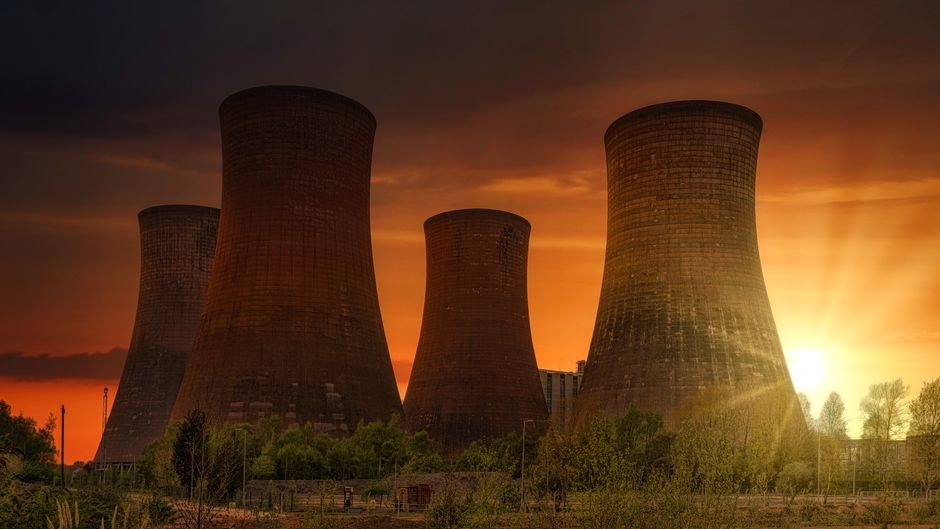
A nuclear reactor that has been switched off does not go silent. The fuel left inside its core and in the cooling pools beside it keeps decaying for months and years, and every decay releases an antineutrino, a particle so reluctant to interact with matter that it slips through steel, concrete, and water without stopping. For the first time, an experiment has counted that residual stream. The Double Chooz collaboration, working at the Chooz B nuclear power plant in the French Ardennes, recorded 106 ± 18 antineutrino events during 17.2 days of observations with both reactors fully shut down, against a prediction of 88 ± 7 events. The 5.9-sigma excess validates a concept first proposed in 1978: that a reactor can be read by the radioactivity it leaves behind, even after it stops running.
The signal exists because fission does not stop cleanly. When a reactor operates, uranium and plutonium nuclei split into fragments, and the fragments are neutron-rich. They stabilize themselves by beta decay, and each beta decay converts a neutron into a proton while emitting an electron antineutrino. Roughly six antineutrinos are produced per fission, which is why a working reactor core is the brightest man-made source of these particles on Earth. But many fission products decay slowly. Isotopes such as cerium-144 and ruthenium-106 survive for months to years after the reactor shuts down, and their decay keeps the antineutrino stream alive at a level below one percent of the operating flux. In the energy window where that residual signal is strongest, between 1 and 3 MeV, the near detector’s antineutrino yield is dominated by just two isotopes: praseodymium-144, which contributes about 54 percent of the events, and rhodium-106, about 38 percent.
Detecting those events required background subtraction. The Double Chooz detector sits underground about 400 meters (1,312 feet) from the two cores and holds more than 30 cubic meters (1,060 cubic feet) of liquid scintillator, a material that emits a flash of light when an antineutrino interacts. The interaction itself is the signature the experiment was built to see: an antineutrino strikes a proton, producing a positron and a neutron, and the two particles create a characteristic delayed pair of flashes. In the 17.2 days of reactor-off data, the near detector recorded 517 candidate events in the 1 to 9 MeV range, or 30.0 ± 1.4 per day. But the overwhelming majority were background: muons raining down from cosmic rays, neutrons knocked loose by those muons, and the short-lived isotope lithium-9 created when muons shatter carbon nuclei. After subtracting all of it, a residual of 6.2 ± 1.1 events per day remained in the 1 to 3 MeV window, against an expected 5.1 ± 0.4. Above 3 MeV the excess vanishes, matching the prediction that the high-energy tail of the residual spectrum is below the experiment’s sensitivity.
The experiment’s geometry gave it an advantage no previous reactor experiment enjoyed. Daya Bay and RENO, the other large antineutrino observatories, sit next to reactor complexes where the units never shut down simultaneously, so an off-state measurement was impossible. Chooz B has two cores, and in 2017 both were switched off at once for four periods totaling 24.4 days. That coincidence let the collaboration measure the residual signal in situ rather than estimating it from operating-period data. The far detector, at 1.05 kilometers (0.65 miles), saw a smaller excess of 27 ± 13 events against 14 ± 1 predicted, consistent with the weaker flux at greater distance. The two detectors’ agreement with simulations built from the exact fuel inventory, burnup history, and fission-product decay chain is what turns the measurement from a curiosity into a validation.
The practical implications reach into nuclear safeguards, the international system for verifying that fissile material is not diverted. Neutrino-based monitoring has been discussed since the 1980s, when Soviet researchers tested the idea at the ROVNO power station, but it was always limited to operating reactors. This result extends the technique into shutdown periods, the maintenance windows when fuel is moved between cores and pools and when material could, in principle, be handled. A detector outside the plant fence could confirm that a reactor is genuinely off, track whether spent fuel has been moved, and estimate how long a given assembly has been cooling, because the ratio of cerium-144 to ruthenium-106 decay products shifts with time. The Chinese JUNO-TAO experiment has already begun exploring the same reactor-off window, using its data to isolate the spent-fuel signal.
The uncertainty is dominated by statistics: the measured 106 events versus the predicted 88 are consistent within error, so the experiment confirms the models but does not yet refine them. The background model, built from muon-tagging and in-situ measurements of accidental coincidences, carries its own assumptions. The detector at Chooz was a physics instrument, not a safeguards tool: a practical monitoring system would need to be smaller, cheaper, and remotely operated. What the collaboration has established is narrower and solid: the residual antineutrino glow of a shut-down reactor is real, it matches the decay inventory of the fuel left behind, and it can be counted from hundreds of meters (hundreds of yards) away. A reactor that goes dark still tells you, particle by particle, what it was and what it left.
Sources:
- Double Chooz Collaboration (Abrahão, T. et al.). “First Measurement of Neutrino Emissions from Spent Nuclear Fuel by the Double Chooz Experiment.” Physical Review Letters 137, 061803 (2026). DOI: 10.1103/dr26-j19g. Preprint: arXiv:2510.04869.
- Max Planck Institute for Nuclear Physics (MPIK) press release, “First measurement of antineutrinos from spent nuclear fuel,” August 4, 2026.
- ScienceDaily, “Scientists Detect a Nuclear Reactor’s Ghostly Afterglow for the First Time,” August 14, 2026.
- Chen, S. “Detecting the Illicit Removal of Nuclear Fuel.” Physics 19, s94 (2026).