

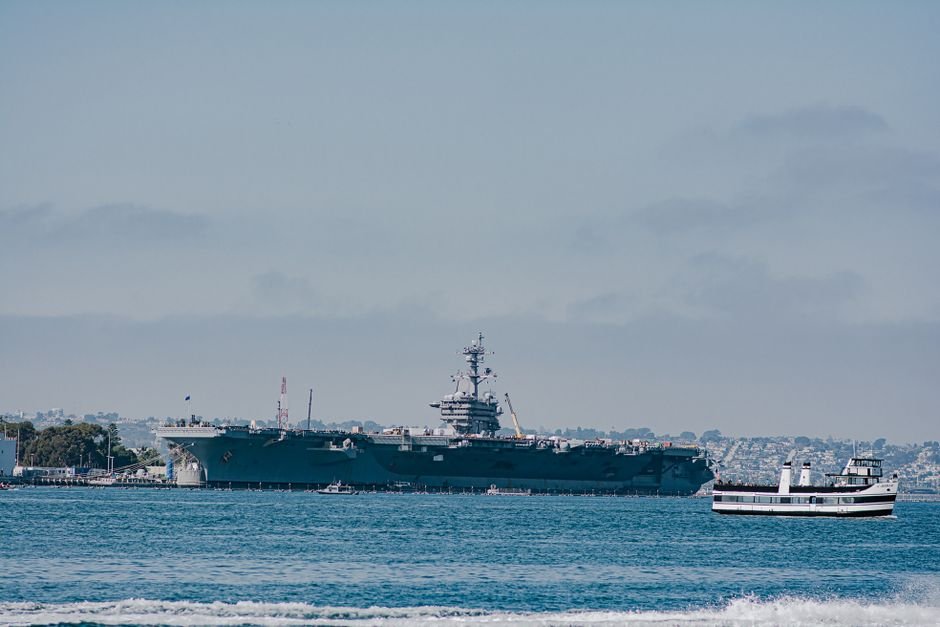
The USS George Washington is on its way to the Middle East because of a number: 241. That is how many consecutive days the USS Abraham Lincoln has now spent at sea, the longest such stretch in the modern history of the American carrier fleet. The record was set in a war, it was set by default, and nobody in the Navy asked for it.
The Abraham Lincoln left San Diego on November 21, reached the area in January, and has not touched port since December 11, when it stopped at Guam. It has been in the Arabian Sea since January, supporting the war against Iran that began on February 28. Its deployment was supposed to end in May, but the war did not end, so the ship stayed. Now it has broken the record set by the USS Dwight D. Eisenhower in 2020, 206 days at sea, a mark set during the pandemic. The new one was set in combat.
The George Washington, based in Japan and on its first patrol of the year, left Da Nang in Vietnam last week, escorted by a cruiser and a destroyer, crossed the Singapore Strait, and by Thursday was confirmed in the Strait of Malacca, making for the Indian Ocean and then the Arabian Sea. The Wall Street Journal first reported that the Washington would take the Lincoln’s place. The question is what the Lincoln’s crew looks like when the replacement finally arrives.
The reports from the ship are not about combat. They are about food, water, hygiene, and mail. Families told Navy leadership they were worried about mental health care, dwindling supplies, and contaminated water. The Navy conceded that the war made the region’s usual supply hubs unusable, which led to shortages and lost mail. It also said leadership prioritized mission-critical supplies, first food, then hygiene items, then mail. That official statement of priorities says everything about what 241 days at sea in a war zone means. Food came first, then soap, then letters from home. Mail was last.
The Navy now says conditions have improved, that sailors have clean water, working air conditioning, and healthy meal options, and that the command has not identified an increase in suicidal ideation or attempts. Those assurances came after a tense town hall on August 6, in which Hung Cao, the acting Navy secretary, sat down with the service’s top air and surface commanders and faced families of the crew, vowing to do whatever it took to get the carrier home.
The families’ anger has reached Congress. Senator Richard Blumenthal of Connecticut wrote to Navy leadership demanding an inquiry and more information about life aboard the Lincoln, noting that the prolonged deployment matters because the war with Iran could keep large US naval forces in the area for a long time. That is the part of the story the Navy cannot fix by sending one carrier. The Lincoln and the George H.W. Bush are the two carriers now in the Middle East, and the Navy is blockading Iran’s ports at the Strait of Hormuz. The Theodore Roosevelt is still in California preparing to deploy. The Ford came back in May after an 11-month tour, the longest such stretch since Vietnam, and it shows the Lincoln is not an exception. It is the pattern.
This is what a war of attrition looks like from the sea. The United States is fighting a conflict with no visible end, against a country it cannot invade, and the burden of that war falls on a small number of ships and the people who crew them. The carriers rotate, but the war does not. The George Washington will relieve the Lincoln, and then the Lincoln will go home to San Diego, and the Washington will begin its own count. Somewhere down the line, another family will sit in another town hall and hear that food comes first, then hygiene, then mail.
The record was set because the war required it. The relief is coming because the families demanded it. Both things are true, and neither changes the arithmetic: one carrier in, one carrier out, and a blockade that has no end date. The Navy calls the crew resilient. The word is true, but it is also a way of saying that the people who break the records are the ones who pay for them.
Sources: Associated Press (via ABC7), USNI News, The Hindu