

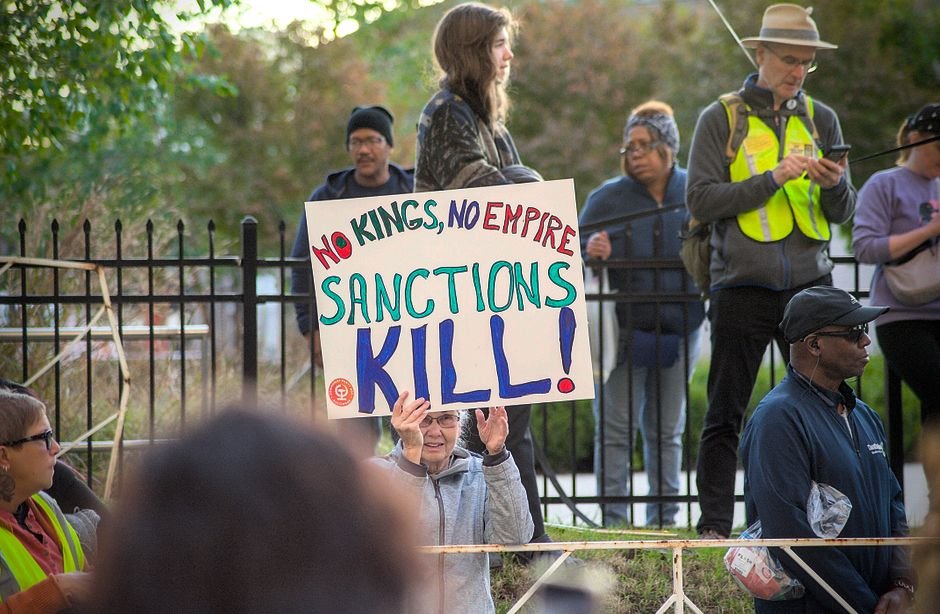
Washington’s offensive against the war-crimes court in The Hague was designed to make life impossible for the court and everyone who works with it. On Tuesday, four of the oldest human rights organizations in the United States went to court to say the campaign is making life impossible for Americans too, and that the law behind it is unconstitutional.
Human Rights Watch, the American Friends Service Committee, the Center for Constitutional Rights, and the Open Society Institute filed suit in Manhattan federal court. The target is Executive Order 14203, issued in early February 2025, and the sanctions imposed under it. The order was retaliation for the court’s decision to seek the arrest of Israel’s prime minister, Benjamin Netanyahu, and his then defense minister, Yoav Gallant, over the Gaza war. It authorizes sanctions on ICC officials and on any non-American who works with the court, on the theory that the court’s investigations of US nationals or allies constitute a national emergency. The designations so far reach eight judges, the court’s former prosecutor Karim Khan, both deputy prosecutors, the United Nations’ special rapporteur for the Palestinian territories, Francesca Albanese, and the Palestinian groups Al-Haq and Al Mezan.
The trap for Americans
The part that touches the plaintiffs is the order’s reach beyond the sanctioned. It makes it a crime for Americans to provide services to any of the designated parties, and the definition of a service is wide enough to cover almost any form of cooperation. The penalties run to twenty years behind bars and fines up to a million dollars. The organizations say the effect has been self-censorship: no more representing victims in The Hague, no more filings to the court, no more joint documentation with Palestinian groups, no contact at all, because any contact could be labeled a service.
The groups argue the order exceeds the statutory authority for presidential sanctions, that it is arbitrary and capricious under the rules of federal administrative procedure, that it breaches First Amendment speech and association rights, that it violates the religious liberty law protecting groups like the AFSC, and that its terms are unconstitutionally vague. They want the whole regime struck down and its enforcement blocked. Liz Evenson, Human Rights Watch’s international justice director, said at a press conference on Tuesday that the Trump administration seeks a get out of jail free card for whomever it chooses, and that with this case, they say no.
The court is under siege from every direction. Khan, the prosecutor who had sought the warrants, lost his post in July, about two years after misconduct accusations against him became public. Rubio laid out a program to break the court’s power over American interests: lean on member states to leave, punish organizations that cooperate with it, bar its staff from setting foot in the United States, and urge countries sheltering under the American security umbrella to refuse its jurisdiction over US citizens. Several states have already announced withdrawals, including Venezuela, which has moved into the American orbit. The withdrawals weaken the court. The lawsuit is the countermove: if the administration can be stopped from punishing Americans for cooperating with the court, the sanctions lose their teeth, because the fear that makes them work disappears.
An anonymous White House official brushed the suit aside, saying the court’s conduct had encroached on the sovereignty and security of the United States and its closest ally, Israel. That is the administration’s position in one sentence, and it is a coherent one: if the ICC is a threat, everything done to it is defense. The plaintiffs’ position is equally coherent: sanctions meant to punish a foreign court are being used to police the speech and association of American citizens at home, which is precisely what the First Amendment exists to prevent.
The case will take years, and the court’s survival will not be decided in a Manhattan courtroom. But the suit matters because it forces the question the administration has avoided: whether a policy aimed at an institution in The Hague may be enforced by silencing people in Washington, New York, and Philadelphia. Sanctions are a blunt instrument, and this one was aimed at the wrong target. The organizations in court on Tuesday are Americans who found out where it actually lands.
Sources: The Guardian, Human Rights Watch, AP, Center for Constitutional Rights