

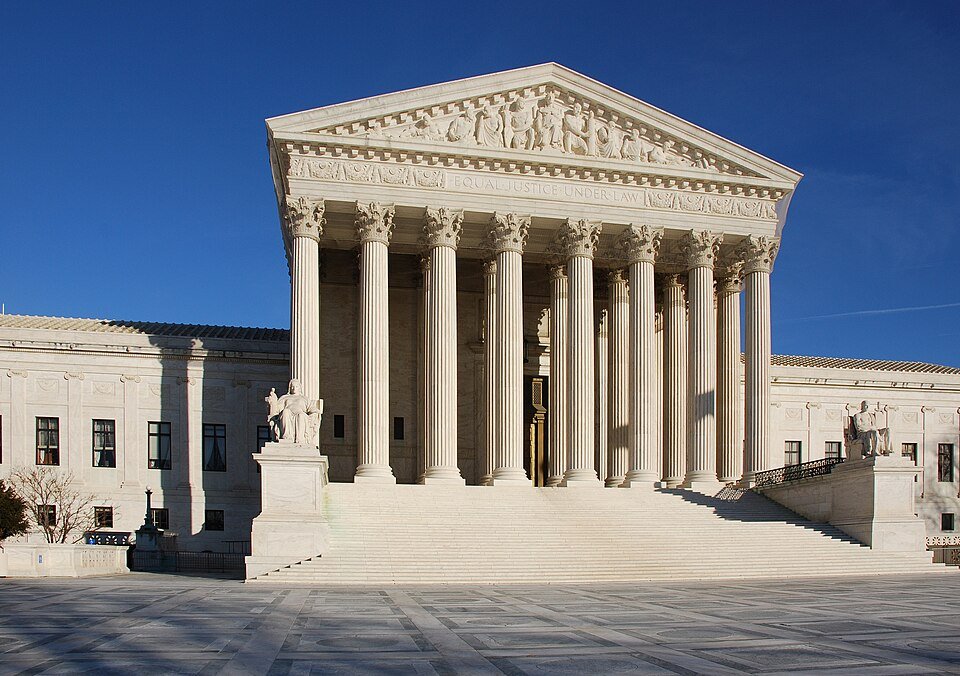
The US Supreme Court on June 25 dealt a decisive blow to tens of thousands of Roundup cancer lawsuits, ruling 7-2 that federal pesticide law preempts state-level claims that Bayer’s Monsanto failed to warn consumers about the alleged cancer risks of glyphosate.
The decision in Monsanto Company v. Durnell, written by Justice Brett Kavanaugh, held that the Federal Insecticide, Fungicide, and Rodenticide Act (FIFRA), which gives the Environmental Protection Agency sole authority over pesticide labeling, prohibits states from imposing additional warning requirements.
“The EPA has repeatedly concluded that glyphosate does not cause cancer in humans and has notified producers that adding a cancer warning would be false and misleading,” Kavanaugh wrote for the majority. “FIFRA requires uniformity in pesticide labeling, and states cannot second-guess that federal determination through tort liability.”
Justices Ketanji Brown Jackson and Neil Gorsuch dissented. Jackson argued that the majority’s interpretation misreads FIFRA’s intent, which she said allows the EPA to review labels but does not give it the final word on whether cancer warnings are appropriate. “This ruling leaves plaintiffs without adequate recourse,” she wrote, “despite legal precedents that rejected similar preemption claims at both state and federal levels.”
The Roundup litigation has been one of the largest product liability battles in US history. After the World Health Organization’s International Agency for Research on Cancer classified glyphosate as “probably carcinogenic to humans” in 2015, thousands of plaintiffs who developed non-Hodgkin lymphoma after using Roundup sued Monsanto (acquired by Bayer in 2018).
Jury verdicts in state courts produced multi-billion-dollar awards, including a $2.1 billion verdict in Georgia. Bayer has already paid more than $10 billion in prior settlements and verdicts, set aside nearly 11.8 billion euros in litigation reserves, and secured an $8 billion loan facility to fund payouts.
In February 2026, Bayer proposed a $7.25 billion class settlement to resolve both existing and future non-Hodgkin lymphoma claims over 21 years. But the settlement, which required court approval in Missouri, was structured so that Bayer could walk away if too many plaintiffs opted out. The Supreme Court ruling changes the legal landscape entirely: if failure-to-warn claims are preempted at the federal level, the basis for thousands of pending lawsuits disappears.
The Scientific Divide
The case highlights a persistent scientific disagreement. The EPA, after multiple reviews, has consistently concluded that glyphosate is not likely to cause cancer in humans when used as directed. The agency has warned pesticide registrants that adding a cancer warning to glyphosate products would be “false and misleading” under FIFRA.
IARC’s 2015 classification, by contrast, found “limited evidence” of carcinogenicity in humans and “sufficient evidence” in animals, placing glyphosate in Category 2A (“probably carcinogenic”). Other international bodies, including the European Chemicals Agency, have classified glyphosate as non-carcinogenic. The divergence stems from differences in how the agencies weigh epidemiological evidence versus animal studies and mechanistic data.
What the Ruling Means
For Bayer, the ruling removes the most existential legal threat the company has faced since acquiring Monsanto in 2018. Bayer’s stock rose on the news. The company had been pushing for a federal solution to the litigation for years, including a state-by-state effort to pass laws shielding pesticide manufacturers from liability and a lobbying campaign to add pesticide immunity language to the farm bill (a provision that was stripped by the House in April 2026).
For plaintiffs, the options narrow significantly. The preemption ruling applies to failure-to-warn claims, which are the legal theory behind the vast majority of Roundup lawsuits, but may not affect claims based on design defect, negligence, or other state-law theories. Legal analysts expect plaintiffs’ lawyers to reframe cases around those alternative theories, though the Supreme Court’s broad language about FIFRA preemption may limit those avenues as well.
For public health advocates, the decision reinforces a long-standing criticism: that the EPA moves too slowly to update pesticide risk assessments in light of new science. The agency’s last comprehensive glyphosate review was completed more than 30 years ago, and critics note that only 1 percent of pesticide labels for chemicals the EPA itself recognizes as carcinogens carry cancer warnings, according to a study by the Center for Biological Diversity.
“All Bayer has to do is put a cancer warning on the product, and the lawsuits go away,” Nathan Donley of the Center for Biological Diversity told Civil Eats. “We are in this whole mess because this company doesn’t want to put a darn warning on their label.”
The ruling also raises questions about California’s Proposition 65, which requires cancer warnings on products sold in the state. The Supreme Court did not directly address Prop 65 in this decision, but legal analysts expect the issue to be litigated separately.
Source: Based on reporting by STAT News (June 26, 2026), CNBC (June 25, 2026), and the Supreme Court opinion in Monsanto Company v. Durnell, No. 24-1068.