

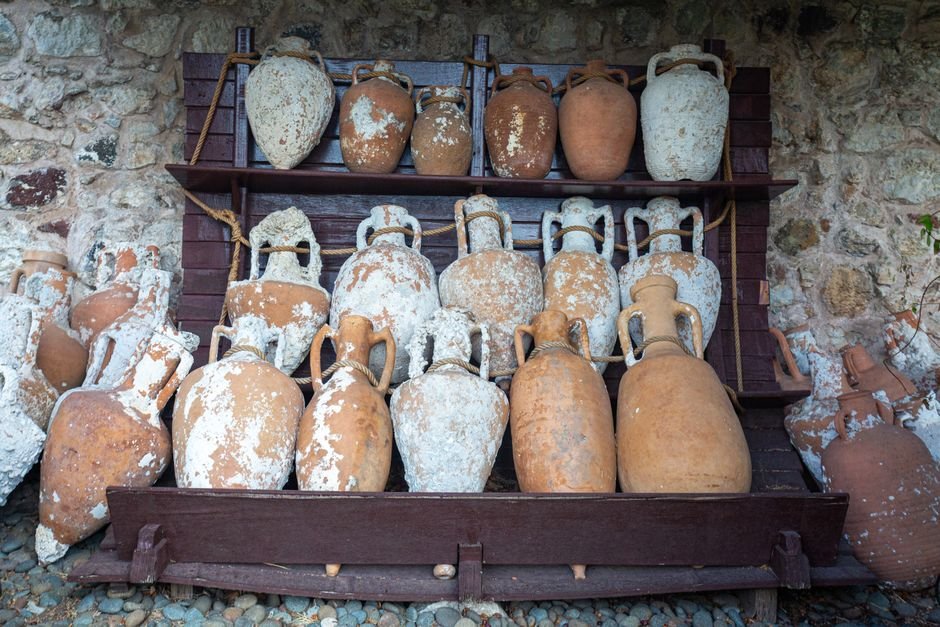
About five kilometers (three miles) off the coast of Mazara del Vallo in western Sicily, in 46 meters (151 feet) of water, lies a Roman merchant ship that has not moved in roughly 2,100 years. Its cargo is still on board: about 500 amphorae, the sturdy clay jars of antiquity, packed for a voyage that never ended. The wreck, announced by Italy’s Ministry of Culture on August 8, is one of the most complete commercial snapshots of the late Roman Republic ever found in the central Mediterranean.
The discovery began with a fisherman’s sonar. Giacomo De Mola, a local underwater fisherman, noticed an anomaly on his boat’s echo sounder, dived to investigate, and found himself looking at a vast expanse of amphorae on the seabed. He and fellow diver Igor Bisulli reported the site to the authorities, who dispatched a joint team: the Carabinieri’s cultural-heritage protection squad from Palermo, the Carabinieri diving unit from Messina, and Sicily’s Soprintendenza del Mare, the regional office responsible for underwater heritage. Divers and underwater cameras documented the site during a survey this month.
A cargo ship frozen in time
The vessel is a navis oneraria, the workhorse cargo carrier of the Roman world, measuring roughly 21 meters (69 feet) long and 6 meters (20 feet) wide. Archaeologists provisionally date it to between the second and first centuries BC, the era of the late Republic, when Rome was transforming from a city-state into the dominant power of the Mediterranean.
The cargo is what makes the site exceptional. The amphorae are predominantly of the Dressel 1A type, a standardized wine jar produced in quantity along the Italian coast in that period. The jar had a bulbous body, narrow neck, two handles, and a pointed base designed to be stacked in a ship’s hold or stood in sand. Dressel 1A jars were manufactured in huge numbers to a common specification, which makes them ideal tracers of ancient commercial networks. Where they are found, and in what company, tells researchers who was shipping what, from where, to where.
Two lead anchor stocks and another lead structure were also found near the wreck, equipment that would have helped hold the ship in place when it anchored in port. The amphorae themselves were likely carrying wine, the most valuable bulk commodity of the era, bound for one of the markets of the Roman world.
Why the location matters
Sicily sits astride the sea routes linking Greece, the Middle East, North Africa and Europe, and its waters are among the richest in the Mediterranean for ancient wrecks. The waters off Mazara del Vallo are already famous for one extraordinary find: the Satiro danzante, or Dancing Satyr, a life-size Greek bronze recovered from the seabed nearby in the 1990s. The new wreck joins a growing catalog of recent Roman discoveries in the region, including a second-century BC wreck found off Palermo in 2021 and a cargo ship off Alassio in Liguria in 2013.
Written sources describe Rome’s appetite for wine and its network of ports, but shipwrecks provide the physical evidence: which amphora types traveled together, in what quantities, and how far from their production sites. A single well-preserved cargo like this one can anchor a reconstruction of a trade route.
What happens next
The Ministry of Culture’s announcement was careful about what is not yet known. The dating is provisional, pending detailed study of the pottery and any organic remains. The condition of the surviving material still needs to be established, and the Soprintendenza del Mare will lead a new phase of scientific documentation: confirming the date, determining the cargo’s origin and destination, and drawing up protection measures for the site. Italy’s culture minister, Alessandro Giuli, called the discovery one of the most important underwater archaeological finds of recent years, and the plan is to study it in place rather than raise it.
Amphorae are fragile once disturbed; a cargo like this one has survived two millennia precisely because it has been left alone. The wreck’s future depends on it staying that way, protected and documented where it rests, as researchers work through the slow, careful process of reading what the jars reveal about the commerce of an empire.
Sources:
- The Guardian, “Roman shipwreck with 500 amphorae found off coast of Sicily” (Aug 10, 2026): https://www.theguardian.com/science/2026/aug/10/roman-shipwreck-with-500-amphorae-found-off-coast-of-sicily
- Italian Ministry of Culture press release No. 29255 (Aug 8, 2026): https://cultura.gov.it/comunicato/29255
- Euronews, “Roman shipwreck with hundreds of amphorae found off Sicily” (Aug 9, 2026): https://www.euronews.com/culture/2026/08/09/roman-shipwreck-with-hundreds-of-amphorae-found-off-sicily
- Greek Reporter (Aug 10, 2026): https://greekreporter.com/2026/08/10/roman-shipwreck-hundreds-amphorae-found-off-sicily/
- ANSA (Aug 8, 2026): https://www.ansa.it/canale_viaggi/notizie/arte/2026/08/08/un-relitto-di-epoca-romana-individuato-al-largo-di-mazara-del-vallo_f9f5918c-788e-4170-ae3c-9576218353cb.html