

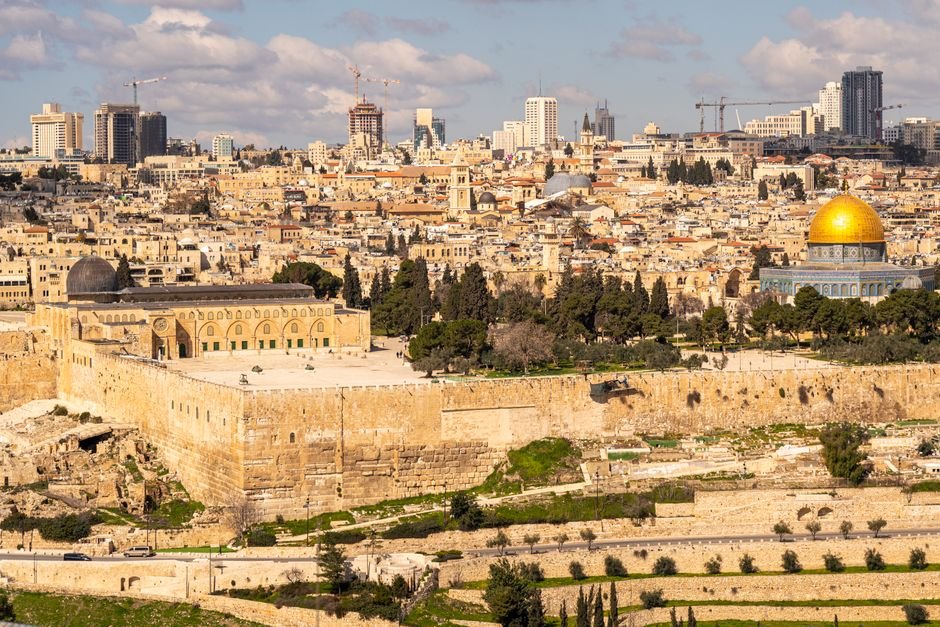
In July, Israeli police built a shelter inside the Al-Aqsa compound. Jordan called it an illegal canopy, erected to shade settler visitors while they walked the courtyards. A canopy is a small thing. It does not move walls or change borders. But the men who watch this ground read it the way border guards read a fence that has been moved a meter at a time.
Al-Aqsa is Islam’s third holiest site, and its administration is one of the most precisely arranged pieces of real estate on earth. The compound is administered by a religious endowment that Jordan finances and controls, under an arrangement with Israel written into the 1994 peace treaty. Jews do not pray inside the compound; they pray at the Western Wall below it. The custodianship dates back to the 1920s, when religious leaders in Palestine handed the custodianship to Sharif Hussein bin Ali, who raised money across the Middle East to restore the mosque, then died in 1931; his grave lies inside the compound’s grounds.
The erosion has been cataloged in detail by the people who keep the site. Since the war in Gaza broke out in October 2023, settler groups have pushed into the compound in growing numbers to pray and perform rites. Restrictions on Muslim worshippers have tightened. At Eid during Ramadan this year, Israel closed the site outright, something that had not happened in sixty years. Excavation work near the compound continues. In East Jerusalem, demolitions of Palestinian homes have increased. A minister has led Jewish prayers inside the compound, a first. Then came the canopy, and with it the question of what is left of the old arrangement.
On August 5, the Arab League committee that Jordan has chaired since 2017 met in Amman. Egypt, Saudi Arabia, Qatar, Iraq, Tunisia, Algeria, Somalia, Morocco and Palestine sent foreign ministers; Pakistan, Turkey, Malaysia and Indonesia sent ministers or deputies. Their communique said Israel is seeking to alter the site’s historic and legal status quo and to impose temporal and spatial division on it. They declared Al-Aqsa a site of Muslim worship alone, with Jordan’s religious departments holding sole legal authority over it. Jordan’s top diplomat, Ayman al-Safadi, said the violations are pushing the region toward the explosion of a religious conflict that cannot be contained. Saudi Arabia’s Prince Faisal bin Farhan, its foreign minister, said Riyadh rejects invoking religious liberty to justify a new political order in Jerusalem.
The warnings have sharpened in the past week. A Jordanian minister told the Independent that an Israeli takeover of the mosque is imminent. German broadcaster DW reported on August 8 that reports from Jerusalem suggest Israeli authorities are taking over the site, and that experts say the outcome could be anything from war to terrorism to the collapse of diplomatic ties. The range of possibilities is wide; the direction is not.
Notice what is missing from the record: any Israeli reaffirmation of the status quo. Governments that mean to keep an arrangement say so, loudly and often. This one does not, because parts of it do not want to. The old order survives only as long as both sides pretend it exists, and one side has stopped pretending.
The Arab response, meanwhile, is a machine that produces communiques. Every meeting restates the same facts and the same warnings in the same careful language. The gap between what Arab governments say and what they can do has never been wider: the capitals that met in Amman are the same capitals watching the war with Iran, the closed strait, and the reordering of the region’s energy routes. None of them is going to war over a canopy, and everyone in the room knows it.
The question DW asked, what happens if Israel takes Al-Aqsa, is being answered in installments. The takeover does not have to arrive as a single seizure. It can arrive as a canopy, a closure, a prayer service, a new gate guard. Jordan holds the keys. Israel holds the doors. Every month the doors open a little wider, and the men in Amman write another communique saying what everyone already knows.