

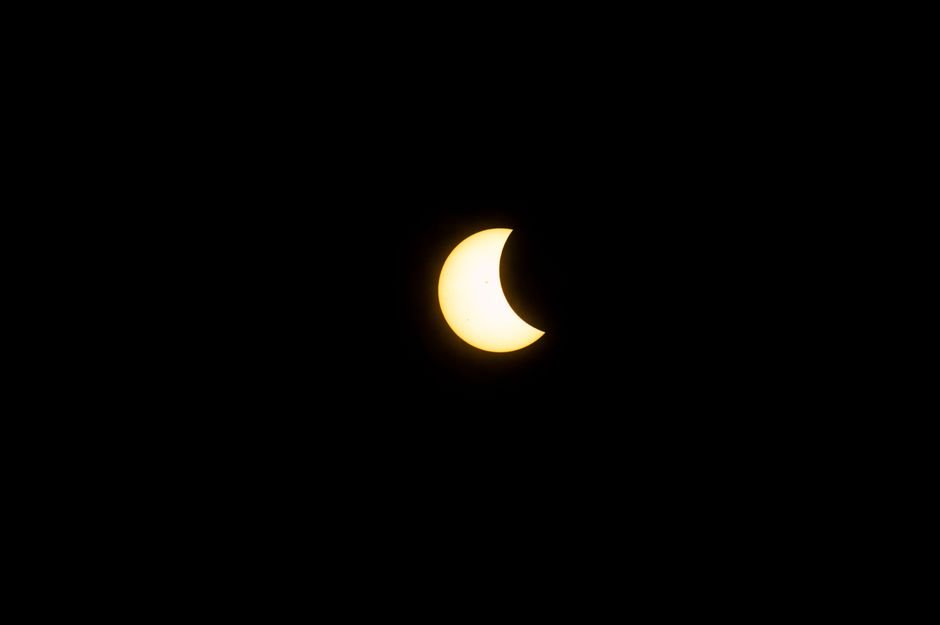
Somosierra has 93 inhabitants, one restaurant with a serious paella operation, and a claim no other place in the Madrid region can match: on the evening of August 12, the sky above its mountain meadows will go dark for one minute and 29 seconds, the full totality of the first total solar eclipse seen from mainland Spain in more than a century. The village, sitting at 1,440 meters (4,724 feet) where the northern edge of the Madrid region meets Castilla y León, is bracing for something it has never experienced in its recorded history: up to 2,000 visitors arriving at once, on foot, at a site reachable only by a mountain road.
The viewing site is an abandoned glider-pilot training aerodrome in the flat meadows above the village, a place where generations of pilots learned to ride the air currents alongside vultures and red kites. It has been selected, to the delight and consternation of the local council, as the best place in the Madrid region to watch the eclipse. The regional government’s list of 51 recommended viewing municipalities puts Somosierra at number one. The council has opened 400 official registration slots for the observation point, and its tourism manager openly expects five times that many people to show up anyway, drawn by the simple fact that this is the closest point of totality to a European capital.
The preparations are a study in small-town logistics under celestial pressure. The council has recruited and trained volunteer stewards, with a company of astrotourism specialists running sessions in the village’s tiny cultural center covering both eclipse safety, including the permanent eye damage that careless viewing can cause, and crowd control: parking, liaison with police and civil protection, and managing a venue where access is on foot only. Yolanda Cerezo, who has run the Hotel Restaurante El Puerto de Somosierra for 26 years, is planning for a tenfold increase from her normal busy day of 200 to 300 customers. She is seeking licenses to set up a stall at the observation site and contemplating hiring eight or nine extra staff on top of her usual nine. The menu plan involves lamb stew and paella cooked in the hotel kitchen and driven up the mountain in batches, because visitors cannot be left stranded halfway up a mountain with nothing to eat.
The safety planning has a sharper edge this year because of what happened just weeks ago. In late July, massive wildfires in Madrid’s Sierra Oeste, described by the regional president as the worst in the region’s history, forced the evacuation of more than 10,000 people and of NASA’s Robledo de Chavela deep-space station. The eclipse draws a crowd of a size the village has never hosted, in a landscape that has recently burned, and the council has coordinated with police and civil protection authorities on risk factors from fire to traffic. The training sessions cover eye safety first and logistics second.
The broader context is a national eclipse boom. Spain’s government has established an interministerial commission for what it calls the trio of eclipses: the total eclipse of August 12, 2026; another total eclipse, longer and deeper, in August 2027, described by enthusiasts as the eclipse of the century; and an annular eclipse in January 2028. The commission, spanning 13 ministries, coordinates health, civil protection, mobility, and tourism. Government impact estimates project nearly 450,000 additional tourists in the affected provinces during the eclipse week, with extra tourist spending on the order of 342 million euros, and the Balearic Islands plan road restrictions on 20 main roads during the eclipse afternoon to prevent gridlock. The last total eclipse visible from the Iberian Peninsula was on August 30, 1905, 121 years ago, and Spain will be the only inhabited territory from which this one is fully visible.
For the people of Somosierra, the event is a collision of the cosmic and the mundane. Volunteers describe it as a once-in-a-lifetime event and a historic scientific milestone; the village tourism manager marvels that a place so close to a huge capital will draw people who decide on the spur of the moment to pack sandwiches and drive up. The restaurant owner takes a practical view: the village has hosted big one-day events before, but never anything of this volume; the eclipse will make for a long day, but the village must make the most of it because there will never be another day like it. In one minute and 29 seconds, the moon’s shadow will pass, the temperature will drop, and the corona will appear above the meadows where the gliders used to soar. Then the crowds will drive home, and Somosierra, population 93, will be left with the memory and the cleanup.
Sources: Jones, S. Spanish mountain village braces for astrotourists lured by total solar eclipse. The Guardian, August 8, 2026. NASA eclipse pages; Spanish Ministry of Science; regional government statements.