

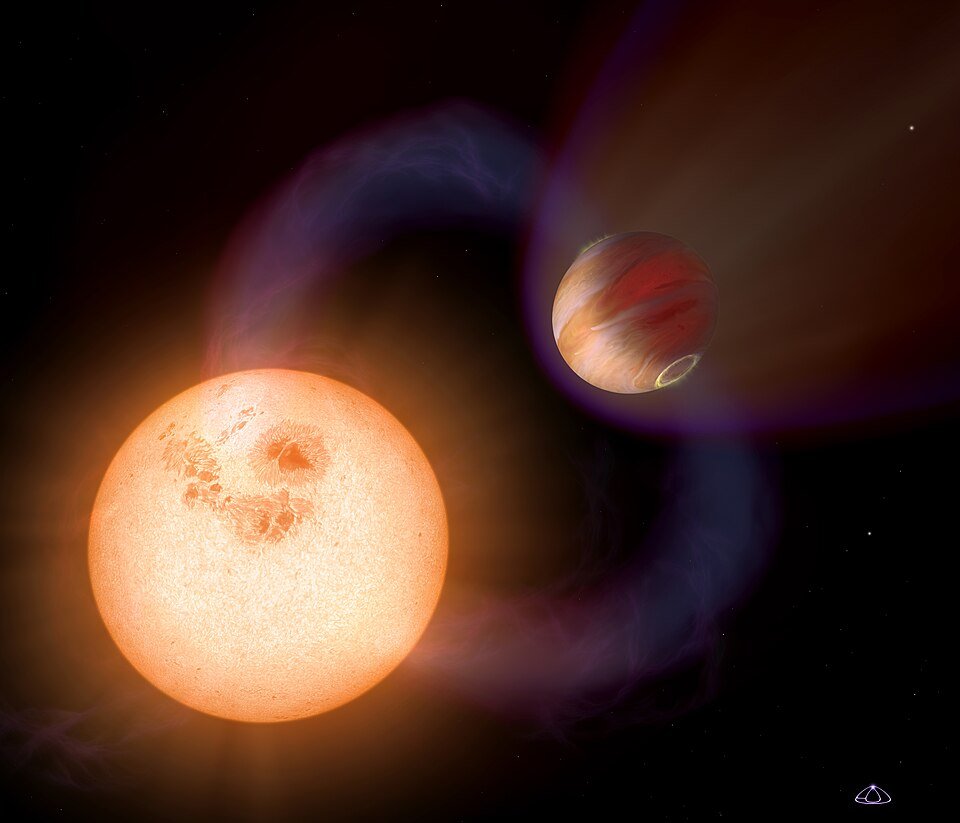
Astronomers have uncovered compelling chemical evidence that a star some 1,300 light-years from Earth consumed one of its own planets, offering a fresh window into the violent late-stage dynamics of planetary systems.
A team of 14 researchers from the United States and Chile detected an unmistakable lithium excess in the outer layers of TOI-5882, a subgiant star in the constellation Lyra. The finding, published in The Astrophysical Journal, points to the recent ingestion of a planet that likely weighed between a few Earth masses and that of Neptune.
The smoking gun is lithium. Stars destroy lithium in their hot interiors over time, so any star showing anomalously high lithium in its atmosphere must have acquired it recently from an external source. Planets, by contrast, are lithium-rich reservoirs, preserving the element in their rocky and icy material.
“You are what you eat, right?” said Brooke Kotten, a graduate researcher at the University of Michigan and lead author of the study. “We know that there is much more lithium in planetary material than there is in stars. So if a star eats a planet, it is going to take on a bunch of lithium.”
The team used the Tillinghast Reflector Echelle Spectrograph at the Fred Lawrence Whipple Observatory in Arizona to measure TOI-5882’s spectrum. They compared its lithium signature against a control sample of 62 other subgiant stars at a similar evolutionary stage. TOI-5882 ranked in the 98.4th percentile, a statistical outlier so extreme that the researchers could rule out ordinary stellar processes.
“No matter how you slice it, TOI-5882 is so enriched in lithium it shows up as being at least in the 97th percentile,” said Melinda Soares-Furtado of the University of Wisconsin, the study’s senior author.
Seth Jacobson of Michigan State University offered a vivid analogy. “Lithium atoms delivered by planetary engulfment to a star are like sports fans arriving at a stadium,” he said. “There may already be a few early arriving fans present, representing the initial amount of lithium in the stellar atmosphere, but they are quickly outnumbered.”
A dynamical crime scene
Unlike the Sun, which will balloon into a red giant and swallow Mercury, Venus, and possibly Earth in about 5 billion years, TOI-5882 has not expanded enough to naturally engulf a planet through stellar growth. The star is a subgiant, a transitional phase between a main-sequence star like the Sun and a full red giant. That means the engulfment was dynamically triggered, not a consequence of normal stellar evolution.
The likely culprit is TOI-5882’s massive neighbor. The star hosts a brown dwarf companion called TOI-5882 b, weighing about 20 times Jupiter’s mass and orbiting every 7.1 days. Brown dwarfs are objects that form like stars but never accumulate enough mass to sustain hydrogen fusion. This particular companion orbits so closely that its gravitational influence could easily perturb any smaller planets in the inner system.
The researchers propose that the brown dwarf gradually destabilized a planet’s orbit, kicking it onto a spiraling path toward the star. Once the planet drifted close enough, tidal forces tore it apart and scattered its material into the star’s outer layers, leaving behind the lithium fingerprint.
Engulfment itself happens on astronomical timescales of days to weeks, far too fast for direct observation. “We cannot just watch the crime happen, so we have to work with all the clues we are given to figure out whodunit,” Kotten said.
What kind of planet?
By modeling how planetary material mixes into a star’s convective zone, the team estimated that the engulfed object had a mass between 9 and 95 Earth masses. That range spans from super-Earths (rocky worlds larger than our own) up to Neptune-class planets. The lower end of that range, around a few Earth masses, is the most plausible scenario for a planet that formed in the inner system and fell prey to the brown dwarf’s gravitational stirring.
The research is part of a growing effort to identify planetary engulfment events through chemical forensics rather than direct observation. Previous studies have found similar lithium enrichment in other stars, and a 2023 study using the Gemini South telescope captured the first direct observation of a star swallowing a planet in real time. But the TOI-5882 case is distinct because the star is still in its subgiant phase, not yet old and bloated, making the dynamical explanation more compelling.
Brooke Kotten, who began the work as an undergraduate at the University of California, Santa Cruz through the Lamat Program, said the detective work is what drew her to the field. “When I was growing up, I dreamed about becoming a private investigator,” she said. “I think that explains a lot about where I ended up. I do feel like a detective.”
Why lithium matters
Lithium is a fragile element in stellar interiors. Most stars are born with a small amount left over from Big Bang nucleosynthesis, but convection quickly carries it down to hot layers where nuclear reactions destroy it. By the time a star reaches the subgiant phase, its surface lithium should be heavily depleted.
Planets, however, preserve lithium in their rocks and ices. When a planet plunges into a star, its material gets mixed into the outermost layers, temporarily boosting the star’s surface lithium abundance before convection can dilute it away.
“The fact that we can look at a star 1,300 light-years away and say with confidence, ‘This star has more lithium than you would expect,’ is a testament to both the precision of modern instrumentation and the hard interpretive work that goes into making sense of that signal,” Soares-Furtado said.
The study was supported by NASA and the U.S. National Science Foundation. The full paper, “Lithium Enrichment in a Subgiant Star with a Brown Dwarf Companion: A Planetary Engulfment Candidate,” is available in The Astrophysical Journal.