

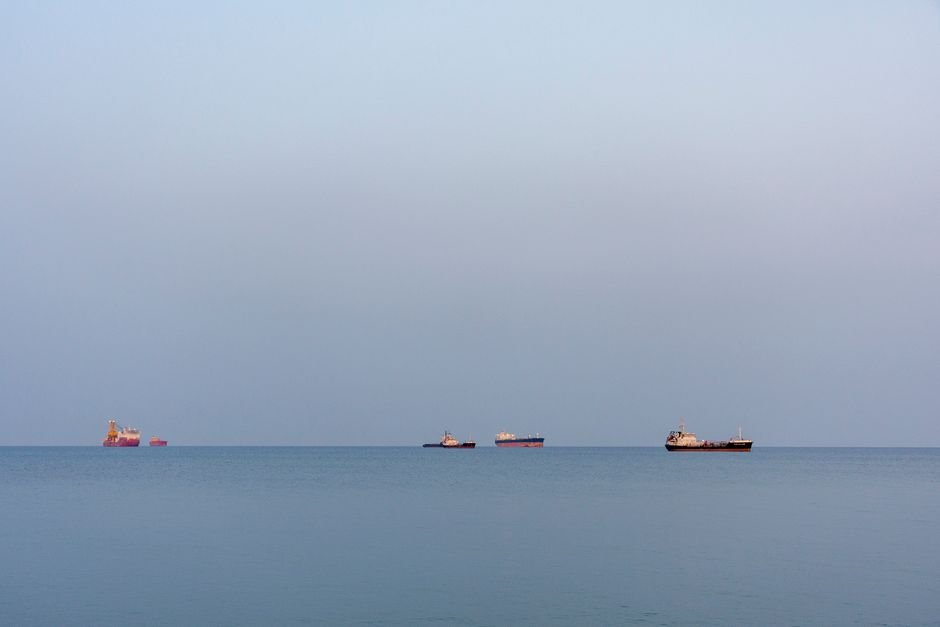
On Thursday, four ships crossed the Strait of Hormuz. One was a supertanker hauling about two million barrels of Iraqi crude. Two carried liquefied petroleum gas. The fourth was a small bulk carrier. For the week as a whole, Monday through Thursday, the count was 33 vessels, down from 50 in the same period a week earlier. Before the war, before February 28, the strait routinely carried 130 to 140 ships in a single day.
The numbers come from Kpler, the maritime data firm, and they describe a waterway that Iran declared closed to all vessels after the war began, yet which still moves a thin but real trickle of traffic. Six crude tankers left the strait all week. Twenty-one vessels entered, most of them by the Iranian route. The world’s most important energy chokepoint, once the passage for a large share of the planet’s oil heading to Asian and Western markets, now carries a fraction of its former traffic.
The market is watching the talks between Iran and Oman, hoping for a deal to reopen the strait, and it is also behaving as if no deal is coming. Chinese and Indian refiners spent the week looking for ships willing to enter the waterway and load crude at Iraq’s Basrah Oil Terminal, where discounts have grown steep. Iraq’s state marketer, SOMO, offered nearly $30 a barrel off Basrah Heavy and Medium for August loading. That is a price gap large enough to move the economics of a voyage halfway around the world. No charter has been fixed. Shipowners, industry sources say, remain wary of sending their vessels into a strait where a single Iranian decision can turn a profitable run into a total loss.
The Iran-Oman negotiations themselves are a study in cautious optimism. The broad shape of a possible arrangement has been reported: Tehran would take a hand in managing inbound traffic at the strait, and the United States would lift its blockade measures once an agreement is in place. A US official has said the waterway blockade could come off the moment a navigation deal is signed. Iran, according to regional reporting, is close to ratifying a negotiated arrangement with Washington and Muscat, pending a decision by its Supreme National Security Council. Industry sources, however, call the proposed framework not easily workable, pointing to American sanctions and insurance rules that make payment nearly impossible. The gap between the diplomats and the insurers is where a reopening would have to happen, and it has not happened yet.
The decline is not evenly spread. While Hormuz empties, the Bab el-Mandeb strait at the southern end of the Red Sea is getting busier: 26 vessels transited on Thursday, up from 19 the day before by one count, 28 by another. Trade is finding paths around the blockage, but a detour cannot replace the strait that sits between the Gulf’s producers and the world’s buyers. The Gulf’s biggest exporter, Saudi Arabia, has watched its customers weigh every barrel against the risk of the voyage. Earlier moments of crisis show how much worse things were, and how fragile the current trickle is: in April, amid a diplomatic deadlock, the waterway saw only ten ships in a week.
Oil prices kept climbing on Friday as the market digested the week’s transit numbers and the state of the talks. The direction of the war, not the direction of the diplomacy, still sets the price. A strait that once moved the world’s oil now moves four ships a day, and the question the talks are meant to answer is whether that is a temporary condition or the new normal.