

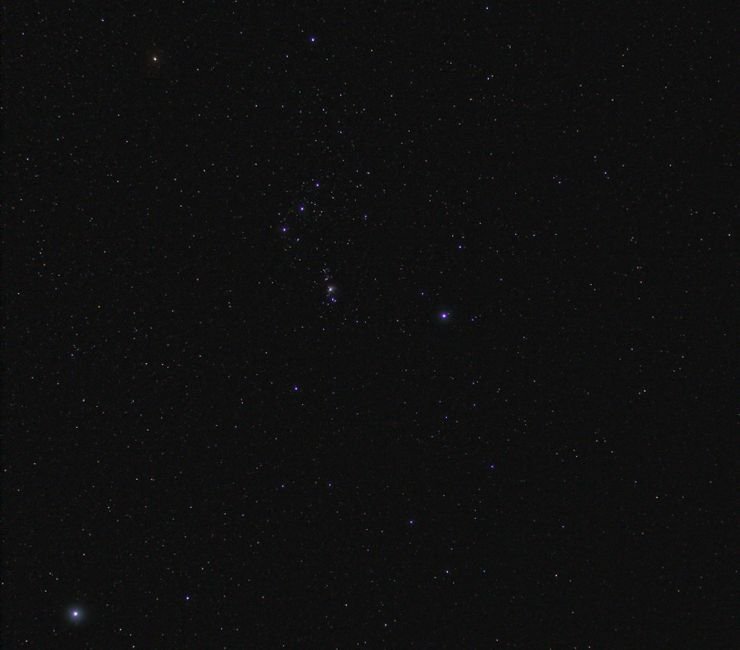
Astronomers have captured what they describe as the clearest image yet of a companion to Betelgeuse, the red supergiant in Orion, after roughly a century of searching. The candidate star, called Betelgeuse B, appears to be about two to three times the mass of the Sun, heavier than the roughly one solar mass that earlier predictions suggested, according to a team led by Miguel Montargès of the Observatoire de Paris and the European Southern Observatory.
The detection rests on observations made in December 2024 with the SPHERE instrument on ESO’s Very Large Telescope in Chile, timed to when the companion was predicted to be at its greatest separation from Betelgeuse. The results appear in a Letter to the editor of Astronomy & Astrophysics, and the ESO press release of July 28 frames the work as the conclusion of a century-long quest. The star’s brightness variations had prompted astronomers to propose a companion long ago, but it had never been directly confirmed.
In the new data, Betelgeuse B was detected at a signal-to-noise of 6.1 in one analysis method and 5.1 in a second, at a projected separation of 52.32 ± 0.18 milliarcseconds from the primary, with a position angle of 117.12 ± 0.60 degrees. The companion was imaged directly, meaning the light from the star itself was detected rather than inferred from its gravitational effects. Earlier evidence included a tentative detection with the Gemini North telescope in Hawaii, and two 2024 studies had predicted the December 2024 maximum elongation.
Assuming the two stars formed together, the team estimates the companion is a 2.6 to 3.1 solar mass young main-sequence star of spectral type B8.5V to B9.5V. Using a distance of 168 parsecs to the system, the observed separation corresponds to a minimum orbital semimajor axis of about 8.8 astronomical units and a minimum orbital period of roughly 5.5 to 5.9 years, consistent with the 2,200-day (about 6-year) periodicity seen in Betelgeuse’s brightness, which had been suggested as evidence for a companion.
The authors are careful about what the result does and does not establish. Formal confirmation that Betelgeuse B is gravitationally bound to the primary awaits a second observing epoch, roughly a year away, when the companion should appear on the other side of the star. The paper consistently refers to the object as a candidate. The authors also note that the distance to Betelgeuse is contested: adopting a radio-parallax distance of 222 parsecs instead of the asteroseismology-based 168 parsecs would push the implied orbital period to roughly 8.2 to 8.7 years, which would no longer match the 2,200-day periodicity. They conclude the shorter distance fits the companion hypothesis better.
The finding also opens questions about the mechanism behind Betelgeuse’s brightness variations. The team tested whether the companion could dim the star by sublimating circumstellar dust along its path, and found the effect could produce at most about 0.1 magnitude of modulation, far less than the roughly 0.5 magnitude variation observed. They propose instead that the long-period brightness changes arise mainly from dynamical effects, as earlier studies suggested.
The new image also fits a broader puzzle about red supergiants. Roughly a quarter to a third of red supergiants show long secondary periods like Betelgeuse’s, and the detection here supports the idea that at least some of those periodicities mark hidden companions. The authors suggest the result makes long secondary periods a promising route for finding companions around these evolved stars, whose bright, active surfaces make them harder to study as binaries than their main-sequence counterparts.
Betelgeuse, a star of roughly 16.5 to 19 solar masses that is expected to die in a supernova explosion, dimmed dramatically in 2019 and 2020, prompting speculation it might be about to explode. Montargès’s earlier work showed that episode was caused by a cloud of dust obscuring the star. Whether the newly imaged companion influences the red supergiant’s evolution or its eventual explosion is now an open question the authors say the detection raises. The team included astronomers from France, the Netherlands, Germany, the United States, Belgium, and Chile, along with two amateur observers from the American Association of Variable Star Observers who contributed photometry.
Sources
1. ESO, “Astronomers find strongest evidence yet that Betelgeuse has a companion”: https://www.eso.org/public/news/eso2611/
2. Montargès et al., “VLT/SPHERE imaging of the candidate companion of Betelgeuse”, Astronomy & Astrophysics (eso2611a): https://www.eso.org/public/archives/releases/sciencepapers/eso2611/eso2611a.pdf
3. Universe Today, “It Took a Century, but Astronomers Imaged Betelgeuse’s Companion”: https://www.universetoday.com/articles/it-took-a-century-but-astronomers-imaged-betelgeuses-companion