

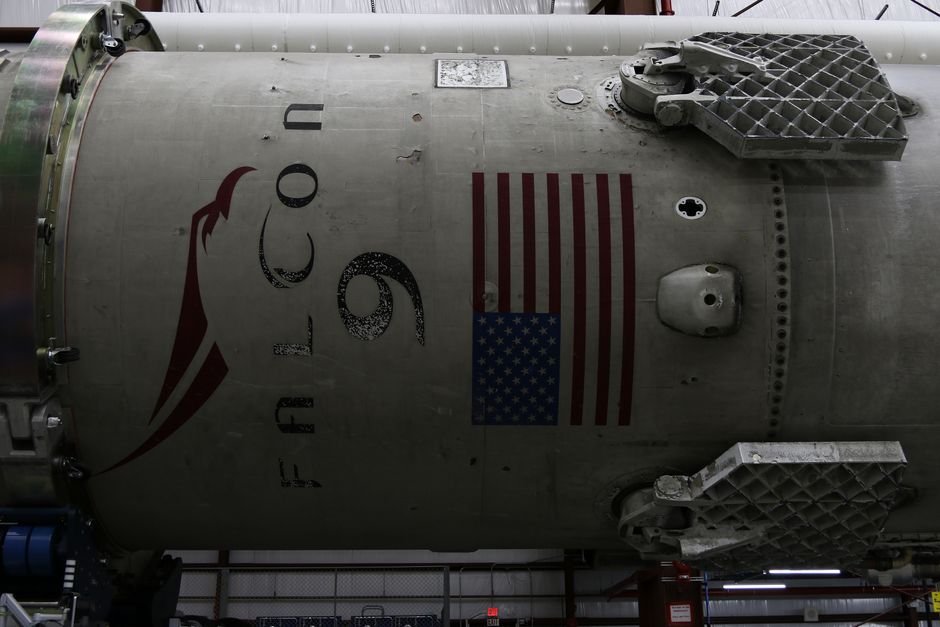
On August 5 at 06:34 UTC, a spent Falcon 9 upper stage weighing roughly 3,900 kilograms will strike the lunar surface near Einstein Crater at 2.43 kilometers per second, releasing 11.8 gigajoules of kinetic energy. The rocket body is a leftover from the January 2025 launch that carried Firefly Aerospace’s Blue Ghost-1 lander and ispace’s Hakuto-R Mission 2 to the Moon. Since then it has been drifting on a chaotic orbit, and its trajectory is now certain enough that astronomers can plan observations.
What makes this event unusual is not the impact itself (spacecraft have been crashing into the Moon since Luna 2 in 1959) but the precision with which it is known. The time, location, velocity, angle of impact, mass, and structural composition of the projectile are all specified in advance. For scientists who study impact physics, this is a calibration source that nature does not provide.
Two research groups have published detailed predictions. A team led by Benjamin Fernando at Los Alamos National Laboratory, with collaborators from NASA Ames, the SETI Institute, and several European institutions, produced an observational planning paper on arXiv that describes what the impact will look like, how bright the flash might be, and how both professional observatories and amateur astronomers can contribute. A separate group led by William Jo at the University of Texas at Austin, working with the Planetary Science Institute and the Belgian Royal Institute for Space Aeronomy, ran high-resolution hydrocode simulations of the impact itself, modeling the Falcon 9’s hollow aluminum structure as it disintegrates against the lunar surface.
The Los Alamos paper identifies three observables, each visible on a different timescale. The first is the flash itself, a sub-second burst of light generated when kinetic energy is converted to heat and radiation at the point of contact. The predicted visual magnitude of this flash ranges from +3 (bright enough to see with small telescopes) to fainter than +15 (undetectable with most Earth-based instruments). The uncertainty spans 12 orders of magnitude because no one knows whether the upper stage will hit hard bedrock or loose regolith, and because the orientation of the stage at impact is unknown. A Falcon 9 upper stage is 12 meters long and 4 meters in diameter, mostly empty fuel tanks with a dense engine at one end; whether it strikes engine-first, side-on, or tumbling changes the energy coupling dramatically. The paper notes that lithium contamination from the stage’s propulsion system may enhance the lithium emission line at 670.8 nanometers, providing a spectral fingerprint that could distinguish this artificial impact from a natural one.
The second observable is the ejecta plume, which should last for minutes to tens of minutes. Jo’s simulations at UT Austin, using the iSALE-2D hydrocode with a 2.5-centimeter grid resolution, show that the plume has two components. A low-angle ejecta curtain, traveling at shallow trajectories, reaches about 20 kilometers in altitude and spreads laterally across 183 kilometers. A narrow central spike of material ejected at near-vertical angles rises to between 50 and 100 kilometers. The curtain carries 99.4 percent of the ejected mass, but the spike is what may be visible from Earth. At five seconds after impact, the peak brightness of the plume at visible wavelengths is predicted at an I/F value of 1.27 times 10 to the minus 3, with a surface brightness of approximately 8.3 magnitudes per square arcsecond. Above 10 kilometers altitude, where the signal separates cleanly from the bright lunar surface, the peak brightness reaches an I/F of 1.33 times 10 to the minus 5, corresponding to about 13.3 magnitudes per square arcsecond. The authors estimate the plume remains detectable against the dark sky background for roughly the first 75 seconds.
The third observable is the crater itself, expected to be 20 to 30 meters in diameter and about 5 meters deep, throwing out roughly 1.2 million kilograms of excavated regolith. This is far too small to resolve from Earth, but NASA’s Lunar Reconnaissance Orbiter will pass over the site seven days before and seven days after the impact, providing before-and-after images. The Korean Pathfinder Lunar Orbiter, KPLO, will be in close conjunction with the impact site approximately two minutes before the event and has already acquired baseline imaging. The ejected material may pose a real hazard: resolved particles have a ballistic range of nearly 1,000 kilometers, meaning future lunar infrastructure anywhere across a wide area of the surface could be at risk from high-velocity secondary debris.
The scientific value of this event goes beyond simple observation. There is no published measurement of the brightness of an artificial impact flash on the Moon. The Apollo Passive Seismic Experiment detected no flashes from the Apollo S-IVB stages that were deliberately crashed into the Moon. The LCROSS mission in 2009 observed a plume but the flash was obscured. The Kaguya impact in 2009 occurred near the terminator and the geometry was unfavorable. This is the first artificial lunar impact in the sunlit hemisphere, at a known time, with known projectile properties, that can be observed in real time from Earth.
At least three major observatories have allocated telescope time: the ARC 3.5-meter telescope at Apache Point Observatory, the 4.3-meter Lowell Discovery Telescope, and the 8.2-meter Very Large Telescope in Chile with its UVES spectrograph. Amateur astronomers are also being encouraged to participate through NASA’s Impact Flash project and the Lunar Impact Flash Network. Even non-detections carry information: an upper limit on flash brightness constrains the physical properties of the target surface.
For the handful of times in history that an artificial object has been observed striking another world, the data have always been equivocal. This time the trajectory, mass, composition, and velocity are known in advance, and the date has been on the calendar for months. The uncertainty is not in the event but in whether enough telescopes will be pointed at the right patch of sky to catch it.
References
Fernando, B., Heldmann, J., Grey, B., et al. Observational planning for the 2026 August 5 Falcon 9 Upper Stage lunar impact. arXiv:2607.14625 (2026). DOI: 10.48550/arXiv.2607.14625
Jo, W., Goldstein, D. B., Varghese, P. L., et al. Predicted ejecta dynamics and observability of the 2026 Falcon 9 upper stage lunar impact. arXiv:2607.23904 (2026). DOI: 10.48550/arXiv.2607.23904