

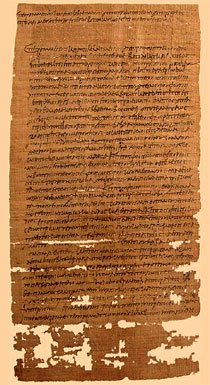
A Herculaneum papyrus scroll carbonized by the eruption of Mount Vesuvius in AD 79, so fragile that any attempt to physically unroll it would reduce it to ash, has been completely virtually unwrapped for the first time, yielding more than a meter of continuous text. The breakthrough, announced at a conference in Naples on June 25, marks a turning point in the effort to recover the library of the Villa dei Papiri, buried and preserved by the same pyroclastic flows that destroyed Pompeii.
The scroll, designated PHerc 1667, dates to the 2nd or late 3rd century BC, making it one of the oldest in the Herculaneum collection. It was broken in half, its outer layers had flaked off, and the surviving fragment measured just 8 centimeters tall by 2 centimeters wide. Diamond Light Source, the UK’s national synchrotron facility near Oxford, imaged it at 4-8 micrometers per voxel resolution. Machine learning algorithms trained to detect carbon-based ink on carbonized papyrus, the ink and the papyrus are both carbon, so the algorithms detect subtle texture differences in the fibers where ink was present, then virtually flattened the layers and read the text.
What was found
Twenty columns of text, recovered in full from the surviving fragment. The content points not to the Epicurean philosophy that dominates the Herculaneum library (primarily the works of Philodemus of Gadara) but to Stoicism. The likely author is Chrysippus, the third head of the Stoic school in the 3rd century BC. The text refers to his nephew and pupil, Aristocreon, and discusses two core Stoic concepts:
- Hormē (impulse), the text warns that failing to regulate behavior with reason leads to harmful passions and diversion from one’s goals
- Phronēsis (practical wisdom), the highest virtue in Stoic philosophy
One sample passage reads: “We will inquire into something, but we will not grasp it, if in some way we depart from ourselves and from our own nature.”
Federica Nicolardi, a papyrologist at the University of Naples Federico II who led the textual analysis, described the moment of recognition: “At first, we were saying this could be an Epicurean talking about Stoic doctrine. But then I stopped and said, you know, if this was found outside of Herculaneum, we would categorise it as a Stoic work.”
A second scroll also read
A second scroll, virtually unwrapped in the same push, revealed the words “Philodemus, On Gods, Book 8”, proving for the first time that On Gods was a multi-book work. Previously only Book 1 was known.
How this happened
The virtual unwrapping technique was pioneered by Brent Seales of the University of Kentucky (EduceLab), who first demonstrated it on the En-Gedi scroll in 2015, reading the book of Leviticus from a charred Hebrew parchment. The Vesuvius Challenge, launched in March 2023 by former GitHub CEO Nat Friedman, Daniel Gross, and Seales, backed by over $1.8 million in Silicon Valley prizes, turned the problem into a global competition. The 2023 Grand Prize winners (Luke Farritor, Youssef Nader, and Julian Schilliger) proved the method worked on a smaller fragment. The current result extends it to a complete scroll.
What comes next
Approximately 800 scrolls from the Herculaneum library remain unopened in Naples, and thousands more may still be buried at the Villa dei Papiri. The technique has now been proven on an entire scroll, including the complex segmentation of individual papyrus layers. As Nicolardi put it: “These unopened Herculaneum scrolls look like dead books, but they’re not. They’re starting to speak again.”
Seales was more direct: “People now know that this can be done and now we’re exploring what the texts actually mean. For me that’s the World Cup. I just won the World Cup: that’s my victory.”
Source: Sample, I. AI helps read papyrus scroll burnt to crisp during Vesuvius eruption. The Guardian (2026). Link