

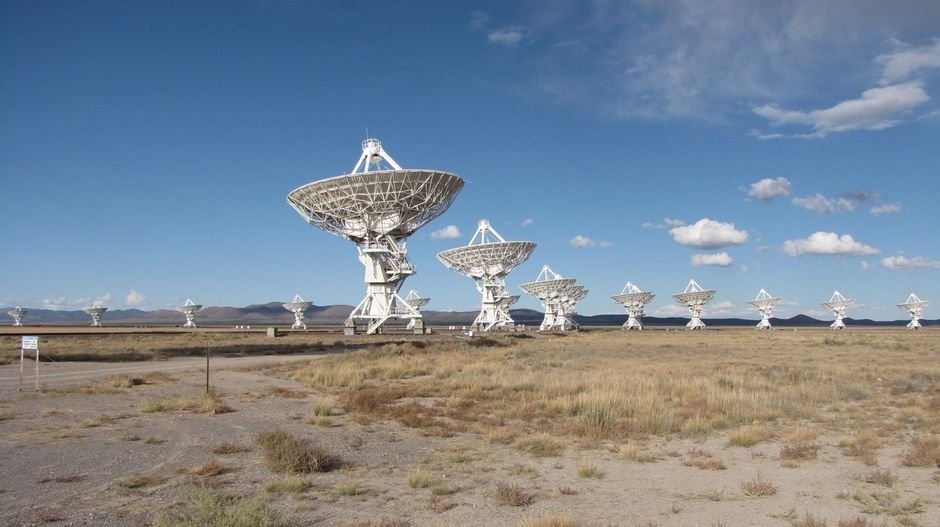
Astronomers using the Karl G. Jansky Very Large Array have detected polarized radio emission from the afterglow of a gamma-ray burst for the first time at centimeter wavelengths, and measured the rotation of that polarization in what they describe as the first detection of Faraday rotation in a burst environment. The work, submitted to the Astrophysical Journal Letters and posted to arXiv on April 30, is led by Collin T. Christy of the University of Arizona with colleagues at the University of Utah and other institutions.
The burst, designated GRB 260310A, triggered the Fermi Gamma-ray Burst Monitor at 04:57 UT on March 10, 2026. Its prompt emission lasted about 60 seconds, placing it in the long-duration class of bursts produced by the collapse of massive stars. That interpretation gained support from an emerging supernova component, designated SN 2026fgk, detected in later optical follow-up. At a redshift of 0.153, roughly 745 megaparsecs (about 2.4 billion light-years) away, the burst sits in the outskirts of its host galaxy and produced what the team calls one of the brightest radio afterglows seen in decades.
The team observed the afterglow with the VLA on March 29, 19.2 days after the trigger, in a three-hour observation covering the X, Ku, and K bands. They detected linearly polarized emission between 11 and 25 gigahertz. The polarization fraction, the share of the emission whose electric field oscillates in a preferred direction, fell monotonically with decreasing frequency, from (3.18 +/- 0.18) percent at 25 GHz to (0.69 +/- 0.22) percent at 11 GHz. At 9 GHz the signal dropped below the detection threshold of 0.6 percent at 3 sigma.
The authors interpret the radio emission as dominated by a reverse shock, the wave that travels back through the jet material ejected by the collapse, in a jet with angular structure. The decline of the polarization fraction toward lower frequencies is consistent with synchrotron self-absorption, in which the emitting region becomes opaque to its own radiation, with a self-absorption frequency of about (13.3 +/- 0.5) GHz matching the peak of the total intensity spectrum.
The measured polarization at high frequencies is low relative to the theoretical maximum of roughly 72 percent for synchrotron radiation in an ordered magnetic field. The team models this as emission from many small patches of magnetized jet material whose field directions are not aligned, inferring a magnetic field coherence scale of about one hundredth of a radian, with on the order of 500 independent patches contributing. That coherence scale is an order of magnitude larger than the value of roughly one thousandth of a radian inferred from the earlier ALMA detection of roughly 1 percent millimeter polarization in GRB 190114C, the first polarized detection of a burst afterglow in the radio regime.
The second result is the rotation of the polarization angle with frequency, the signature of Faraday rotation. The team measures a rotation measure of -(6250 +/- 70) radians per square meter in the observer frame, or -(8300 +/- 90) radians per square meter corrected to the burst’s rest frame. Faraday rotation twists the polarization angle as radio waves pass through a magnetized plasma, and the size of the effect encodes the magnetic field strength and electron density along the line of sight.
Contributions from the Milky Way and the intergalactic medium along this sight line are estimated at roughly 10 radians per square meter, two orders of magnitude below the measured value, so the authors conclude the rotation arises near the burst itself. A Faraday screen associated with the shocked circumstellar medium would produce only about 3 radians per square meter, far too small. Instead, they find the measured rotation measure is consistent with propagation through a dense, magnetized region of ionized hydrogen around the progenitor star, an HII region of the kind long-duration bursts are thought to form in. Modeling of X-ray afterglows of long bursts has placed their progenitors inside photoionized regions spanning roughly 5 to 100 parsecs with free electron densities of 100 to 10,000 per cubic centimeter, and magnetic field measurements of Galactic HII regions range from about 1 to 100 microgauss. The expected rotation measures from such environments span roughly 400 to 80 million radians per square meter, comfortably covering the measured value.
The HII region interpretation is consistent with a massive star progenitor for GRB 260310A, but the authors are careful about what the single measurement establishes. Optical polarimetry of the burst at 2.89 days after the trigger returned only an upper limit of 1.5 percent, which they note is naturally explained if the optical emission at that time came from the weakly polarized forward shock rather than the reverse shock. They also flag that if the rotation measure is produced by an HII region, it should remain constant in time, a prediction future multi-frequency polarimetric monitoring over days to weeks could test, along with the predicted rise in polarization below the self-absorption frequency and a 90-degree rotation of the polarization angle across it.
The results demonstrate that gamma-ray burst afterglows are measurably polarized at centimeter wavelengths, and that the polarization carries information about both the magnetic field structure inside the jet and the magnetized medium through which the emission passes. Whether the Faraday rotation stays constant, as the HII region scenario predicts, is the open question the team says future observations can answer.
Sources
1. Christy et al., “First Detection of Faraday Rotation in a Gamma-Ray Burst Afterglow: Low Polarization and High Rotation Measure in GRB 260310A Reveal Jet Magnetic Structure and Environment,” arXiv:2604.27480: https://arxiv.org/abs/2604.27480
2. Universe Today, “Radio Array Detects Polarized Light From a GRB”: https://www.universetoday.com/articles/radio-array-detects-polarized-light-from-a-grb
3. NRAO, “Astronomers Detect Magnetic Fingerprint of a Cosmic Explosion for the First Time”: https://public.nrao.edu/news/gamma-ray-burst-vla/