

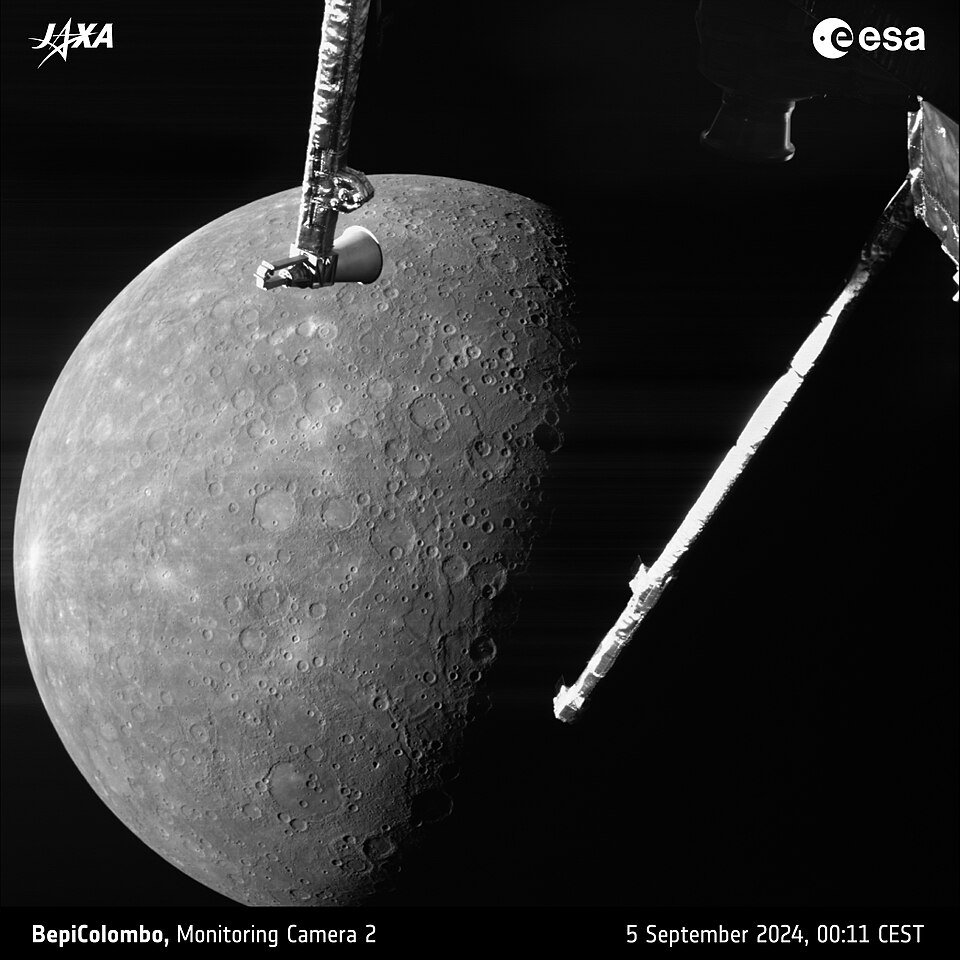
On June 15, 2026, at 15:24 CEST, a faint blue glow in space was switched off for the last time. After nearly eight years of nearly continuous firing, ESA and JAXA’s BepiColombo mission permanently shut down its solar electric propulsion (SEP) system, marking the end of its long interplanetary cruise and the beginning of the final approach to Mercury.
The command, pre-programmed and sent from ESA’s European Space Operations Centre (ESOC) in Darmstadt, Germany, was executed at the precise moment the last thrust arc completed. Lead SEP thruster engineer Neil Wallace was on hand for the milestone.
“It’s the end of an era for the propulsion team,” the ESA article noted. “But for BepiColombo, the most challenging part of the journey is just beginning.”
What the Blue Glow Was
The blue glow that BepiColombo has trailed through the inner solar system for nearly a decade is the visible plasma from its ion propulsion system. Four QinetiQ T6 electrostatic ion thrusters, mounted on the Mercury Transfer Module (MTM), used solar arrays to ionize xenon gas and accelerate the resulting ions to speeds of roughly 50 kilometers (31 miles) per second.
Unlike conventional chemical rockets, which burn propellant quickly in short bursts, ion propulsion produces very low thrust (the T6 thrusters delivered a combined maximum of 290 millinewtons, or about the weight of a sheet of paper) but can sustain it for years. The system operated at 7-14 kilowatts depending on distance from the Sun, making it one of the most efficient and flexible propulsion systems ever flown.
The characteristic blue color comes from excited xenon plasma relaxing to its ground state, the same phenomenon seen in NASA’s Dawn mission and the ion thrusters on the Psyche spacecraft. With a specific impulse of 2,000-5,000 seconds, the system used far less propellant than chemical alternatives while enabling the complex, gravity-assist-rich trajectory needed to reach the innermost planet.
A Long Road to Mercury
Launched on October 20, 2018, aboard an Ariane 5 from Kourou, French Guiana, BepiColombo has spent the past 7 years and 8 months threading through the inner solar system. Its itinerary included one flyby of Earth, two of Venus, and six of Mercury itself, each gravity assist carefully calculated to gradually lower its orbit toward the Sun.
The cruise was not without drama. In September 2024, thruster issues forced a trajectory redesign that added 11 months to the journey, pushing Mercury orbit insertion from December 2025 to late November 2026. Despite the delay, the spacecraft and its instrument payloads remain healthy.
What Comes Next
With the SEP system now silent, BepiColombo is coasting ballistically toward Mercury. The next major milestone comes on September 3, 2026, when the Mercury Transfer Module containing the ion thrusters will be jettisoned. In late November, the spacecraft will execute its critical Mercury orbit insertion, firing chemical thrusters on the Mercury Planetary Orbiter (MPO) to achieve a weak capture into a highly elliptical polar orbit with an apocenter of approximately 178,000 kilometers (110,600 miles).
Shortly after, in early December, the two science orbiters will separate: ESA’s MPO and JAXA’s Mio (Mercury Magnetospheric Orbiter) will each adjust their orbits using their own chemical propulsion systems before beginning their nominal one-year science mission, with a possible one-year extension.
Science at the Innermost Planet
Once operational, the two orbiters will tackle some of the solar system’s most persistent questions. The MPO, carrying 11 instruments, will map Mercury’s surface composition, topography, thermal characteristics, and magnetic field while also conducting radio science to test Einstein’s theory of general relativity via precise measurements of Mercury’s perihelion precession.
JAXA’s Mio, carrying five instruments, will study Mercury’s magnetic field and magnetosphere, a key puzzle given that Mars and Venus lack intrinsic magnetic fields while tiny Mercury somehow generates one. The orbiter will also analyze the planet’s tenuous sodium exosphere and search for possible water ice in permanently shadowed polar craters.
BepiColombo is the first two-orbiter mission to Mercury and the first Mercury mission for both ESA and JAXA. Only two spacecraft have visited Mercury before: NASA’s Mariner 10 (1974-1975, three flybys) and MESSENGER (2011-2015, orbiter). BepiColombo is named after Professor Giuseppe “Bepi” Colombo (1920-1984), the Italian mathematician and engineer who first explained Mercury’s 3:2 spin-orbit resonance.