

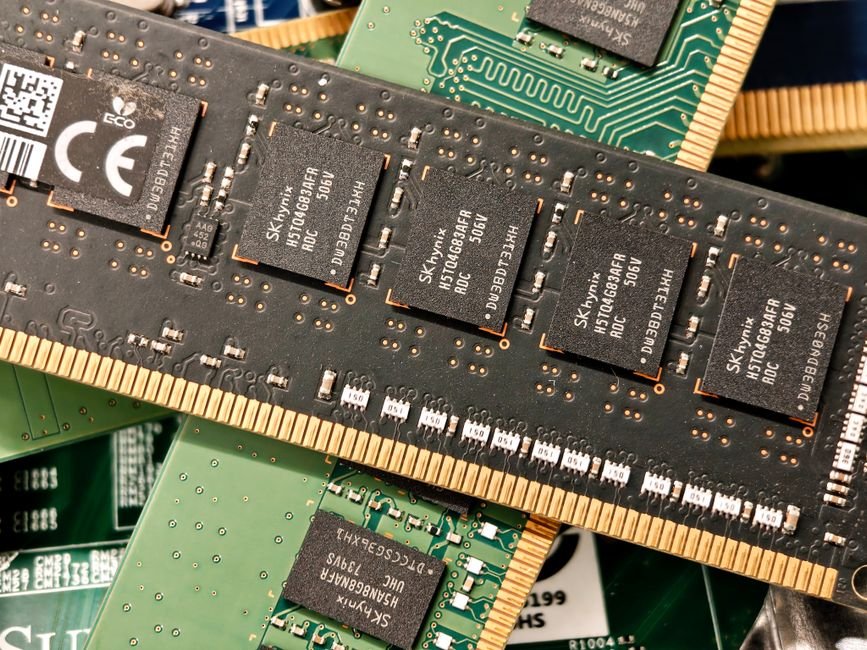
The structural shift in the memory industry from commodity DRAM to high-bandwidth memory for artificial intelligence is about to inflict its most severe blow yet on the companies that supply the modules consumers and businesses actually buy. Apacer Technology’s CEO warned July 24 that chip allocations from Samsung, SK Hynix, and Micron to independent module makers could fall by more than 70 percent year-on-year in 2027, leaving only about 30 percent of 2026 volume available for the open market.
Chia-Kun Chang, who leads the Taiwan-based memory module manufacturer, delivered the forecast during Apacer’s first-half 2026 investor conference. The greatest risk facing his company, he said, is no longer paying high prices for DRAM chips; it is obtaining any supply at all. Apacer has responded by stockpiling aggressively, growing its inventory to NT$12.4 billion, approximately $383 million, a 48 percent increase from the previous quarter, and arranging a NT$4 billion ($124 million) syndicated loan to buy more chips while they remain available.
The underlying cause is structural rather than cyclical. All three major DRAM manufacturers are steadily pivoting their wafer output toward HBM, the 3D-stacked memory used in Nvidia and AMD AI accelerators. An HBM die requires three to five times the wafer area of a conventional DDR5 die of equivalent bit capacity, and the trade ratio is widening with each generation: HBM4 and its successors consume even more silicon per chip. Roughly 60 percent of global DRAM manufacturing capacity is already directed to server applications, a share that is expected to grow.
The Big Three, Samsung, SK Hynix, and Micron, control more than 90 percent of the global DRAM market. Unlike past boom-bust cycles, they are not adding capacity aggressively. Capital spending is directed at HBM-specific fab expansions rather than general-purpose DRAM output. SK Hynix posted a 557 percent year-on-year profit increase in Q2 2026 and announced a $27 billion expansion plan tied primarily to HBM production. Multi-year supply agreements with hyperscaler customers lock up the most profitable output before it ever reaches the spot market.
The consequences cascade through the supply chain. Module makers such as Apacer, ADATA, TeamGroup, and Transcend purchase raw DRAM chips from the manufacturers, assemble them onto printed circuit boards, test them, and sell finished modules to retailers, system integrators, and industrial customers. If their allocation drops by 70 percent, the consumer DRAM market faces both scarcity and sharply higher prices. DRAM contract prices are already forecast to rise roughly 30 percent in Q3 2026, with NAND flash prices up more than 20 percent.
The squeeze extends beyond PCs. Automotive manufacturers are feeling the pinch as memory content in vehicles grows with advanced driver-assistance systems, infotainment, and electronic control units. Industry observers at TrendForce and other research firms project that severe shortages will persist at least through mid-2027, with no meaningful relief until the next wave of HBM-specific fabrication capacity comes online.
Consumers face a market where memory may account for 30 percent or more of a PC’s total component cost, compared to the historical range of 5 to 10 percent. Module makers face a more existential question: those with the balance-sheet strength to stockpile at peak prices may survive; those without may be squeezed out as the industry consolidates around the small number of players who can secure supply.
For the DRAM manufacturers themselves, the pivot is a strategic bet that AI demand will continue absorbing their highest-margin output for years to come. For everyone else in the chain, it is a test of whether the old market structure, in which independent module makers provided price competition and retail distribution, can survive the transition to a memory industry organized around direct supply to hyperscalers.
Sources: DRAM supply to module makers could drop by more than 70% in 2027 (Tom’s Hardware, Jul 29); Apacer CEO warns of severe DRAM shortage (TweakTown, Jul 29); TrendForce DRAM supply outlook 2027 (TrendForce, 2026)