

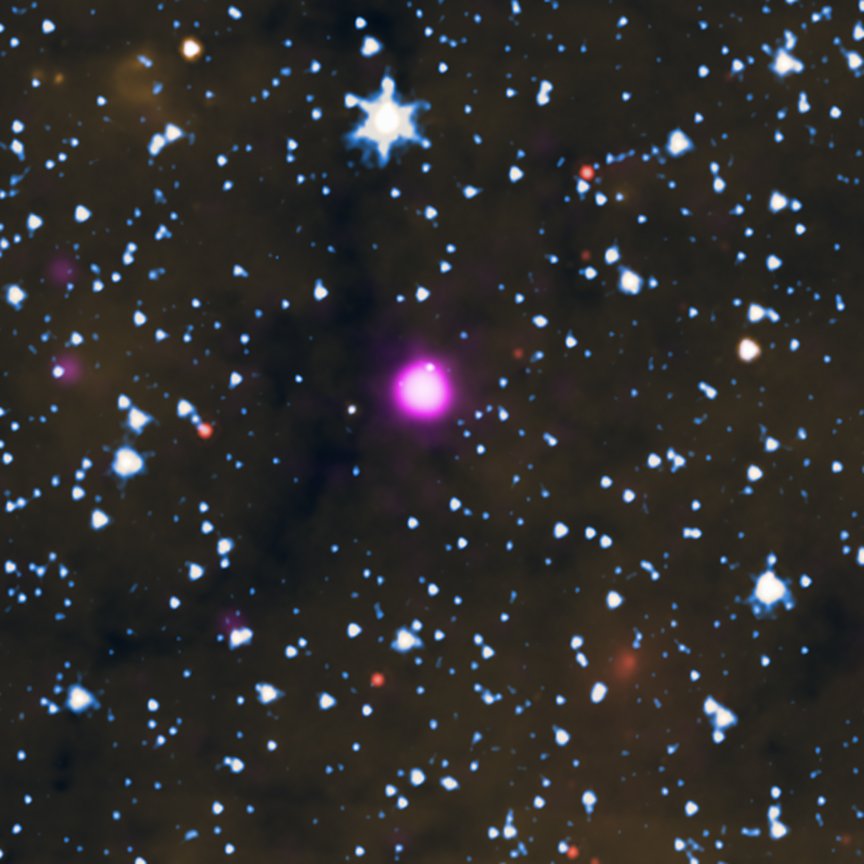
Astronomers have detected a rare damped millisecond oscillation pattern in a fast radio burst, offering one of the clearest signals yet that these enigmatic cosmic flashes originate from young, highly magnetized neutron stars.
The study, led by Shuo Xiao and Di Li of Guizhou Normal University and Tsinghua University, analyzed publicly available data from the Canadian Hydrogen Intensity Mapping Experiment (CHIME) for FRB 20190122C, a non-repeating burst detected on January 22, 2019. By examining the baseband voltage data, which provides microsecond-level time resolution, the team found that the burst consists of eight closely spaced radio sub-pulses with a characteristic separation of 3.6 milliseconds.
That translates to a quasi-periodic oscillation at roughly 280 hertz, in the range expected for vibrations of a neutron star crust.
An exponential fingerprint
What makes this burst stand out from the roughly 140 other multi-component FRBs examined in the CHIME archive is the pattern of its pulses. After the initial peak, the amplitude of each successive pulse decays exponentially, following a clean mathematical decline. The damping timescale is 2.24 pulse components, and the significance of the exponential pattern is 3.2 sigma, meaning the probability of it occurring by chance is approximately 0.16 percent.
“This is the first reported case of an exponentially decaying quasi-periodic oscillation in any FRB,” the authors note in the paper, which is posted on arXiv (2601.03950).
The exponential damping envelope is reminiscent of quasi-periodic oscillations seen in the tails of magnetar giant flares from within our own galaxy, such as the famous 2004 flare from SGR 1806-20 and the 1998 flare from SGR 1900+14. Those oscillations are thought to be crustal vibrations excited by starquakes on magnetars, neutron stars with magnetic fields a thousand times stronger than ordinary pulsars.
Connecting to magnetar physics
The 3.6-millisecond pulse spacing allows the team to make two key inferences about the source. Using the Alfven velocity, the speed at which magnetic disturbances travel through the neutron star’s interior, the observed oscillation frequency implies a local surface magnetic field of roughly 10^12 gauss, compatible with low-field magnetars such as SGR 0418+5729.
A separate scaling relation between microstructures and rotation periods, established by Kramer and colleagues in 2024, suggests the central neutron star has a rotation period of roughly 3.6 seconds, well within the known range for magnetars.
The absence of any frequency drift in the pulse spacing over the burst’s roughly 30-millisecond duration rules out a binary merger as the origin. Merger scenarios typically produce rapidly evolving pulse timing as the two objects spiral together.
Recent theoretical work supports the interpretation. Simulations by Burnaz and colleagues (2025) and Qu and Bransgrove (2025) showed that crustquakes on magnetars can excite Alfvenic disturbances that would imprint quasi-periodic oscillations on FRB-like radio emission. This observation lines up well with those predictions.
Statistical caution
The authors are careful to note that the periodic signal does not quite reach the conventional discovery threshold. The false-alarm probability is 0.009 if the eight-component structure is taken as given, and 0.019 when accounting for the random chance of seeing any number of components. The damping envelope, however, is more significant at 3.2 sigma.
Among the 140 CHIME/FRB bursts with baseband data examined, only 10 contain more than five components. FRB 20190122C shows the clearest structure of any of them, and it is the only one exhibiting an exponential amplitude decay.
The dispersion measure of FRB 20190122C is 690 parsecs per cubic centimeter, indicating that the burst traveled through a substantial amount of ionized gas on its way to Earth. The burst’s fluence was 120 jansky-milliseconds, with a peak flux density of 13 janskys.
The study, which is currently under peer review, was conducted by researchers at Guizhou Normal University, the Guizhou Provincial Key Laboratory of Radio Astronomy and Data Processing, Tsinghua University, the National Astronomical Observatories of the Chinese Academy of Sciences, and Zhejiang Lab. The public data is available through the CHIME/FRB collaboration.