

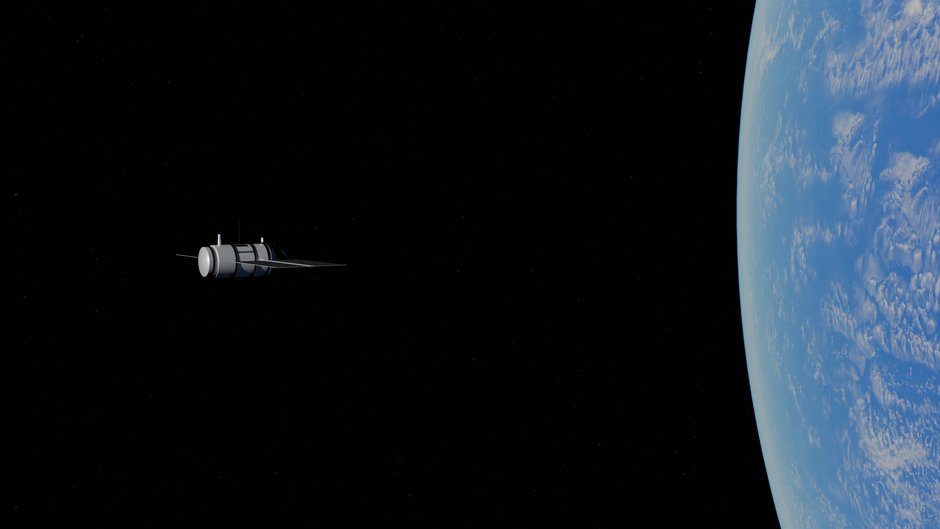
A spacecraft built by the startup Katalyst Space Technologies to lift NASA’s Neil Gehrels Swift Observatory to a higher orbit is spinning out of control, raising doubts about the first-ever commercial contract of its kind.
The LINK servicing vehicle, launched July 3 on a Northrop Grumman Pegasus XL rocket from Kwajalein Atoll, suffered a dual failure over the final weekend of July. Two of its three reaction wheels (the primary system for attitude control) have stopped functioning. The cold gas thrusters that serve as the backup maneuvering system have also partially failed. The combination has sent LINK into a multi-axis tumble, causing intermittent communications as its antenna loses lock with ground stations.
Katalyst Space, based in Flagstaff, Arizona, designed, built, tested, and launched LINK in under 12 months on a budget of approximately $30 million. The target is Swift, a gamma-ray burst observatory launched in 2004 that has drifted down to roughly 302 km (188 mi) of altitude from its original orbit of about 600 km (373 mi). Without a boost, the telescope will re-enter Earth’s atmosphere within months.
NASA awarded Katalyst the contract in late 2025 as a test of commercial satellite servicing, the agency’s first hire of a private company to extend the life of one of its own observatories. The mission’s pre-launch odds, as assessed by NASA astrophysicist Regina Caputo, were around 50-50. The spacecraft itself was designed to be expendable: three articulated arms for grappling and towing, electric Hall-effect thrusters for orbit raising, and a rendezvous sensor suite.
Those Hall-effect thrusters, originally intended for the orbit-raising phase, are now the primary tool for recovery. Flight controllers have begun using them in a series of burns to slow LINK’s spin rate. Katalyst stated that the burns are producing the intended effect, though full stabilization will take weeks.
The recovery plan proceeds through several stages. First, the spacecraft must be brought under full attitude control using only the remaining reaction wheel and whatever thruster capability remains. The guidance, navigation, and control software must then be rewritten and tested on the ground to compensate for the altered hardware configuration. Only after that can LINK attempt to maneuver into a co-elliptical orbit with Swift, perform inspection and rendezvous operations, and finally attempt a capture.
Each step is contingent on the previous one succeeding. NASA has stated that the decision to attempt the Swift rendezvous will be made only after LINK’s health is fully assessed and the approach can be conducted safely.
The stakes extend beyond Swift and its $250 million original cost. A successful capture would validate the commercial satellite-servicing model, opening a market for extending the life of expensive orbital assets. A failure would reinforce the view that on-orbit servicing, despite decades of study, remains technically premature for operational missions.
Katalyst chief engineer Kieran Wilson acknowledged before launch that the risks were substantial, noting that many spacecraft with far longer development cycles and far more funding have failed for mundane reasons. The warning has proved prescient. The next 30 to 60 days will determine whether the company can turn a tumbling prototype into the first operational commercial space tug.
Sources: The robot NASA hired to lift an orbital telescope is tumbling out of control (TechCrunch, Jul 28); NASA Science Blog: LINK Commissioning Update (NASA, Jul 28); Katalyst Space LINK mission page (Katalyst Space, 2026); Neil Gehrels Swift Observatory (Wikipedia, launched 2004)