

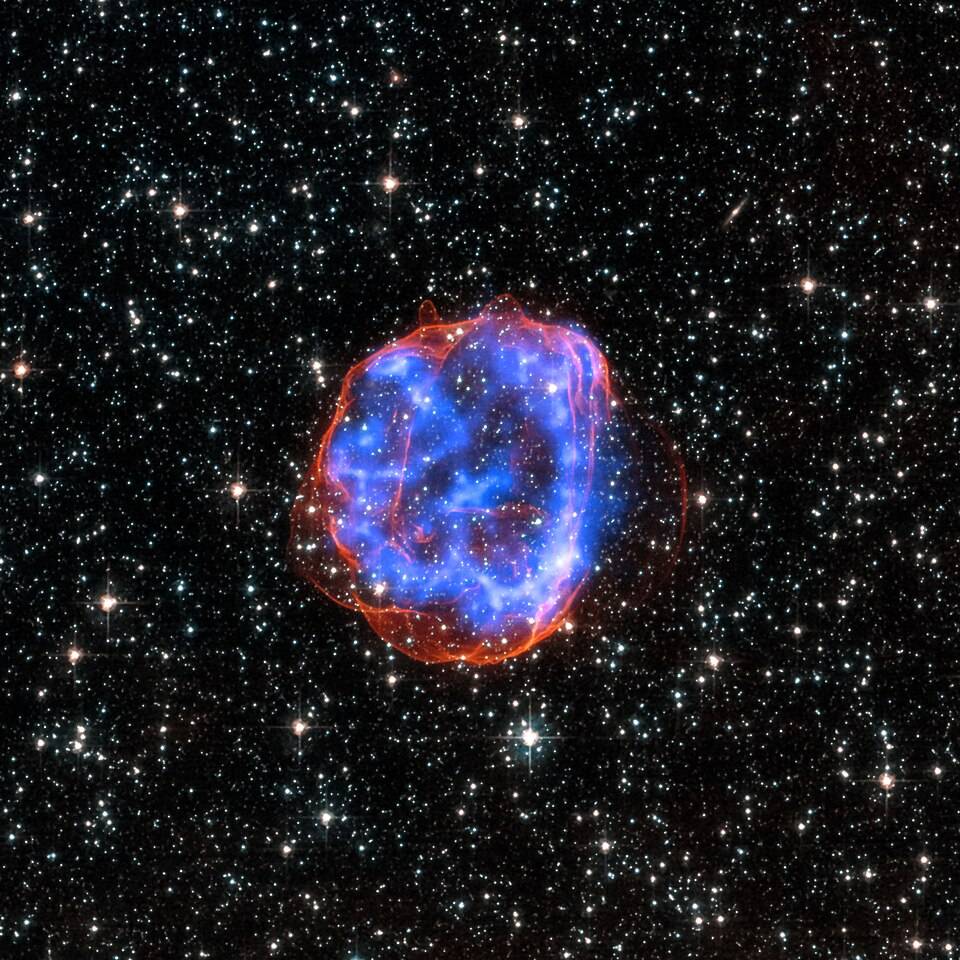
Exploding stars have left their radioactive fingerprint on our planet. A new study published in Nature Astronomy has detected traces of radioactive iron and plutonium in deep-sea crust samples, revealing that Earth has been gently dusted with the debris of nearby supernovae and a much rarer neutron star merger over the past 10 million years.
The discovery provides the clearest picture yet of how the products of stellar explosions travel through interstellar space and accumulate on Earth, while also settling a long-standing debate about the origin of the heaviest elements in the universe.
Three isotopes, two cosmic sources
An international team led by Dr. Dominik Koll of the Helmholtz-Zentrum Dresden-Rossendorf (HZDR) analyzed a 1.9-kilogram ferromanganese crust recovered from the Pacific Ocean floor in 1976 at a depth of 4,830 meters. These crusts grow millimeter by millimeter over millions of years, absorbing and preserving interstellar material like a natural recording tape.
The team divided the crust into nine layers, each representing roughly 1 million years of growth, and measured three radioactive isotopes: iron-60, plutonium-244, and curium-247.
The results told two distinct stories. Iron-60 (half-life 2.6 million years) appeared in two clear peaks at approximately 2.5 million and 7 million years ago, confirming that two nearby core-collapse supernovae within a few hundred light-years rained material on Earth. These findings align with previous studies that had mapped iron-60 in deep-sea sediments and Antarctic ice.
But plutonium-244 (half-life 81 million years) told a different tale. The isotope was found in a constant, uniform drizzle across all nine layers, showing no correlation with the iron-60 peaks. This steady signal points to a much older source: a kilonova, the explosive merger of two neutron stars, that occurred more than 100 million years ago.
“We searched for both iron-60 and plutonium-244 and compared the traces,” said Koll. “Iron-60 is a clear fingerprint of conventional supernovae.”
The curium clue
The key piece of evidence came from curium-247. With its 15.6-million-year half-life, this isotope should still be detectable if a kilonova had occurred within the past 100 million years or so. But the team found none beyond trace amounts from 20th-century nuclear weapons testing.
“The absence of curium-247 tells us it happened a very long time ago,” said Dr. Michael Hotchkis of the Australian Nuclear Science and Technology Organisation (ANSTO), who performed the plutonium and curium measurements using the VEGA accelerator, the world’s most sensitive instrument for heavy rare isotopes. “But not more than about 1 billion years ago, otherwise the plutonium-244 would also be undetectable.”
The sample contained just 77 extraterrestrial plutonium-244 atoms out of 286 total detected (the rest came from nuclear bomb tests). The sensitivity was extraordinary: the team could detect roughly 100 plutonium atoms hidden among 10 sextillion (10^22) background atoms.
“A plutonium atom hides in about ten sextillion other atoms,” Hotchkis said.
What it means for life on Earth
The amounts involved are vanishingly small. “It’s such a light drizzle that physicists struggle just to prove it’s there,” the authors note. The team was able to detect plutonium in only two of the nine layers at sufficient concentrations to confirm an interstellar origin.
Nevertheless, the question remains open whether such events could have affected life on Earth. Prof. Brian Fields of the University of Illinois Urbana-Champaign, who provided external commentary, noted that the findings open the door to investigating possible links between nearby supernovae and evolutionary changes.
The team plans to extend the analysis further back in time. “We have plans to go back to about 25 million years with crust dating and several hundred million years with lunar samples,” said Koll.
Why this matters for nucleosynthesis
Perhaps the most important implication is what the study reveals about the origin of the heaviest elements. The non-correlation of plutonium-244 with iron-60 proves that supernovae alone cannot account for all r-process elements (elements heavier than iron produced by rapid neutron capture). Neutron star mergers, or kilonovae, are essential contributors.
Prof. Anton Wallner, senior author at HZDR and the Australian National University, explained: “Our results suggest that the plutonium originated from very rare cosmic explosions, such as those that would occur during the merger of two neutron stars or in extremely energetic supernovae.”
These rare events are 1,000 to 10,000 times less frequent than ordinary supernovae. The solar system has traveled roughly halfway around the galaxy since that ancient kilonova, making it impossible to pinpoint its exact location.
The study was published in Nature Astronomy (DOI: 10.1038/s41550-026-02841-6). Co-authors include researchers from HZDR, ANSTO, the Australian National University, and collaborating institutions.