

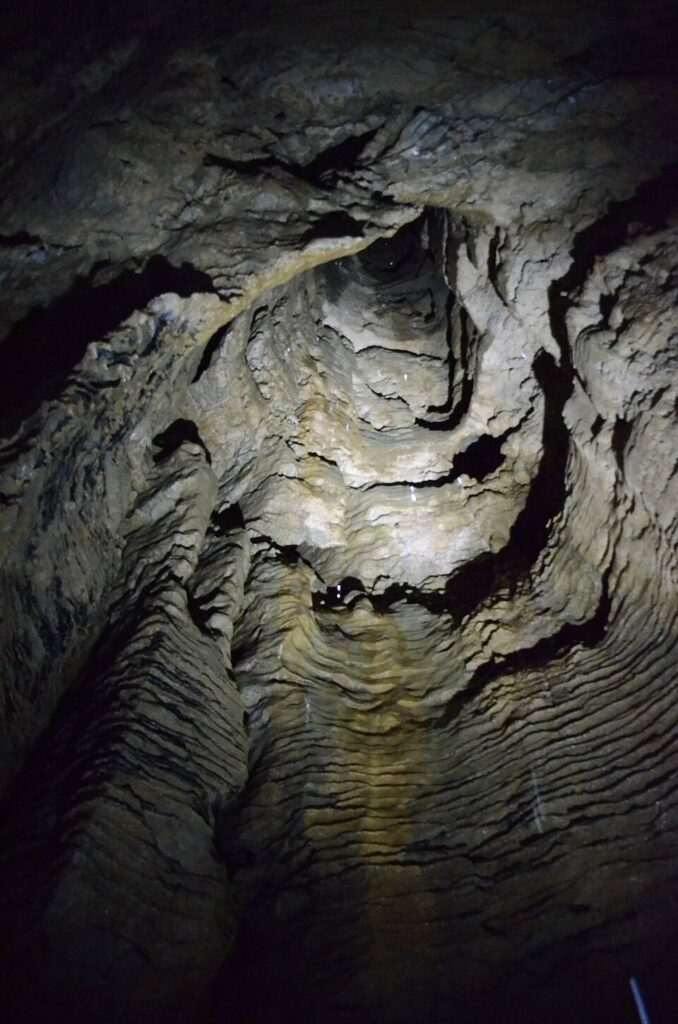
A collapsed cave near Waitomo on New Zealand’s North Island has yielded the first large terrestrial vertebrate fossil assemblage from the Early Pleistocene in the country’s history, and it tells a surprising story: between one-third and one-half of the bird species found in the deposit went extinct in the million years before humans ever reached New Zealand.
The finding, published in Alcheringa: An Australasian Journal of Palaeontology by Trevor Worthy at Flinders University and colleagues from the Canterbury Museum, Victoria University of Wellington, and the University of Auckland, fills what the researchers call a “missing volume” of New Zealand’s fossil record, bridging a 15-million-year gap between well-known Miocene deposits and the Late Pleistocene-Holocene record.
The time capsule
The fossils were preserved in a cave deposit sandwiched between two precisely dated volcanic ash layers: the Ngaroma eruption at 1.55 million years below and the Kidnappers supereruption at 1 million years above. A speleothem date of 535,000 years at the sediment’s top surface provides an additional upper bound. This puts the age of the fossil bed at approximately 1 million years, making it the only Early Pleistocene terrestrial vertebrate site in New Zealand.
The team recovered 12 bird species and four frog species from the site. Among the birds was a new species of probable flying kākāpō ancestor, named Strigops insulaborealis, with weaker legs than the modern flightless kākāpō, suggesting it still retained the ability to fly. A second new species, Porphyrio claytongreenei, is an extinct ancestor of the takahē. A phabine pigeon related to Australian bronzewing pigeons was also identified, marking the first record of this group in the New Zealand avifauna.
Unexpected extinction before humans
The conventional narrative of New Zealand’s biodiversity loss centers on human arrival approximately 750 years ago, which brought hunting, habitat destruction, and introduced predators that drove the moa, Haast’s eagle, and numerous other species to extinction. The Waitomo cave fossils show that extinctions were happening at substantial rates well before humans arrived.
At least four to six of the 12 bird species found in the cave are not known from any Late Pleistocene or Holocene sites, meaning they went extinct within the million-year window before human arrival. The researchers estimate 33 to 50 percent species turnover over that period.
The likely drivers are volcanism and climate, not human activity. The Kidnappers supereruption approximately 1 million years ago blanketed much of the North Island in meters of ash. At the same time, glacial-interglacial climate oscillations were intensifying, repeatedly shifting New Zealand’s landscape between forest and shrubland. These natural forces were, as the authors put it, already sculpting the unique identity of New Zealand’s wildlife over a million years ago.
Filling the gap
New Zealand’s modern terrestrial vertebrate fossil record had a conspicuous gap. The St Bathans Fauna, dated to 20 to 16 million years ago, was well studied. The Late Pleistocene and Holocene record was also well documented. But almost nothing was known from the intervening 15 million years.
“This was not a missing chapter in New Zealand’s ancient history, it was a missing volume,” said Paul Scofield of the Canterbury Museum.
The Waitomo cave deposit represents a single snapshot in time at approximately 1 million years ago. Additional Early Pleistocene sites will be needed to confirm whether the species turnover observed here is representative of broader patterns. The team is actively searching for other cave deposits of similar age across New Zealand.
Source: Worthy, T.H., Scofield, R.P., Suresh, S. et al. The first Early Pleistocene (ca 1 Ma) fossil terrestrial vertebrate fauna from a cave in New Zealand reveals substantial avifaunal turnover in the last million years. Alcheringa 50(1), 480-519 (2026). DOI: 10.1080/03115518.2025.2605684