

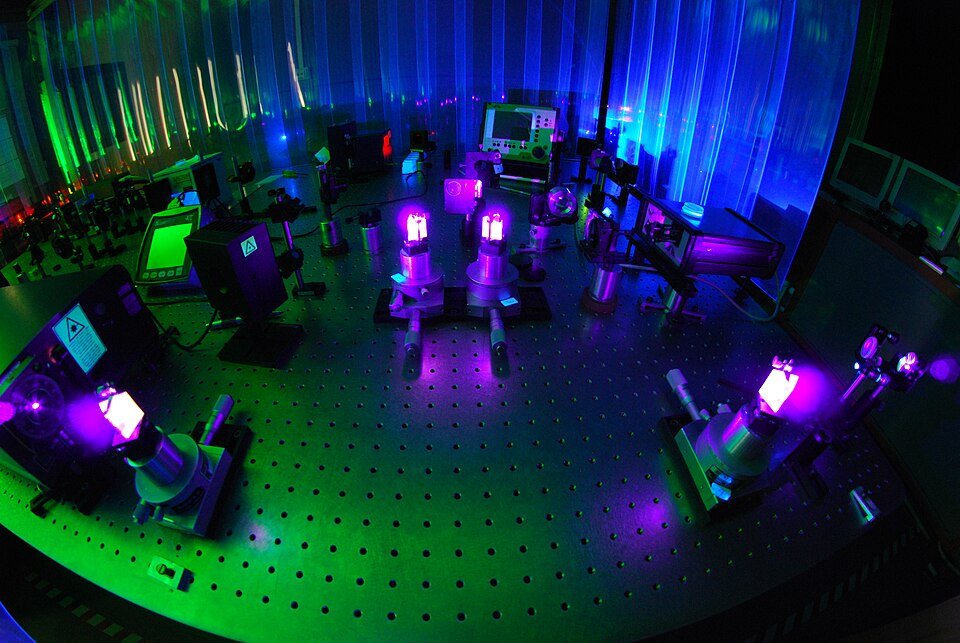
For the first time, quantum teleportation has outperformed the best possible direct transmission of photons through an identical lossy channel. The experiment, led by Jian-Wei Pan and Chao-Yang Lu at the University of Science and Technology of China, achieves what the researchers call an “unconditional advantage” for teleportation over direct state transfer.
The finding, published in Nature Physics on June 23, represents a fundamental milestone in quantum communication. Previous teleportation demonstrations, while conceptually important, could never beat the simple approach of just sending the photon directly. The overhead of generating and distributing entanglement always made teleportation less efficient in practice.
What they did
The team built an all-optical remote entanglement preparation scheme that creates heralded entangled photon pairs across a lossy channel without using matter-based quantum memories. When the heralding signal indicated readiness, the entangled pair was present with 82 percent efficiency through an effective 15 decibel channel loss.
Direct transmission of single photons through the same channel would yield at most approximately 1 percent transmission efficiency. Even with optimal quantum-state cloning, the best possible classical strategy, the maximum achievable transmission probability at their achieved fidelity of 0.826 is only 2.1 percent.
Using the pre-distributed entanglement, the researchers performed quantum teleportation of single-photon states with an average fidelity of 0.826 plus or minus 0.019, exceeding the classical bound of two-thirds. The teleportation scheme transmitted the quantum state with a 2.95-fold enhancement over direct transmission, and beat the optimal cloning bound by 18.6 standard deviations.
Why this matters
The result establishes what the team calls a “teleportational advantage,” placing it alongside other celebrated quantum advantages: quantum computational advantage (demonstrated by Sycamore and Zuchongzhi processors), quantum metrological advantage, and quantum learning advantage.
The practical significance is that teleportation can now overcome photon loss, which is the single biggest barrier to long-distance quantum communication. The experiment functions as a three-node quantum relay and is compatible with quantum memories and heralded entanglement purification, making it a building block for future large-scale quantum networks.
Potential applications include loophole-free Bell tests over long distances, device-independent quantum key distribution, and quantum repeaters that interconnect distant quantum computers.
How it works
The core insight is that teleportation decouples the transmission of quantum information from the physical transport of the carrier particle. Instead of sending a single photon through a lossy channel where it has a high probability of being absorbed or scattered, the team first distributes entanglement across the channel, then uses the entanglement to teleport the quantum state. The heralding signal tells them when the entanglement is ready, converting a probabilistic process into an effectively deterministic one.
The all-optical approach is significant because it avoids the complexity and bandwidth limitations of matter-based quantum memories. The entire protocol runs on photonic hardware, which is compatible with existing fiber-optic infrastructure.
Caveats
The experiment was performed in a controlled laboratory setting, not over deployed fiber. The 15 dB channel loss is substantial but was implemented in a tabletop configuration. Extending the same protocol to kilometer-scale distances will require improvements in photon source brightness, detector efficiency, and entanglement distribution rates.
The heralding efficiency of 82 percent, while transformative for a proof-of-principle demonstration, would need to approach 99 percent or higher for practical quantum repeater applications. The experiment also used single-photon-level states; teleportation of more complex quantum states, such as those used in quantum computation, remains a significant additional challenge.
The rapid pace of improvements in photonic quantum technology from Pan’s group, which has set multiple world records in entanglement distribution and quantum communication over the past decade, suggests that many of these limitations may be addressed in the near term.
Source: Peng, L-C., Wu, D., Li, Y. et al. Unconditional advantage of quantum teleportation over direct transmission of single photons through a lossy channel. Nature Physics (2026). DOI: 10.1038/s41567-026-03348-7