

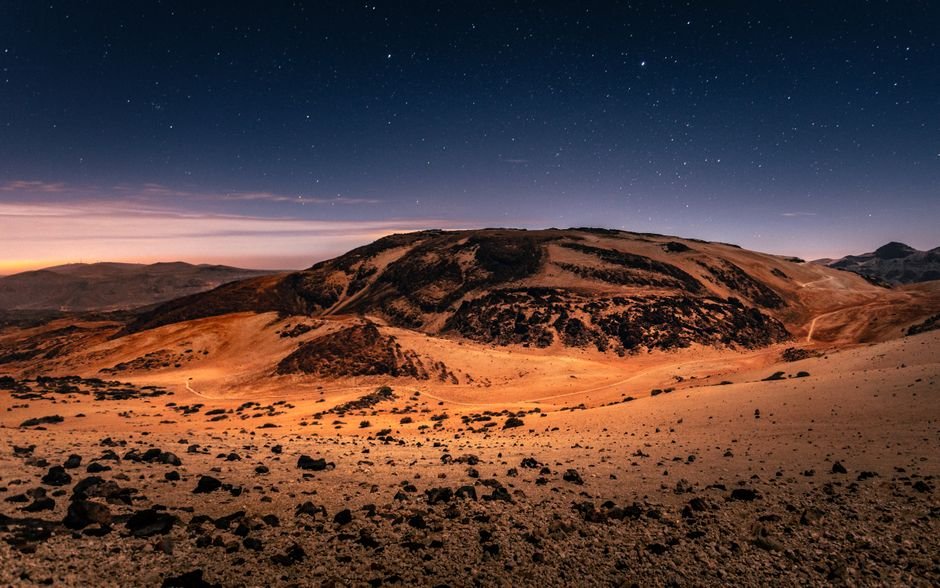
Mars Express Spots Dunes That Look Like Liquid Metal Rolling Across an Ancient Crater
An image from the European Space Agency’s Mars Express orbiter shows what appears to be a pool of liquid metal frozen mid-ripple across the floor of an ancient impact basin. The metallic sheen is an optical illusion, but the geology behind it is real and telling.
The feature is Kaiser Crater, a 180-kilometer-wide (112-mile) impact basin in the Noachis Terra region of Mars’s southern highlands. The crater floor, several kilometers deep, is covered in sand dunes made of dark volcanic material rich in pyroxene and olivine. The image was taken during the second half of the Martian southern winter by the orbiter’s High Resolution Stereo Camera (HRSC), a joint project of Freie Universitat Berlin and the German Aerospace Center (DLR).
The metallic appearance comes from contrast. Seasonal hoarfrost creeping up from the south pole to mid-latitudes clings to the southern slopes of the dunes, leaving a bright white coating. The stark boundary between the white frost and the nearly black volcanic sand creates the illusion of polished metal. The dunes themselves are massive, exceeding 100 meters (330 feet) in height and stretching for several kilometers.
The dune field reveals two distinct patterns. Crescent-shaped barchan dunes sit at the edges with their horns pointing downwind. Nearer the center, long parallel transverse ridges run perpendicular to the prevailing wind, which comes from the west. These shapes allow planetary scientists to reconstruct local wind patterns on a planet that no longer has weather stations at most latitudes.
Other features in the image include light-colored clay deposits near the dune field, exposed by wind stripping away the topsoil. These minerals formed in the presence of water, hinting at a wetter past. Narrow gullies cut into the steep inner walls of the crater, possibly carved by dry landslides or melting ice from an earlier epoch.
Mars Express has been in orbit since 2003, making it one of the longest continuously operating missions at Mars. More than two decades into its mission, the spacecraft continues to deliver both scientific data and images that challenge how we see the planet’s surface.
Images:
- ESA Mars Express Kaiser Crater image: https://www.esa.int/ESA_Multimedia/Images/2026/07/Metallic_waves_on_Mars
- Freie Universitat Berlin HRSC image archive: https://www.fu-berlin.de/mars-express-hrsc