

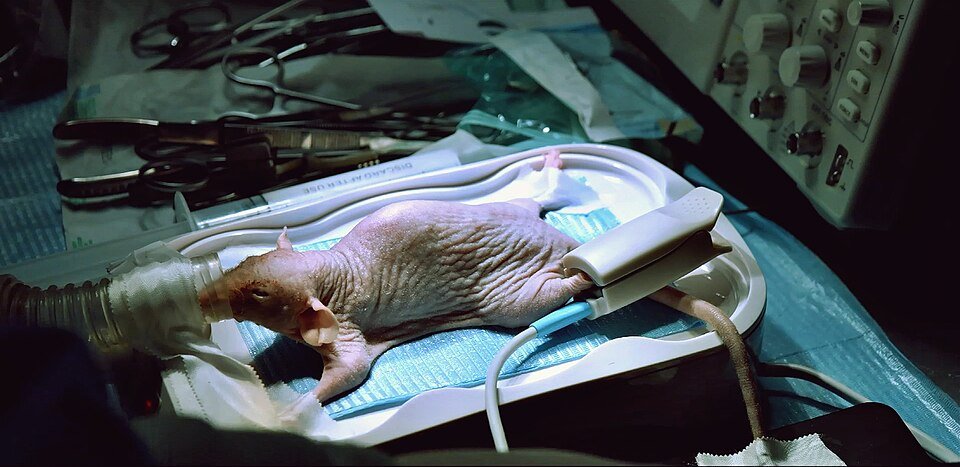
Researchers in Russia have reported that a chemical gel applied to the severed ends of a completely transected spinal cord can restore walking in pigs within two months. The approach, which the team calls “fusogenic neurosurgery,” uses polyethylene glycol and chitosan to physically fuse severed axonal membranes rather than waiting for slow natural regeneration.
The study, published in PLOS ONE on June 10 by a team led by Michael Lebenstein-Gumovski at the Sklifosovsky Research Institute in Moscow, represents a proof of concept that membrane fusion chemistry can restore functional continuity across a complete spinal cord lesion, something that has never been convincingly demonstrated in a large animal model.
But the results come with substantial caveats that experts say must be addressed before any human trials can be justified.
The procedure
Five female Hungarian Mangalica pigs underwent complete surgical transection of the spinal cord at the T8 thoracic vertebra under general anesthesia. The surgical field was cooled with ice slurry to 0 C for one minute before cutting, a non-physiological precondition that drew immediate criticism from independent researchers.
In three experimental animals, the surgeons immediately applied a gel containing polyethylene glycol (PEG) and chitosan directly into the spinal gap. PEG is a well-known membrane fusogen: it dehydrates and apposes lipid bilayers, causing severed axonal ends to fuse. Chitosan, derived from crustacean shells, acts as a sealant and supportive scaffold. The experimental group also received daily intravenous PEG-600 infusions for seven days postoperatively.
The two control animals received surgery without the fusogen.
All animals received daily electromyostimulation, rigid spinal fixation with screws and rods, and continuous encouragement to stand, an intensive rehabilitation regimen that the authors acknowledge contributed to the functional outcomes.
The results
The timeline of recovery was strikingly rapid. Experimental animals showed sensory responses to pinpricks in the hind limbs by postoperative day 2. Motor attempts began by day 7. By day 18, they could stand with support. By day 60, all three experimental animals walked on all four limbs with an unsteady but clearly coordinated gait.
Control animals remained completely paralyzed throughout the 60-day observation period.
Histological examination revealed axonal bridges of twisted, thickened NF-200-positive axons traversing the injury site. Retrograde tracing with FluoroGold confirmed that dye transported across the lesion, proving axonal continuity. In controls, the injury zone showed Wallerian degeneration, cysts, glial scar formation, and no axon crossing.
Neurological scale comparisons between experimental and control groups yielded p < 0.001.
Why it might work
The mechanism is fundamentally different from regeneration. The rapid timeline, sensation at 48 hours, motor attempts at 7 days, is far too fast for axons to grow across the gap de novo. Instead, the PEG-chitosan gel appears to fuse the severed axonal membranes directly, restoring physical continuity within minutes to hours.
Fusogenic neurosurgery, as the team calls it, is a repair strategy rather than a regrowth strategy. It does not require axons to navigate a hostile glial scar environment; it simply reconnects them at the cut site. This is conceptually analogous to splicing a severed electrical cable rather than growing a new one.
The caveats
The study has drawn skepticism from spinal cord injury researchers for several reasons.
The sample size is tiny, five animals total, three experimental and two control. There was no blinding of surgeons, although assessors were reportedly blinded. The team did not perform electrophysiological confirmation of complete transection immediately after cutting, meaning critics cannot rule out the possibility that some neural fibers were spared. Melissa Andrews at the University of Southampton, quoted by New Scientist, noted that the cooling of the cord before cutting is a major caveat: real spinal cord injuries involve crushing, contusion, hemorrhage, and delayed presentation, not a clean cut under controlled hypothermia.
The injury model is acute, treatment was applied at the time of injury. This bears no resemblance to the clinical reality of chronic spinal cord injury, which affects over 15 million people worldwide, most of whom sustained their injury months or years ago.
The presence of Sergio Canavero as a co-author raises credibility concerns. Canavero has a long history of making extraordinary claims, including a 2015 announcement that human head transplants would be possible within two years, which never materialized.
Even if the axonal fusion works, the spinal cord is not a passive cable. It contains axons projecting to diverse targets, interneurons, immune cells, and blood vessels. Random reconnection could produce spurious signals including pain, spasticity, or loss of coordination rather than functional recovery. Prior mouse work suggests that functional recovery after axonal fusion requires guiding axons to their natural targets.
The pig spinal cord is also smaller and simpler than the human cord. The distance axons must traverse and the complexity of neural circuits are substantially greater in humans.
What’s next
The authors acknowledge the need for larger studies with independent replication and electrophysiological verification before any human trials can be justified. The regulatory landscape is shifting: Russia is adding nerve tissue to its authorized transplant list effective September 1, 2026, becoming the first country to explicitly permit spinal cord allograft procedures.
For now, the study remains a provocative but preliminary demonstration that membrane fusion chemistry can produce functional recovery in a large animal model. Whether the approach can be translated to human spinal cord injury, acute or chronic, is an open question that will require far more evidence to answer.
Source: Lebenstein-Gumovski, M., Rasueva, T., Kovalev, D. et al. Fusogen-induced recovery of spinal cord function and morphology after complete transection. PLOS ONE (2026). DOI: 10.1371/journal.pone.0349579