

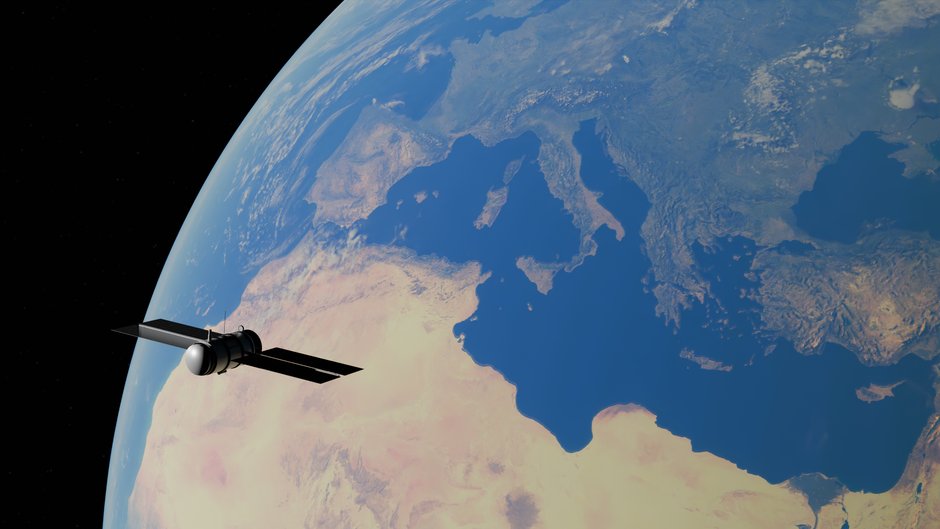
Europe’s Galileo satellite navigation constellation has grown stronger with the official entry into service of two new satellites, leaving only four first-generation spacecraft remaining to be launched.
SAT 33 and SAT 34, launched together on an Ariane 6 rocket on December 17 last year, received their operational authorization from the EU Space Programme Security Accreditation Board in May and July respectively. SAT 34’s authorization on July 23 marked the full deployment of the L14 mission satellites within the constellation.
A Near-Perfect Insertion
The launch achieved what ESA described as the most precise orbital injection ever recorded for Galileo, a near-perfect insertion that confirmed Ariane 6’s high performance. Galileo is the only program to have flown satellites of the same mass to the same orbit on four different launcher families: Soyuz, Ariane 5, Falcon 9, and now Ariane 6.
Satellite separation occurred about four hours after launch, followed by signal acquisition and solar array deployment. Mission operators at the Galileo Control Centre in Germany then spent months guiding the satellites through their commissioning phase.
In early 2024, the satellites transmitted their first signal-in-space to ESA’s in-orbit testing station in Redu, Belgium, opening the payload testing campaign. Teams configured and validated the navigation payload, atomic clocks, transponders, and security functions while maneuvering the satellites to their precise orbital slots at 23,222 kilometers altitude.
The State of the Constellation
Galileo is the world’s most precise satellite navigation system, serving over five billion smartphone users globally since entering Open Service in 2016. All smartphones sold in the European Single Market are now guaranteed Galileo-enabled, and the system is used across rail, maritime, agriculture, financial timing, and rescue operations.
With 34 satellites now operational, the constellation has achieved enhanced system redundancy and continuous data provision. Four Galileo First Generation satellites remain to be launched, with the next pair planned for the end of 2026.
Galileo is a flagship program of the European Union, managed and funded by the European Commission. ESA leads the design, development, and qualification of space and ground systems and procures launches. The EU Agency for the Space Programme acts as the service provider.