

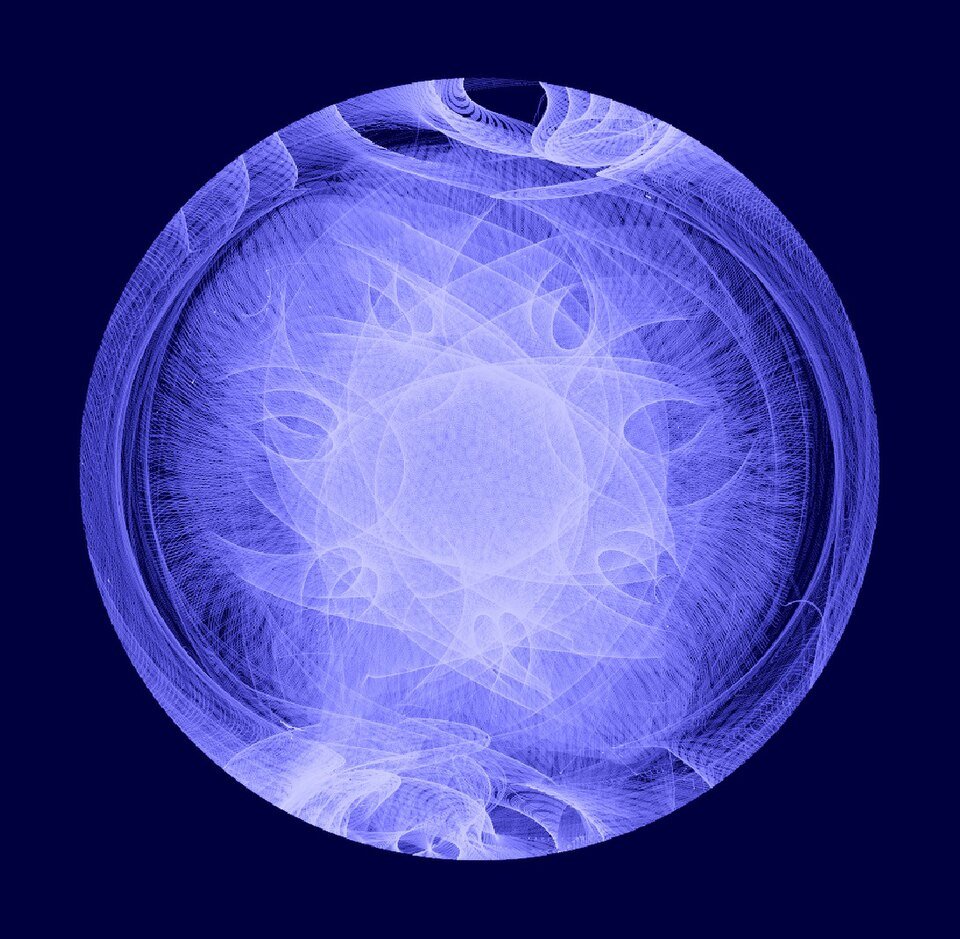
For more than a decade, a faint spherical glow of gamma rays emanating from the heart of the Milky Way has divided astrophysicists. Known as the Galactic Center Excess (GCE), this high-energy signal has been interpreted as either the long-sought fingerprint of dark matter annihilation or the combined light of tens of thousands of rapidly spinning dead stars. A new machine-learning study published in Physical Review Letters has now shifted the balance of the debate, showing that dark matter remains a viable explanation.
The research, led by Florian List of the University of Vienna and Nicholas Rodd of Lawrence Berkeley National Laboratory, applied a novel machine-learning technique to over one million simulated gamma-ray observations of the galactic center. For the first time, the analysis incorporated the energy of each individual detected photon alongside its spatial position, a dimension that previous studies had overlooked.
“The origin of the Galactic Center Excess is one of the longest-running debates in astrophysics,” List said. “Our work does not show that dark matter is responsible for the signal. However, it suggests that it is still too early to rule out this possibility.”
A Signal With No Consensus
The GCE was first detected in 2009 by the Large Area Telescope aboard NASA’s Fermi Gamma-ray Space Telescope, initially flagged by Dan Hooper and Lisa Goodenough in a landmark 2011 paper. The emission forms a roughly spherical halo stretching thousands of light-years around the galactic nucleus, peaking at energies of a few gigaelectronvolts (GeV), consistent with the theoretical signature of self-annihilating weakly interacting massive particles (WIMPs), the leading class of dark matter candidates.
Dark matter accounts for approximately 85 percent of all matter in the universe. It is invisible because it does not interact with light or ordinary atoms, but some proposed WIMP particles have a crucial property: they are their own antiparticles. When two such particles meet, they annihilate, producing a flash of gamma rays. This process would be most intense where dark matter is most densely concentrated, such as the galactic center.
The competing explanation involves millisecond pulsars: neutron stars that rotate hundreds of times per second, emitting beams of radiation like cosmic lighthouses. A large enough population of these objects near the galactic center could, in aggregate, produce the observed gamma-ray glow.
Previous statistical analyses of the GCE’s spatial structure had favored the pulsar interpretation. These studies found that the emission appeared “clumpy,” consistent with many discrete faint sources rather than the smooth diffuse signal expected from dark matter distributed throughout a halo. This spatial argument became one of the primary reasons many researchers had effectively set aside the dark matter hypothesis.
The Missing Dimension: Photon Energy
The new study changed the game by asking a question no one had asked before: what if the energy of each photon carries information that can distinguish between pulsars and dark matter?
“We developed a machine-learning method trained on more than a million simulated gamma-ray observations,” the team explained. The method evaluated spatial and spectral information simultaneously for the first time, allowing the researchers to test whether the observed GCE could be explained by a population of unresolved point sources, and if so, how bright and how numerous those sources would have to be.
The results were striking. Earlier analyses had pointed to comparatively bright but unresolved point sources, consistent with a few hundred to a few thousand pulsars. The new analysis, incorporating energy information, showed that any point sources responsible for the GCE would have to be extremely faint: at least 35,000 millisecond pulsars would be required, an order of magnitude more than previously assumed.
“Our new analysis shows that the sources would have to be so faint that they would be almost indistinguishable from the emission expected from annihilating dark matter,” Rodd said.
What This Means for the Dark Matter Hunt
The finding does not confirm that dark matter is responsible for the GCE. The study detected no direct dark matter signal, and the pulsar hypothesis has not been ruled out. What the research has done is dismantle one of the strongest arguments against the dark matter interpretation.
Previous spatial-only analyses had suggested that the clumpiness of the GCE pointed decisively toward pulsars. By incorporating spectral information, the new work revealed that those same pulsars would need to be far fainter and far more numerous than anticipated, blurring the line between the two explanations. A population of 35,000 extremely faint millisecond pulsars is not physically impossible, but it represents a far more extreme demand on the pulsar model than had previously been recognized.
The debate over the GCE now stands at a pivot point. Neither explanation has been proven or eliminated. Future instruments, including the Cherenkov Telescope Array (CTA) currently under construction, may be able to distinguish between the two by observing the GCE at higher gamma-ray energies, where dark matter annihilation and pulsar emission produce different spectral signatures.
For now, as List put it, the case of the galactic center’s mysterious glow remains open. “Our results weaken one of the strongest arguments so far against the dark matter hypothesis. Although the study does not provide direct evidence for dark matter, the hypothesis remains a plausible explanation.”
Publication Details
The study, “Energy Distribution of the Galactic Center Excess’s Sources,” by Florian List, Yujin Park, Nicholas L. Rodd, Eve Schoen, and Florian Wolf, was published in Physical Review Letters in June 2026 (DOI: 10.1103/dkcq-6y4f). A preprint is available on arXiv (2507.17804).
Draft for 1ban.news – Space Desk